Tuesday, September 15, 2015

5 Ways We Could Have (and probably should have!) lost the Revolutionary War


John Adams once wrote that there were three camps of American opinions about what he called "independency:" one-third who wanted to remain part of the British Empire, one-third who didn't, and one-third who were either too slave, female, illiterate, Indian, insane, or too far away from the colonial centers of population to give a shit about it one way or another.  Of course, John Adams had the luxury of writing this before the war for independence had gotten started, and his polling methods may not have been statistically sound, but he did not write this from prison at the close of an unsuccessful revolution awaiting the hangman, so he and his co-conspirators must have done something right.  Or did they?  What if American independence wasn't won by the Founding Fathers, but lost by an inept British king and his mad-cap, bumbling, 3-stooges-like ministers.  Here are, in no particular order of importance, 5 times we could have lost our revolution.  And the first is:

1. Lexington and Concord- On one very early April morning in 1775, His Majesty's troops stationed in that loutish city of Boston were on a super-secret mission: about 700 redcoats under Lt. Col. Francis Smith were to row across the Charles River, march to Concord (about 25 miles away), destroy arms and ammunition that radical colonial Whig politicians were storing there, and bring back two disreputable characters, John Adams and John Hancock, for questioning.

This wasn't a very tough assignment.  And this army had done the same type of thing before.  When they marched north to Salem, Massachusetts (yes, that Salem!), the town militias  along their way turned out and escorted the British Regulars down the road.  Once they arrived in Salem, they were greeted by Salem selectmen and were told that the army wasn't allowed into town until Salem's militia that did not contain any witches had finished hiding their secret stash of arms and ammunition, even though the British army was very keen on confiscating it all.  So there things stood, quite literally: the Salem militia, town fathers, other town militia units, umm, milling around, and the King's Own Regiment of Foot or some other bunch looking very silly because they weren't allowed to kill anybody.
Oh, please? Can't we kill just one person? Somebody you don't like?
To stop that sort of embarrassing thing from happening this time, strict secrecy was to be observed.  It was so secret that Paul Revere and all his friends and drinking buddies at the Green Dragon, a couple of prostitutes that specialized in British officers, one washerwoman, five apprentices and a guy named Phil were the only ones on the Colonial side to know.

To make a long story short and way more interesting, Revere, William Dawes and Dr. Samuel Prescott woke up the captain of the Lexington Militia. as well as everybody else along their route.  The militia did the sensible thing: voted to go home.  Then a bunch of them went to Buckman's Tavern for some 'flip, the colonial equivalent of the mudslide.  Then they got a bit bottle-brave and lined-up on Lexington Green.

And nobody would have sculpted me!
And here is where we could have lost the war before it even started.  The Lexington Minutemen stood their ground in a very manly fashion, while a British officer screamed at them to lay down their arms and disperse.  Nobody moved.  Farmer, husband, teenager, battle-scarred veteran of the French and Indian Wars, all stood facing a detachment of the army that won the 7-Years War, and nobody blinked. Then some idiot's pistol went off and the British column threw a fiery sheet of lead musket balls into the Minutemen, dropping a lot of them in the process.

But what if nobody shot anybody?  The troops would have gone to Concord, the same stand-off would have happened as at Salem, cooler political heads would have prevailed, America would have stayed in the British Empire, and we all would be like Canada today, except maybe not quite as polite.

You see, it was the out-of-control soldiers who fired against their orders that touched-off the swarming militia response that battered the retreating British column until it was rescued by Brig. Gen. Hugh Percy.  Without the battles, the Second Continental Congress would have adjourned after sending a severe message to Parliament to leave our taxpayers the fuck alone, commercial trade with America and India would have paid off Britain's war debt, and British North America would have run from the North Pole down to the Bahamas, but only as far west as the Mississippi because Napoleon probably wouldn't have sold Louisiana to the British in order to raise money to attack them.  Sure, imperial foreign policy might have had us invade Mexico and add all that Southwestern territory, and we might have bought the Louisiana Purchase from France a little later on, or maybe not. However, there would have been no Civil War in 1865, because slavery would have been ended in 1833 when it was ended in the British Empire.  So, tell me again why we fought this stupid war in the first place?  Oh yeah, Taxation without Lap Dancing is Tyranny.  Or Give me Rogain, or give me one of those cool powdered wigs.  Or some shit like that.

And George Washington?  Gentleman planter of Virginia's Tidewater, never to grace the one dollar bill, or quarter, or ever to have a new car sale dedicated to his birthday.

2. Bunker Hill- Just about everybody I talk to except historians, who are really hard to wake-up at faculty mixers, think that we won Bunker Hill.  We did not.  The town of Charlestown had the shit burned out of it by flaming cannon balls fired from British warships, and the earthenware redoubt constructed on Breed's Hill, not Bunker Hill, fell after four determined British charges.  But it WAS a Pyrrhic victory, because we wasted so many British regulars that day, with an especially high proportion of officers killed.  This is the reason that General Gage was so cautious about breaking out of the ring of colonial militia that kept him a prisoner in Boston.  But what if things had gone slightly awry at Bunker Hill?

Tell me again why we're attacking this stupid fort?
The two big heroes on the American side at Bunker Hill were William Prescott and John Stark.  Prescott lead the bunch who fortified the hill in the first place, and Stark played pivotal roles both during the battle and during the retreat.  If Prescott had built the fort on Bunker Hill like he was supposed to, the British in Boston couldn't have shelled it from their warships.  They might not have even attacked it, because it was too far away from Boston to do the colonists any good offensively either.  So no battle.  No battle, no casualties.  No casualties, no cautious British commander, who probably would have blasted out of Boston some other way.

I am John Stark and you must believe me
when I say, "Winter is Coming."
John Stark is the other variable.  His 1st and 3rd New Hampshire Volunteers were among the last to arrive on the scene, having to bully their way through a bunch of guys who had deserted before the fight actually started! so he was able to immediately see that the fort could be easily flanked on either side.  It looked like the British were going to try the side where a rail fence was first, so Stark sent his troops over there to shore up the fence as well as they could with straw and big rocks.  Sure enough, the British came his way first.  Stark had his guys hold their fire until the British had already passed them, making for an even more unpleasant surprise.  After getting sliced to ribbons by the future Granite Staters, the Brits came back and charged again.  Even though they were ready for Stark's men, they still got their asses handed to them and kicked down the hill.

By now, British command took the wise step of going full-frontal on the fort (slaughter continues), so they figured, why not do it again?  As luck would have it, the Americans were out of powder, shot, and witty "yo-Mama" insults to hurl down the hill, so on the fourth charge, everybody broke and ran for it.  John Stark to the rescue!  He held the only piece of land that connected Charlestown Peninsula to the rest of the dry land, and he calmed down the fleeing idiots that came running down the hill, making the American retreat off Breed's Hill much more orderly and profitable for the nascent American Army, for he who turns and runs away, lives to fight another day.

Hanging.  Because the British
don't do pinatas
So, what if Stark hadn't shown up?  What if he never got through that bunch of deserters, or had deserted along with them?  What if he had instead marched his volunteers to the coast to protect Portsmouth, New Hampshire, from an attack from the sea?  New Hampshire had to temporarily relocate its capital during the war for that very reason.  What if Stark had been killed during his service in Rogers' Rangers during the French and Indian War?  The other New Hampshire military light, General Cilley (pronounced "silly."  I swear I am SO not making this shit up!) was more of a politician than a soldier.  It's fairly certain that if he was in command of the 1st and 3rd New Hampshire, they may not have even sought out the most vulnerable point on the battlefield to defend, and in the unlikely event they did, they might not have withstood the first British assault.  And the retreat would have been a mess, so tons more Americans would have died than British.

So instead of no battle, we're faced with a big loss for America, fewer British casualties, an emboldened British commanding general, and one revolution crushed when Gage breaks out of Boston and begins stringing-up rebel officers at Town Neck in Roxbury.

3. New York City- The British had three, count 'em, three chances to obliterate the American Army and end the revolution --four if you count the diplomatic mission the Howe Brothers were charged with, so let's start with that.  The British landings at Staten Island was the largest amphibious landing ever seen until that time, only to be eclipsed by the Crimea, Gallipoli and Normandy D-Day in the future.  New Yorkers who saw this display of imperial might quite wisely ran-up the Union Jack and tried to get their daughters married to a handsome British or German soldier.  Congress and Washington, perversely, prepared for a fight.

Whole books are devoted to Washington's mistakes during the defense of New York.  Suffice it to say that he divided his outnumbered force in the face of overwhelming numerical superiority (a big no-no), and stuck his soldiers into trench works and breastworks of questionable design.  But before all the shooting, the Brothers Howe were entertaining certain gentlemen Congressmen on board Sir Richard Howe's flagship.  The topic of conversation was pardons.  The Howes were authorized to give anybody a royal pardon and once the army outside that was making all the tactical and engineering mistakes had disbanded and people started singing "God Save the King" again instead of "Yankee Doodle."  They would then take all their scary soldiers and go home.  --but leave behind a few JUST IN CASE Indians attacked.  Or the French.  Or Dutch.  Or Chinese.

Nice boat.  But beg your pardon, no pardons needed here, thank you.  Oh yes, I will have another crumpet!

If the Crown was really serious about ending things without bloodshed, they would have sent a few cabinet ministers as well who would have worked out a way to redress American complaints and keep her in the British Empire, not just a pair of military brothers armed with blank pardons.  To get a pardon, you have to admit you've done something wrong, and the Congressional delegation told the Howes that America had done nothing wrong, so no pardons needed, so fuck off and take your hired Kraut mercenaries with you.  Was this a real peace offering, or just a stalling tactic for both sides so they could get ready for the slaughter to come?  There are few hints in the extant letters, but the Congressmen were impressed by the cordiality and sincerity of the Howes, so at least they believed it, but everybody knows how easy soldiers are to fool into doing stuff, so who really knows.  The fact remains that the British had an opportunity to stop the war after only a few battles, make nice with the Americans, and they blew it.  Onto the shootin' war!

The British kicked-ass in Brooklyn, Long Island, Haarlem Heights, White Plains and some death trap named Fort Washington, and were about to finish annihilating the American Army when it got all cold and rainy, so General William Howe called off the attack so that he could take what he believed would be the American surrender in the morning, after everybody had had a good night's sleep.  Dumb move.  Washington's whole entire army slipped out of town like a sleazy salesman slipping out of a motel without paying.  The whole hot mess ended up in New Jersey, where they would go on to cause havoc at Trenton and Princeton, but most importantly, they were all alive and very much in the game.
Yeah, you bitches need me.

Had William Howe pressed his attack that night, the Americans had a huge army in their face and a river at their backs.  They would have all been shot down or surrendered.  The fight for American independence would have either died that night, or would have morphed into a hit-and-run guerrilla war that would have torn the country, its people and the imperial occupiers apart.  America could have become like Northern Ireland during the Troubles.

Finally, during one particularly badly fought battle around the Big Apple, the redcoats sounded the fox-hunting call as they chased fleeing Americans through some tall swamp grass.  This pissed-off Washington to no end.  He wheeled his horse around and then rallied anybody around him (about 16 guys who were looking for the ferry to Hoboken) and charged the offending British.  For his trouble, most of the guys died and Washington himself was hit multiple times in the coat, the hat, his saddle and his horse.  BUT  NOT  HIM!  Washington may have had some kind of Matrix-Ninja-ass stuff going for him, because this wasn't the only time he got shot but not anywhere in his body.  Since Generals Stirling and Sullivan were captured during the New York defense, that would leave Congress with Nathaniel Green, "The Fighting Quaker," Horatio "Granny" Gates, and Benedict "You guys wanna trade, 'cause I'm a great traitor" Arnold as possible replacements.  Not quite the Big GW.

4. West Point- Today, it's the home of the U.S. Military Academy, but back in the day, it was the most strategic spot on the whole Hudson River, which is strategic in itself because it is navigable all the way to Albany, deep in the interior of New York.  To get there, you have to sail past West Point, the part of the river that sailing ships of the day had to make a series of tacks, only if the wind is cooperating, which makes them vulnerable from getting blown out of the water by cannons from the West Point fort.  Benedict Arnold was given command of this fort, after he had married the most beautiful Loyalist girl of Philadelphia society, Peggy Shippen.  And after he was pissed-off at the way other generals and Congress treated him, passing him up for promotion again and again, and not giving him the credit he thought was due to him. 
It's not polite to Point.

Strangely enough, Arnold decided to sell the plans of the fort and the fort itself to the British, after doing everything he could do to weaken the fort's defenses.  All was set for him to defect.  Once in British hands, they had a chance to control the Hudson, despite Burgoyne's failed invasion from Canada.  Then two things happened: a robbery and a surprise visit.  The robbery was committed on the person of British Maj. John Andre, spy extraordinaire, and former boyfriend of Peggy Arnold.  The highwaymen who robbed him found West Point plans stuffed in his boots, and turned him over to a local militia unit.  The surprise visit was George Washington and company, come to see the Arnolds socially, and to inspect the fort, militarily.

Needless to say, it all fell through.  Andre was hanged, the Arnolds were shown the door (Peggy was.  Benedict had already defected).  But what if the "keys to the continent" wound up in British hands?  The force from New York City could have secured British access all the way to Albany.  The British then, having enjoyed naval superiority throughout the war, could have stockpiled provisions in Albany, concentrated troops there, and linked up with the garrison in Canada.  This would cut New England off from the rest of America and allow the British to blockade it and then destroy it.  Under this scenario, America would have probably become a place like Ireland or Scotland, occupied and beaten, but still in the British Empire.

5. The French Stay Home- Pretty much every historian says that it was French involvement that tipped the balance scale in favor of the Americans.  Not that there was any real love between the French and the American colonists.  The French were regarded as half-Indian frontier rats who fought dirty and were <gasp!> Catholics.  This was a clear case of the enemy of my enemy is my friend.  It was the French fleet that chased the British away from the Chesapeake; it was French engineers and artillerymen who designed the siege at Yorktown.  Finally, it was the French who the British tried to surrender to --Rochambeau refused, indicated Washington, who refused, indicated General Lincoln who had just been chased out of Charleston, South Carolina, who finally accepted it.

But what if there were no French?  They were almost broke at the time; the American Revolution put them firmly in the red, causing a fiscal crisis that started their own revolution.  What if Louis XVI's ministers convinced him that America was a lost cause?  After all, the only Frenchman Washington liked was the Marquis de Lafayette, the rest of the French volunteers being stuck on KP or latrine duty.  Let's say that Franklin, Adams and Jay completely botch their diplomatic mission.  Who was left?  Who could replace French power and might?

Now zis is what a real army looks like.  Go and fetch my poodle.

The Dutch sent some money and allowed St. Eustatius in the Caribbean to be used as a smuggling port.  Spain sent food and cloth through their possessions in Florida.  Russia was sympathetic, but it was doubtful the Czar would send any troops.  Prussia was too expensive to hire as mercenaries, as were the other German principalities.  Poland sent a couple of generals, one of whom created the U.S. Cavalry even!  Unfortunately, all this well meaning help would still not have been enough to replace the French if they didn't show.  So merci beaucoup Frenchies!  Without you. we'd be just like Canada, but not the hip, cool, chic French part.

Our revolution was by no means a sure thing,  In fact, it should have failed.  What is surprising is that it did succeed.  And a good thing, too!  Where would this world be without World Wars I and II?  There is no way in hell Germany, a new nation in 1874, would have started anything untoward, certainly not against a humongous British Empire that included all of America.  World War I might have just been the 3rd Balkan War, with minor participation by Russia and Austria, with a peace treaty mediated by France or even Romania.  And without World War I, no World War II.  Hitler would have lived and died in obscurity.

No Civil War, maybe no Vietnam either, but there's a downside too.  We would have been involved in every British colonial fight in Africa, the Middle East and Asia.  And who knows: we, not India, might be the brightest jewel in the crown, and therefore the last one to go, if at all.  I'm sure that Britain would have had the sense to get rid of the endemic corruption American Patriots complained of.  I am also sure that the democratic movements of the 19th and 20th centuries would have been well received in Britain and her North American possessions, and also that Constitutional Law and English Common Law would take deep root in American soil.  And it wouldn't be too bad to be like Canada --hey, they seem to like being in the British Empire, unlike those Israeli kooks who hated the British because they wanted their own little synagogue-sized country, but hey every family has some nuts.

Wednesday, September 9, 2015

Woodstock: Fact or Fiction?


Woodstock, or as it was billed, the Woodstock Music and Art Fair, did, in fact, happen.  However, there are a number of anecdotes connected with the festival that are just plain myths, outright lies, or blurred facts of the kind that worm their way into just about every historical event.  In order to debunk these hardy weeds of history, please allow me, Ex-Prof, free access to the natural amphitheater-bowl on Max Yasgur's dairy farm in Upstate New York, so that I may drop the historian's equivalent of Agent Orange on the sea of mud left after the last flower-child pooped her last poop into the Porta-San, stamped-out her Panama Red joint, and departed for the next "happening" during the Summer of '69.

1. Woodstock happened in Woodstock.  ><ah-OOO-gah!>< Lie.  The concert promoters had talked initially about a small outdoor festival there, but the Woodstock selectmen voted down their permit application.  The Town Board of Bethel, where the festival was eventually held after some last minute realtor shenanigans, tried to do the same thing, but by then it was too late.  The stage had almost been constructed and bunches of fans had already started to show up, so to prevent the riot that would have happened if the concert was shut down, the building inspector, Tom Clark, wisely did not enforce the Stop Work Order he had been given by the Town Board.

"Oh, Mama, could this really be the end?
To be stuck inside of England with the QEII Blues again?"
--> So why was it called Woodstock?  Because a) that's where it was originally planned, b) Woodstock is the nearest largish town, and c) it's where Bob Dylan lived.  By the way, Bob Dylan was a no-show to the festival.  He was bugged that hippies had begun turning up at his home to begin with, and he was booked to play the Isle of Wright Festival that summer, so when the ultimate "happening" of the 1960's was getting started, the Zimmerman (Bob's real last name) family was boarding the Queen Elizabeth II for their trip to England.

2. Woodstock was a free concert.  Partly true.  The promoters clearly intended to make money off of it.  Tickets were printed and sold, posters and other advertising had been purchased, bands had been hired and paid, Porta-San toilets had been rented, so there was way more good old American capitalism at the start than most would readily admit.  It turned into a free concert when promoters realized that they had resources for either a kick-ass stage and sound system, or a fence and ticket booths, but not both.

--> So how much money did they make?
 Not much.  In fact, if it weren't for the film and record album, they wouldn't have made any money at all.  Let's face it: there wasn't a whole ton to be made on what inexorably became a free concert.  To be honest, if I were one of the dopes who bought tickets in advance, I'd be pissed!  Still, wish I could have been there, although I don't know how much a four-year-old would have gotten out of it all.

Note the complete absence of a t-shirt vendor in this pic.  Amateurs!

3. So many people showed up that the New York State Thruway was closed. ><ah-OOO-gah!>< Lie.  This one came straight from Arlo Guthrie's mouth when he declared on stage that "The New York State Thruway is closed, man!  A lotta Freaks!"  While the interstate highway had severe backups and local roads were overwhelmed by rain, mud and throngs of concert goers who just drove as far as they could, abandoned their cars and hiked the last bit, the Thruway never closed down.  New York Governor Rockefeller almost sent in 10,000 National Guardsmen to keep order, but the organizers persuaded him to not do that.

Even this one was abandoned!  Zoinks!
-->So how did the acts get there?  At least one act, Joan Baez, was flown in by National Guard helicopter.  Most of the others were really, really late.  Richie Havens, the opening act, had a two hour set, mainly because there was nobody around backstage to go on next!  One act, John B. Sebastian, was attending the concert and agreed to perform because the Keef Hartly Band (ever hear of them?) were late.  The first big act to sign, Creedence Clearwater Revival, went on so late that almost everybody in the audience was asleep! By sunrise on the third day, almost everybody had left, leaving Jimi Hendrix to belt-out his psychedelic Star Spangled Banner to the clean-up crew and only 10,000 hippies who had slept in late that day.  Afterwards, Bethel and surrounding towns had to deal with lots and lots of abandoned vehicles.  Concert goers left stranded cars and vans stuck in the mud and hitch-hiked their way back home.

4. The conflict-free, caring atmosphere of the concert was a demonstration of the pure, peaceful power of the "Age of Aquarius."  ><ah-OOOOOOO-gah!!!!  BIG  LIE.  If anything, the concert demonstrated peaceful affect of a much maligned herb, Cannabis Americana.  Most of the attendees were well-prepared, if not for the rain, mud, and lack of food --they brought lots of pot with them.  Those who didn't could buy loose joints or take a toke off a buddy's spliff.  In fact, the only ones who walked away from the festival with more money than they started were the bands who had, in fact, been paid, and the dope-dealers.  Can we now dispense with criminal sanctions for pot growing, selling, possessing and using?  Oh, the other reason the statement is a lie?  The Age of Aquarius either happened in 2012, or it will happen in 2597.  Woodstock happened in 1969.
I call this batch the "Age of Aquarius Peacemaker" because --wait, what?  Aw, fuck it.  Anybody got a Zig-Zag and a light?

-->So what about the harder drugs?  Yes, there was a fatal heroin overdose.  Also, according to the stage announcer, "The brown acid is specifically not too good.  Stay away from the brown acid."  Finally, Yippee front-man Abbie Hoffman dropped a few hits of acid and ran onstage during The Who's set,  He tried to get the crowd to chant Yippee slogans, but was instead smacked off the stage by The Who's Pete Townshend.  So yes, the more serious drugs produced problems which, thankfully, were mitigated by all the stoners.
"Gimme an F!  Gimme a toke! --no, wait, Gimme a U!"

5. Every band that was there became instantly famous.  Partly true.  Sha-Na-Na, the 50's-style doo-wop band, wasn't too well known outside of their niche in the music industry.  The exposure they got from Woodstock drove their success into the early 80's.  Some acts like The Who, Jefferson Airplane and the Grateful Dead were already pretty famous, so Woodstock was merely one more notch on the necks of their guitars.  For one act, Crosby, Stills, Nash and Young, it was their first gig together as a group.  The constituent members had known each other for a while and had been in other groups like Buffalo Springfield, but had not performed together until Woodstock.  And some groups like Country Joe "Gimme an F!" MacDonald and the Fish were lucky to stay together through parts of the 70's.

-->So what about the bands who were invited, but didn't come?  Some were sorry they didn't make the scene.  Dylan was on the way to England; The Doors thought it would be Monterrey Pop all over again, and regretted their non-appearance.  Lead Zeppelin were at the Asbury Park Convention Center in The Boss' neighborhood.  Chicago's manager substituted Santana, a band he also managed, and booked what was still called The Chicago Transit Authority for the Filmore West that weekend.  Joni Mitchell missed because she was booked to do the DicK Cavett Show, but made up for that by writing that great song, "Woodstock," and letting Crosby, Stills, Nash and Young record it later.  And Frank Zappa and the Mothers of Invention?  Frank declined, later saying, "A lot of mud at Woodstock."

6. One-half a million attended Woodstock.  Who the hell knows?  Maybe.  Probably not.  Besides, people came, went, came back with friends, two children were born, there were two deaths, so yeah, a half-million is a stretch.  More like 350,000-400,000.

-->So, what's YOUR Woodstock story?  Were you there? Were you prevented from being there?  Want me to research a myth/truth for you?  Let's hear some comments on this one, people!  So until we meet again, Peace, Love and Dope!
...and birds!  Don't forget the Bird!

Friday, September 4, 2015

5 Things You Can Do To Make the U.S. Government Work


Since not every reader has a spare couple of billion bucks to splooge on advertising for the candidate of your choice (hint: do this before Citizen’s United gets repealed!), I thought it would be a fun exercise in civics to list five things that you, Oh Great and Terrible Blog-Reader, can do in order to fix all the crap that’s wrong with government these days.  That, or you could just sit on your couch watching Fox News and bitching about Obama and how shitty things are today.  Or move to Idaho and dig yourself a survivalist shelter, and stock it with tons of canned food and ammo for your legally protected firearm.  Ready?  Spoiler alert: all of these things will require you to actually interact with another human being, perhaps even talk to them face-to-face and in the same room!!!  Hey, republican democracy is a fully interactive, participation required sport, so I ask again: READY?!?

1. Get to Know 5 Elected or Appointed Officials in your Hometown.  The late, great Thomas “Tip” O’Neil once said that “all politics is local.”  No, he wasn’t a white gabacho trying to sound all Latino-like and say it’s all loco; he meant that the most important politics take place right at the local level.  Do you know who the Registrar of Probate is in your county?  Do you even have the tiniest inkling of what that dude does?  No?  Then ferChristsake, find him or her and actually have a conversation with them.  Here, I’ll give you some talking points:  a) Hey dude(ess), I’m fill-in-your-name-here.  So, you’re the Registrar of Probate for Essex County, huh?  No shit!  What do you do?  Uh-huh.  Uh-huh.  b) Cool!  So, how do you like it?  c) What do you see as your greatest challenge?  d) What would you change if you could?  e) Would you like my assistance in making that change?  f) Do you like sport peppers, onions, mustard, relish and poppy-seed buns on your hot dogs, or is that just a weird Chicago-thing?
Nope- even people from Essex County, Massachusetts
loves them some good ol' Chicago-dog!


àWhy this will work: most elected or appointed town officials interact with the public only on those rare occasions when there is a contested election (meaning, an election that has a different human being running for the same office) and don’t deal with the public the rest of the time.  Why is that?  Mostly because they are busy doing the job they were elected/appointed to do!  Our local officeholders labor on for the most part in lonely obscurity, occasionally gaining nationwide fame because they’re refusing to give a same-sex couple a marriage license, despite the fact that the SUPREME  FUCKING  COURT of the UNITED  STATES of AMERICA  basically told them they had to.  Your little visit with the Registrar will in all likelihood make his day, if not his entire week.  It will also remind him that he works for you.  It’s good to remind our officeholders of that little fact.  Even the President.  Especially him (or her?)

2. Vote.  Then make everybody in your family vote.  Then shame all of your friends into voting.  Then volunteer down at the Senior Center to drive the old folks to the polls on Election Day.  Did you know that just before this country was founded, one needed to be white, free (as opposed to an indentured servant, which was kinda like a white short-term slave), male and, in Virginia at least, Episcopalian AND own enough property to qualify to vote?  Right after the revolution, things got WAY more equal: all the above qualifications remained, except for the Episcopalian one.  Even Jews were allowed to vote, provided that they were white, male, free, etc. etc.  It took a fucking  CIVIL  WAR  to get the vote to black folks, then the repeal of poll tax, then the Civil Rights marches, Martin Luther King Jr., the Seneca Falls Convention, the Women’s Suffrage Movement, Edith Bunker standing up to Archie on “All In the Family,”  the Vietnam War, the Student Non-violent Coordinating Committee, and the whole 1960’s student protest movement, to get where we are today.  Every citizen over 18 who registers to vote may do so.  So GO  AHEAD  AND  VOTE, you lazy dumbasses!  And if you’re concerned that it will be too hard or take too long, then you might want to share your concerns with the Afghan voters who, in their latest election, braved Taliban fighter attacks and waiting lines TWO  DAYS  LONG in order to cast their vote.

And if you didn't you're an IDIOT, gosh!
àWhy this will work: incumbents count on the fact that roughly 15-30% of potential voters, and 20-40% of registered voters will show up for Election Day, so guess what they do?  They make sure that every one of their friends and their friends and so-on actually show up and vote for them, meaning that they go into the election with a stacked-deck and count on voter apathy to keep them in office.  This works great if the official up for election is actually doing a good job.  If they’re using the office as a cash-cow and as a way to get their entire extended family government jobs, and not even bothering to show up and pretend to do the work they were elected to do, you’ve only got your own lazy-ass self to blame for the fact that they don’t get voted out of office.

3. Get educated about the Issues.  From more than one source.  This item is deceptively hard, because for every Fox News, there’s an MSNBC and a PBS.  And, for every message, there’s a media: billboards, blog posts, newspaper and magazine articles, pop-ups, TV and radio commercials, blimps and skywriting.  And thanks to Citizens United, those political messages will be EVERYwhere, literally screaming at you in an attempt to get your attention.  And heaven help you if you live in a state or district that is considered politically up-for-grabs.  I lived in New Hampshire for a while, and the media avalanche during the Presidential Primary Season just about buried me.  So, how do you do it?  How do you educate yourself?  Use the computer you’re on right now for something other than reading Cracked.com or scoring the coolest Star Trek coasters on Amazon.com.  Start with Google and Wikipedia, then go to wherever the answers lead you.

OMG, WHY is mom researching Immigration Policy?
Does that mean we have to move AGAIN?!?

àWhy this will work: despotic rulers, demagogues and really fiendish douche-canoes rely on an uneducated, apathetic, easily intimidated population in order to impose their will on the masses.  What works for a Hitler or a Mao also works for politicians within a democratic republic, albeit in smaller doses, and without all the killing.  If you’re uneducated about a particular issue, you just might believe whatever line they’re singing about it at the moment.  And really well funded politicians have ads, focus groups, and talking heads who can increase the volume level and coverage of any politician’s message.  So figure things out for yourself first. This will help you to sift through the mountain of crap-ola that invades the mediasphere every Election Season.

4. Make your own laws.  I live in Massachusetts, which has as one of its quirkier laws the one that says citizens have the right to propose laws, and their representative in the Great and General Court, our legislature, is required to introduce the proposed law for debate and a vote.  Lots of states have these laws on the books, generally known as initiative laws.  If not, your state might have a process for putting petitions on the ballot.  This is how a lot of citizen-laws are made.  There’s nothing so magic about it.  Sure, it’s a good idea to have a lawyer draft it, and you’ll probably have to get a lot of signatures to get your question on the ballot, but at the end of the process, you will have made your own law.  Just make sure the law is a good one, not a selfish or silly one, like making every May the fourth “Star Wars Day” on your state.  Even though it SO  TOTALLY should be!

...or get stabbed by this totally phallic pen!

àWhy this will work: hey, if the old laws aren’t working for you, maybe your new law will be just the right fix we all need.  This is what democracy is all about.  The people, demos in Greek, rule, “cratia,” also Greek.  This is because democracy was invented in Greece.  We practice it here in America, kind of.  We have a Republic, the Roman’s take on Greek democracy.  Res Pvblica means “the people’s business,” which is actually done by our elected officials so that we, the people, can devote our energies to our jobs, families, and our wacky, borderline hobbies like turning the living room into an exact replica of the USS Enterprise (TNG)’s bridge.  However, sometimes we the people have to take matters into our own hands and “do it like Greeks.”

5. Revolt and start from scratch.  Did I mention I lived in New Hampshire for a while?  Those wild Granite Staters have as part of their state constitution the Right to Revolt.  I kid you not.  If you live in the 603, a.k.a the “Live Free or Die” state, you can revolt against New Hampshire, overthrow the government and start from scratch.  There are a few caveats, however: you have to try all the peaceful  (and legal) ways of change first.  You then have to overpower the state police, the National Guard, and all the 2nd Amendment gun-nuts way up north.  THEN, your revolution MIGHT succeed, unless the United States of America intervenes (which they might), so it’s an iffy prospect at best.  In that case, how about having a revolution outside of New Hampshire that has a chance at succeeding?  Why not call a new Constitutional Convention and draft an entirely new system of government, one which takes into account all of the info-tech improvements that have happened since the first American Revolution in 1776.

àWhy it will work: ok ok, this one's the hardest to pull off (don't try this alone or at home!), but the case can be made that it's time to have a new government here in the United States.  Back in 1776, the fastest a message could go was limited to the speed a person could sail in a boat or ride on a horse.  Today, information travels at light-speed.  This means that the citizens can, in fact, exercise direct democratic rule, a-la Athens during the Age of Pericles.  Why not have a nationwide broadband channel that broadcasts just public policy questions that must be voted on.  Bribe the citizens into participating by giving tax credits for every vote cast.  Run government this way, and we can eliminate Congress and the Senate.  We'll still need an executive department and head of state, so the President stays.  And we'll still have to have a highest court in the land, so The Supremes can stay.    
Clarence Thomas isn't smiling because he didn't get the memo to "Go Commando" under the robes for this year's pic

If this sounds far-fetched, remember that our Founding Fathers convened the first Constitutional Convention with the limited purpose of making changes to the Articles of Confederation.  They ended up scrapping the whole enchilada and creating the federal government we enjoy today.  Or don’t enjoy.  And there is, in our Constitution, a procedure to allow us to do the same thing they did to the government they created.  If you want to look it up, it’s in Article V.


So now that you know how to make government work, go out there and DO something about it!  If you don’t, I don’t want to hear any of you whining about how crappy our government is, because, you slacker, you refuse to do anything at all to fix OUR government!

Friday, August 21, 2015

Maine- USA, Not Maine, France


I am on vacation with my in-laws this week.  It's not as bad as it sounds --they're great people and are usually asleep by the time I get two paragraphs into whatever historical subject I am currently expounding on, so they get a nap and I get a quiet audience.  Win-Win!  As we are in Maine, I thought you constant readers might like a few historical observations about Vacation-Land, a.k.a. Lobster-Land, a.k.a. the last bastion of Moxie tonic (soda-pop to the rest of you people from-away), a.k.a. the Deep South's got Nothin' on Redneckery if ya Go to Maine, Ayuh!

So, who was living in Maine at about the time the Sumerians were inventing the wheel, writing, buggery and civilization?  Why, the Native Americans, who everybody knows aren't Indians, because India is "wicked-farh" from Maine.  And what did they do here?  Why, they fished, hunted, trapped crabs & lobsters, dug for clams, hung-out in the forests and along the coastline, and played a game that was all the rage amongst the East Coast Ind- uhhh, Native Americans called "lacrosse," or at least that's what the miserable French fur trappers from Quebec, Canada, called it when they asked their Penobscot or Passamaquoddy friends, "Whut ze hell is dat game called-ah?"
Damariscotta Native Americans and a lost French Priest
who they called "Uncle Whitey" and let hang-out with them
Things were great back then.  The People, as each nation referred to themselves in their native languages, lived in tune with the seasons, moved around once in a while if the herds of moose and deer were on the move, snagged the odd Canada goose on its way to the Chesapeake, built big bonfires on the beach and danced around them, slurping down clams, oysters, mussels and such.  A lively trade in seashells, deer jerky, corn, wives, slaves, dogs, ex-husbands and aromatic cedarwood was carried on with neighboring nations, and things were pretty cool until the Europeans arrived.

My junk is just fine, thanks.  I keep it in a codpiece.
Maybe that's why is always smells like fish.  Hmm...
First to blast by was Giovanni Cabot,  an Italian sailing for the English.  He charted Cape Cod and a good chunk of the Maine coast.  When he arrived back in London and showed the maps he drew to the English court, they all thought he was "wicked-pissah," gave him a ridiculous sum of money and then promptly forgot all about North America because Henry VIII was having issues with his junk --umm, his lack of a male heir, which was followed by Elizabeth and a nasty war with Spain, which was followed by James I, who finally remembered that England might have some land in North America.

But hold the fort: Louis "The Sun King" XIV had already started sending French people over to North America in order to grab fur pelts, codfish and the occasional barrel of tobacco.  The only problem is that he sent them to Canada, which we all recognize as a mistake because it wasn't the home of any empires dripping with gold, and it wouldn't someday lead the world in maple syrup exports, hockey-related injuries per capita, or ever host the Olympics --wait, they did manage all that expect the gold stuff --ANYway, Canada had a few issues before the invention of the Zamboni ice resurfacing machine, so those French people naturally pushed southward into... Maine!  They put farms along the rivers, trading posts along the coasts, and even named it after a place in France sort of close to Germany.  

The French North Americans didn't really have too much trouble with the locals.  The Native Americans didn't really like wine, snuff, snails or yappy little curly-haired dogs, and the French weren't all that into using captives as archery targets, rubbing an enemy's body all over with poison ivy, or the odd bit of cannibalism once in a great while.  In fact, lonely French fur trappers or French farmers were so good at convincing Native American women to "Make ze whoopie" with them that things probably would have turned out fine, were it not for the arrival of the English.
I say, which way to the pub?  Anybody see a fish and chip van?
Remember James I?  Of England?  Formerly James VI of Scotland?  Well, he had a problem with this bunch or hard-core religious wack-o's called the Separatists.  They thought the Church of England wasn't Protestant Enough for them, so they wanted to set up their own churches and their own communities in order to worship God and Jesus and stuff the pure, right way.  Today, this bunch would probably all be wearing suicide-bomb-vests, but back then, they all wore these stupid hats with belt buckles on them --or at least the men did.  Soooo, James I thought it would be just great if they all just died, or failing that, left England forever.  

A bunch did leave, but they made the mistake of trying to live in Maine, and their luggage got lost, and the buses didn't pick them all up on time, and they were all eaten by black bears and bluefish.
So another bunch left.  This bunch landed on Cape Cod at Provincetown, but had a problem with all the art galleries and gay nude musical revues there, so they sailed to Plymouth MA where an entire village had been wiped-out by a plague, so they got the place for a steal (they stole it) and invented Thanksgiving, or something closely resembling it.  They then declared war on --wait for it --the French trading posts in Maine!

Kill the French!  Because we're fresh out
of Irish to kill!
To make a long story short, the Pilgrims won because they had a boatload of Roundhead soldiers to help them, sent by Oliver Cromwell in England.  This was the same Oliver Cromwell who had chopped off the head of James I's son Charles I, crushed the Irish, smashed the Scots, beat the seven-shades-of-tulips out of the Dutch, and was a rotten bastard to Catholics all over the British Isles.  After that, Maine became owned by Massachusetts.  In fact, Massachusetts owned all the east coast, from Buzzards Bay in the South to the Canadian Maritime Provinces in the north, with this little "Fuck You!" portion of New Hampshire in between.  Which is just fine today, because that's where I pick up all my booze, fireworks, cigarettes and lotto tickets.  Back then it was also a bit of a problem, because to get to Maine by land, one had to pay a toll those money-sucking Granite-Live-Free-or-Drop-Dead-ers charged, a tradition that continues at the Newington Tolls on I-95.  Which is why everybody sailed to Maine and mooned and/or flipped-off New Hampshire on their way past.  But I digress.
The year was 1775.  The British had yet to abandon Boston after George Washington mounted all of the cannons Benedict Arnold (more on him later) stole from Fort Ticonderoga, leaving a poor, fat, Boston bookseller named Henry Knox (more on his house later) to drag all of said cannon from New York to Dorchester Heights --and this was before there was a New York State Thruway, Massachusetts Turnpike, or Dorchester Heights Orange Line stop on the MBTA!  Benedict Arnold was flush from his victory at Fort Ticonderoga, although it was more of a knock-knock joke than a battle: Knock knock! Who's there?  Benedict.  Benedict who? Eggs-Benedict-Cumberbatch-Arnold, motherfuckers!  Gimme all your cannons!  He thought that the Canadians reeeeaaaalllllllyyyy wanted to revolt against the English, too, forgetting that most of the Canadians then were French or Ind --uhhh, Native Americans --and were also Catholics, whom Protestant American Colonists hated almost as much as paying taxes.  So, the Big B.A. took a bunch of militiamen to Canada to try and get them to join the United States of America at musket-point.  The only thing standing in his way?  You guessed it: Maine.
It'll be easy.  We just go from
Point A to Point G, fight a BIG
battle in a blizzard, and win.

If only they had packed enough food.  If only there were proper roads instead of horrible rivers and muddy portages to travel by.  If only Maine's mosquitos weren't almost as big as Maine's seagulls.  If only somebody had remembered to bring a stupid map!  The expedition left in late summer from Cambridge, marching over decent roads to Essex County, Massachusetts where they embarked on boats to avoid you-know-who in you-know-where.  The whole hot mess landed at the Kennebec River where they traded their ocean-going boats for something bigger than your average canoe, which had to be carried in between rivers and lakes on poorly marked, negligibly maintained portage trails.  Have you ever gone camping?  Try to imagine that experience, while at the same time bringing horses, guns, freakin' cannons, cannon balls, lots of gunpowder, tons of musket balls, cooking gear, food processors, espresso machines, a lawn mower, and at least one dog.  Oh yeah, and enough food for everybody.  Which they all promptly ate during the first 15 days.

But wait a sec, Ex-Prof!  They were in Maine!  Why couldn't they just shoot a moose or deer or dig clams or eat tasty wild Maine blueberries?  Firstly, the muskets were stupidly inaccurate.  Every moose they shot at, they missed, and alerted every other moose in all of Maine that there were a bunch of hungry, belligerent tourists in the vicinity, so  WATCH OUT.  Secondly, they were going inland and clams live by the seashore.  Thirdly, wild Maine blueberries are indeed tasty, but not enough to feed an entire freakin' army, so guess what happened to that dog in the previous paragraph.  Yeppers, rotisserie dog-on-a-spit.  The troops were so hungry that Arnold raced ahead to the Chaudiere River where the nice French Canadians had farms, borrowed a bunch of cattle and drove them back to his starving troops, who promptly turned them into steak and burgers.  Hooray, the invasion of Canada was still on!

However, it was a total fiasco.  They managed to take Montreal because everybody was hanging-out in cafes, smoking Export A cigarettes, drinking wine, being witty and dressed really chic instead of expecting invading Massachusetts soldiers, but Quebec City was another story altogether.  Because it had this kick-ass wall all around the Upper Town.  And because a bunch of English warships were anchored in the St. Lawrence River, just a-waitin' for to blow away any invaders.  And because Arnold's second force of reserves were late, because they came the more sensible way by boat, and stopped at those charming coastal towns along the way for souvenirs and ice cream, so the whole mob decided to attack in a blizzard.  Arnold was wounded during the fighting, but was really amped-up and wanted to stay, even after General Montgomery was killed, but the Big A sensibly buggered-off after the English brought in reinforcements.

I am Daniel Webster.
I do have an especially roomy ass.
The good news in general is that the USA revolution was a huge success, after those miserable French arrived and basically won the Revolutionary War for us, so Maine became part of a brand new country.  Hooray!  However, nobody knew just where the heck Maine ended and Quebec began, until in 1842, the Webster-Ashburton Treaty fixed that thorny problem when Daniel Webster totally pulled a map out of his ass with this big red line drawn in crayon, fer chrissakes! showing that Aroostock County was, indeed, part of the USA.  Yay for us, because THAT's where those delicious Maine potatoes come from.

And so Maine continued to be Maine-a-part-of-Massachusetts for the first part of USA's history.  Soldiers who could prove that they were Continental Army Regulars were granted plots of land in Maine, and many of them moved there and prospered or STARVED TO DEATH or FROZE TO DEATH because, hey, it was Maine, where that shit happens even today.  One famous person who moved to Maine was that fat bookseller who had a knack for sneaking stolen cannons around, Henry Knox.  He built a wicked-pissah house in Knox County in the town of Thomaston, which you can sort-of visit today.  I say sort-of, because the original house was gutted, abandoned and torn-down, but the people of Thomaston really needed a big tourist-trap, so they recreated the entire huge freaking house in the 1920's, probably doing a better job than the original carpenters, plumbers, glassiers, tilers, patio-guys and wallpaper-hangers did.  But it's still not quite the real deal, so SHENANIGANS  ON  YOU, FAKE  KNOX  HOUSE!!!

So, how roomy IS your ass, Webster?
Shut up, Calhoun, you slave-owning dweeb!
Then in 1820, something happened that wildly affected Maine, although it started out in a completely different part of the country and involved people whom Maine-Massachusetts had outlawed anyway.  Up until 1820, states were coming into the Union left and right, or I should say North and South, at a fairly even rate.  This was just fine, because of the unofficial understanding that Southern new-states could contain slaves, whereas Northern new states could not.  So when Missouri wanted in and wanted to keep its slaves, the whole country was thrown into a tizzy, because that would disrupt the balance between slave and free states in the Senate, where there was also an understanding that nobody would EVEN MENTION slavery because people just lost their shit whenever they talked about a topic that controversial.  Enter John C. Calhoun, Henry Clay and our friend Daniel Webster.  They set up a compromise, allowing Missouri to keep its slaves "But only Missouri, so don't try to sneak in any other slave states in the North, you evil buggers!" --quote attributed to Henry Clay after a night of HEAVY drinking.  That, or I just made it up.  Probably the latter.  But here's the genius part: to keep the free-slave-state balance in the Senate, Massachusetts agreed to part company with Maine, so Maine became its own state!  Yay!  It even had its own state flag, something which is very important.
My mustache proves that there is a walrus
somewhere in my family tree.

Nothing especially exciting happened in Maine until the Civil War, which sounded kind of fun for a bunch of Maine guys who were tired of fishing, farming and lumbering --sometimes all three on the same day! --so a bunch of them enlisted, whereupon they promptly pissed-off their officers so much that they wound up in a penal battalion (not as much fun as it sounds) and were headed off to army jail when lo and behold, General Lee had the good sense to attack Gettysburg, PA, and Maine's own Colonel Joshua Lawrence Chamberlain grabbed the whole bunch of them, marched them up Little Round Top hill, and totally saved the entire United States Army and probably won the war by beating the Alabama Rebels sent to kill those valiant Maine criminals --uh, soldiers. Huzzah, the USA was saved by Mainiacs!

After the Civil War, not much else happened in Maine again except electricity, the rest of the Industrial Revolution, powered flight, corn dogs, cotton candy, and the Eisenhower Interstate Highway system, which totally changed Maine because now, families could get to Maine by car, drop their brats off at some sadistic Maine summer camp like Outward Bound, and discover how quaint and charming (tourist-talk meaning backward and probably in-bred) Main really is.  And it is beautiful!  FDR had a place on Campobello, and even George Herbert Walker Bush, George "Dubbyah" Bush, Jeb "I'm really trying hard to be a Latino" Bush would summer in Kennebunkport.

And what do these tourists do all vacation-long?  Why, they fished, hunted, trapped crabs & lobsters, dug for clams, hung-out in the forests and along the coastline, and played a game that was all the rage amongst the tourons called "Guess Just What the F*ck the Locals Are Trying to Tell Us," because not only do Mainards have a really thick New England accent, but they also have bizarre grammar.  Like this sentence I totally heard come out of a Mainard's mouth: "But you wasn't gonnah be stahtin' to do nawthin yestahday no-how."  Right.

So come to Maine!  But plan to arrive after I depart, because I'm here also to get away from you :-P
Because moose are a bigger target.

Monday, August 3, 2015

Closing-in On Our 10,000th Pagewiew!

10,000?  Seriously?
I never expected when I started this little history/crass humor blog that I'd ever get 10,000 views, by my stats tell me I'm just 65 views short of that milestone!

Thank you, constant reader, for your support over these three years.  It is my fondest hope that you have read something surprising here, something that might have made you chuckle, or something that you just found interesting.  My wife asked me why I do this in the first place.  I told her that I write this stuff just for the fun of it.  Everybody takes history so damn seriously, as if the past were populated by marble statues that conversed together in lofty, erudite discourse.  The plain facts are that the past was peopled by people like you and me --but not the guy sitting just to the left of where you are --people who liked a good laugh at someone else's expense.

So to you, Mr. or Ms. 10,000, Thank you once again for giving me a look.  In the words of the immortal Mae Wast, "It's much better to be looked-over than to be overlooked."
Just as long as you realize this is probably the only Mae West pic this blog will ever display

Fun With Flags


I was on the beach yesterday in where can only be called "not close to the Mason-Dixon Line" AT ALL.  What I saw would have made Colonel Robert Gould Shaw (Mass. 54th Infantry- see Ferris Bueller's portrayal of him in the film, "Glory") turn over in his grave: the Confederate "Stars 'n Bars" in the form of a beach towel, being sat on by a nice little old lady from South Carolina.  I didn't ask her if her towel came from the flagpole at the statehouse in Colombia, but I did ask her how she liked Salisbury Beach: "Oh, such a lovely spot!  A bit more rocky than our beaches, but refreshingly cool."

Artist's conception of the sweet little old
Southern lady in her youth
What initially amazed me was that not one --not one of Massachusetts' nationally famous liberals, me included              --pointed out to the nice old Southern lady that her towel is the very image of slavery, racism and red-neck-ism, and she might want to exchange it for something a little less controversial, like, I don't know, Muhammad dancing the hokey-pokey.

That got me to thinking: why are people so apeshitedly invested in one flag or another?  And I'll give pride of place to the first crack at this question to that eminent historian, Dr. Eddie Izzard:  Eddie on Flags  We'll be coming back to Dr. Izzard and his sparkly dress later, but first, let's kick it back to what the first flags were, what their job was, and how that job changed over the years.

Yeah, like THIS bad-ass needed protecting!
Flags started out as identity markers for military units.  While there is no mention of Sparta's 300 or Thebes' Sacred Band or even the feared Bull Dykes of Lesbos using flags at or around Troy, Marathon or Thermopylae, we do see them being used by the Persian Sassanids' armies, and their implacable foes, the Roman Legions.  For a legionnaire, the legion's standard was kind of a cross between a battle banner and a religious idol. When a legion came to grief on the battlefield, its soldiers were expected to die defending their eagle to the last man; and indeed, battlefield anthropologists in places like Teutoburg Forest and Canea have found Roman corpses clumped together in such a way as to suggest that at the end, they all died fanatically defending something or someone. 

The "Something" was the golden eagle on top of that pole, carried by the huge guy wearing AN ENTIRE LION'S HEAD for a helmet, an officer called the Aquilifer.  As our modern re-enacter suggests, this job was given to the biggest, strongest soldier who was completely ok with marching into battle with a bird on a stick for a weapon.  So he might not have been the sharpest spear in the whole Legion, or maybe he was, because he knew an entire Roman Legion would be protecting him and his stupid bird.  And the officer who would wisely be standing next to him: a Consul in the days of the Republic. or a great general like Caesar Augustus.  

The Roman Eagle, or Aquilla, was a major deal to Roman Legionnaires.  The Aquilla was presented to the Legion during a huge religious ceremony, presided over by the Pontifax Maximus, or chief priest of Rome, who was usually the Emperor himself.  It was treated as a sacred idol, making it a powerful source of pride and identity to the Legion who possessed it.   But wait a minute: what's that red bit of fabric in the background, just to the right of our Roman Rob Gronkowski?
Modern recreations of actual Roman Legion battle standards.  Not shown are the Ducky, Moo-Cow
and Rainbow-Unicorn Legion standards.
These are among the first flags ever, and you can see they're not all that grand --merely a bit of red cloth stuck to a crossbar added to somebody's spear that told anyone who could read which Legion it was, its nickname and its mascot.  This was all very important to somebody the Legion had just run over; it was equally important to generals in the field, planning their battle strategy, as well as ordinary Roman citizens who loved to watch the Legions celebrate big victories with something called a Triumph --basically a huge parade. 

Meanwhile, over in China, the great armies of the Han Dynasty were using way more gaudy banners than our plain old Romans to identify their armies, and they were doing more: using them to communicate.  With the help of kites.  Really.  A Han General could get off a message to General Tso's army (of tasty chickens) by tying different colored banners to kites and then flying them high enough for said General Tso to see.  For example, green might mean, "Attack!" --red might mean "Retreat!" --yellow might mean "Gotta Take A Wizz- Be Right Back!" and so on.

And white with teal fringe might mean "Just ignore the guy with the boom mike"
The next time and place we see flags in is Medieval Europe.  By this time, the Roman Legions have had the stuffing knocked out of them by the Goths, Huns, Angles, Saxons, Franks, Teutons, Slavs and Vandals, just to name a few, and everybody who was left was too broke to field an army as big as a legion; but what they lacked in size, medieval armies made up for it in hardware.  By 1066, the average Anglo-Saxon knight, French-Norman chevalier or Spanish caballero andante was wearing so much steel that they needed these huge horses to carry them around the battlefield.  And, because they wore helmets that completely obscured their knightley faces, they needed some other way to identify themselves.  Seamstresses to the rescue!  They needed their own flag.

At first, knights would paint their shields with pictures and symbols that told a bit about their family history and their status, such as to whom they owed allegiance or held estates from.  Knights who fought from horseback sometimes put these designs on something called a pennon --basically a pennant-shaped bit of cloth tied around one's lance that made it easier to pull said lance out of the other knight one had just skewered.  In time, these bits of cloth got very fancy indeed and were carried about by a knight's Herald --basically a guy with a loud voice who would announce the knight's presence at the Lists, or Tournaments.
This one's a king's standard, because it hasn't
got shit all over it.

We're getting closer to Dr. Izzard's type of flag, but not quite yet.  For that kind of flag, humanity would have to suffer --and when I say suffer, I really, REALLY mean suffer.  Why?  Because it was after Europe's Medieval period that Europeans started to think of themselves as more than somebody's son or the resident of some village, the vassal of some lord or another.  They started to identify with other Europeans who spoke the same language, lived in the same general location, shared the same religion, history, dreams and aspirations.  They had begun to create something that the world had never seen before: the Nation State.
That's one old Danish
And this was its symbol.  At the top of Germany sits one completely bad-ass country: Denmark.  From the 780's onward, the Danes raided, plundered, killed, extorted and generally intimidated the hell out of the rest of Europe.  Ever hear of the Vikings?  Yeah, the ultra-violent ones came from Denmark.  Pretty soon, England, Ireland, France, even Sicily were terrorized by the mere sight of these Vikings swarming ashore from their longships.  Some local rulers went so far as to give in completely and pay them off with whatever the raiders wanted.  One even gave an entire province, complete with all the people and buildings in it, to this one especially nasty Viking named Rollo.  The land he was given is named Normandy, in honor of the Norse or Northmen who settled there.

Meanwhile, back in Denmark, the Vikings who stayed home began doing strange things.  They started brewing their own distinctive beer, making their own tasty cheese which they ate along with herring and rye bread, stewed berries, lots of different pork products, and speaking a language that wasn't quite Viking, German or Norse.  In short, they started behaving like Danes.  To celebrate this uniqueness breaking out all over the land, the Danes chose a king who would rule over them all, and adopted the white cross of Christ on the bloody red field of the Vikings as their symbol.

Hmm... coincidence?
Other peoples who fought for and established their very own nation states included the Swiss, whose flag looks remarkably like the Danish flag.  As a matter of fact, crosses were a kind of recurring motif in early European flags.  The best example of this is Great Britain's Union Jack, a flag that combines St. George's Cross (English) with St. Andrew's Cross (Scottish) and St. Patrick's Cross (Ireland) all into one flag.  By the way, missing from this flag is any direct reference to the kingdom of Wales.  This is because England had annexed Wales before the Union Jack was adopted.  That fact has made Welshmen cross for centuries (see what I just did there?  Cross? Welsh?  Hahahaha!)
Nope, no Wales here.  So just stop looking.

Which brings us to the late 18th, early 19th century.  Due to all of their keen inventions (steam engines, dynamite, cannons, muskets, railroads, kinky sex, canned food and --wait for it --textile sweatshops!), European countries set out with all the enthusiasm of a hipster-foodie turned loose in a Whole Foods market after-hours to explore, "discover," study and conquer the entire rest of the planet.  At gunpoint.  Why?  because: 1) they could; 2) the rest of the world was super-into European stuff like cotton underwear, woolen blankets and ironclad, steam-powered battleships; and 3) Europe's economic system of Capitalism demanded ever expanding overseas markets, ever increasing and infinitely inexpensive raw materials, tons of laborers smart enough to run the machines, yet stupid enough to work for shitty pay in dangerous conditions for 10-16 hours a day.  Or send their wives and children in to do the same thing.

The staff at Proletariat and Follicle's polishing their wieners after lunchtime floggings
Just a second Ex-Ppppprof, I hear you drunkenly stammer, Who'd be dumb enough to do that?  Well, given that the only other choice was to be stuck inside a workhouse, which was in turn stuck inside a Charles Dickens novel, which would later be stuffed inside an Andrew Lloyd Weber musical --a workhouse where you performed mind-numbingly boring work and got paid in floor space to sleep on and all the watery gruel you could shove  into your face at your 17-minute meal/pee-break/ flogging-free respite --even I would chose factory life.  That's not to say that everybody liked working in the factory: some didn't.

Help!  Save us from the evil factory --and that gigantic cop!
In fact, it was during this period that Karl Marx and Friedrich Engels invented communism as a way for the workers (who totally outnumbered the capitalists at this point) to steal their own lives, souls and destinies back from someone Marx (Karl, not Groucho) called the Industrial Bourgeoisie.  Well, the I-B thought to themselves, these poor misguided poopy-heads need some sort of distraction, so because there isn't any television just yet, we're going to give them all little flags, have them wave, teach their children to hate everybody who waves a different flag than their own one, and stick their older kids into gigantic conscript armies in order to: take over trade routes with their valuable markets and resources, as well as slaughter the older children from different countries who are trying to do the same thing.  And you know what?  It worked.  A whole bunch of times.  Hooray!

We'll be changing the line-up slightly for WWI, part II...
In places like the Soviet Union, where they gave Marx's ideas (Karl again, not Harpo) at least a half-hearted try, the state declared war on religion itself, substituting Russia's flag and portraits of her leaders Lenin (Vladimir Ilych, not John) and Stalin, for Russian saints and religious icons.  On the other side of the world, the United States, a country that has the separation of the state from religion in its founding documents, added the clause, "under God" to a little ditty it forced schoolchildren to recite every morning, something called The Pledge of Allegiance.  And what were these little darlings pledging their loyalty to?  Why, the United States of America.  And what was its symbol?  

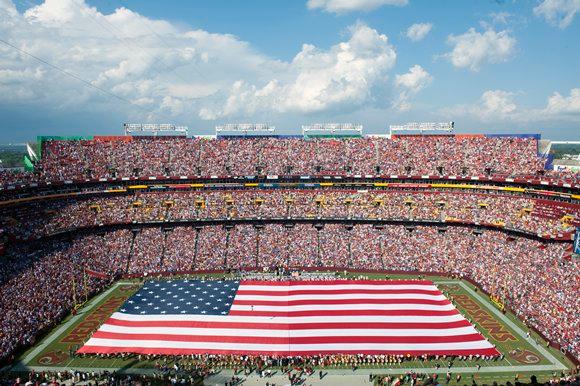
Does nobody besides me find it ironic that a flag this BIG is on the field at RFK Stadium, where the Redskins play?
Bingo.  There you have it.  The reason people are so attached to their flags is because of all the historical, moral and racial baggage that those flags represent.  That's not to say the world would be a better place without them,  I think a flag flying around a flagpole can be a beautiful sight, no matter which country it represents.  For this reason, I kind of like the emerging tradition among American home owners where they fly a holiday or seasonally appropriate flag from their front porch (my favorite?  Halloween Black Cats!)  And maybe, just maybe, we would all benefit from going a little less apeshit whenever somebody flies a flag we don't like.