Showing posts with label medieval. Show all posts

Monday, March 5, 2018

Relax. It's Not the End of the World


Evangelical Christians, who I have a lot of fun with only they don't know it, believe that Donald Trump's election is one of the heralds of something they like to call "The End Times."  Based on a totally sideways reading of the Book of Revelations,  it's a time when the world will be divided up into warring nations all following false prophets, the environment gets wrecked, some kind of beast shows up (Roseann Barr?) as does Jesus, everybody living and dead will be judged, and 1,000 years of peace and prosperity will follow -no word of what happens January 1 of year 1,001.  To answer this claim, I quote the late 20th century philosophers Frankie Goes to Hollywood and say, "Relax."  Sure, things aren't too spiffy now, but we -as in humanity -have been here before.  And we've pulled through.

It's me, Akhenaten, and really not an alien
Take the New Kingdom period in Egyptian history.  Things were finally looking up for the Two Lands: foreign invaders had been repulsed, monumental building projects resumed, the weather cooperated, and all looked peachy keen.  Until the reign of Amenhotep IV.  Five years into his rule, the Big A got this crazy idea that Egypt's polytheistic religion was a bunch of water buffalo poop and decided to do something about it.  He closed all the temples except the sun god Aten's,  moved the capital from Thebes to a city he was in the process of building, changed his name to Akhenaten (Everything's Great with Aten), and spent all his time bonking his wife, the fabulously beautiful Nefertiti.  Well, you can imagine what happened next! All the out of work priests were pissed, the people were terrified of offending the traditional gods, the new capital at Samarna royally sucked, and Nefertiti got bored with the Big A and took up papyrus origami.  If it wasn't the end of the world, it was pretty darn close.

Luckily, Akhenaten died and after a fumble or two the throne wound up in the hands of an eight year old boy called Tutankhamun -King Tut to you and me.  Now the Egyptians were really screwed, right?  It turns out no, because Tut's vizier was a capable career civil servant named Ay who really had a knack for ruling.  Under Tut/Ay, the capital was moved back to Thebes and the temples reopened, which earned the priestly class' undying gratitude.  And so things went on swimmingly on the banks of the Nile, right up until the 1180's BC, the next time the world turned into a festering pool of excrement.

For many reasons way too obscure to go into here, the entire greater Mediterranean world fell completely apart in the late Bronze Age.  How bad was it?  The Egyptians were totally whupped by a bunch of nasties collectively called the Sea Peoples, but that's not all.  Troy fell -for the fourth or fifth time, I lose track -Mycenaean Greece entered the Dark Ages, the Hittite Empire vanished, Assyria and Babylon were trashed, and even the mighty Phoenicians left town for Carthage, safely far away in present-day Tunisia.  Not one, but several end-of-the-world scenarios were being played out during this time.
Hey, we're the Sea Peoples.  So, Egypt... wassup?

However, eventually the Greeks got it together and invented philosophy, drama, democracy and baklava.  In Mesopotamia, the Persians put together the largest empire humans had managed to create up until that time.  It turned out that the move to Carthage was just what the Phoenicians needed, because they got staggeringly rich pedaling dye, grain, wine, olive oil and adult marital aids all over the known world.  And although Egypt wasn't the world-striding colossus it was during Ramses the Great's time, at least it turned into a peaceful backwater.

Let us next consider Rome, though let's skip the Grandeur part and go right into the Decline and Fall.  After Emperor Marcus Aurelius went on to join his family ghosts on the Elysian Fields, the Roman Empire lurched from one crisis to the next until the whole shebang wrenched apart and the Western half folded like a chump holding only a pair of sevens in a Texas hold 'em game.  Sure, the Eastern half would keep the lights on until the 1453, but for everybody in Spain, Italy, France, England and other smaller bits of Europe, life was shit that just kept on getting shittier.  Barbarians?  You bet: Huns, Vandals, Goths and Picts.  Disease? Yup.  Starvation and hopelessness? Ditto.  End of the world?  Not quite.

Know why it was called the Dark Ages? Because of all the KNIGHTS!!  Bwa-Ha-Ha!

For all the headaches of Western Europe's so-called Dark Ages, a vibrant culture emerged commonly called the Medieval world.  Knights, ladies, monasteries, great cathedrals and tales of chivalry were all hallmarks of this period.  Granted, life was difficult, but it went on all the same.  During this time, the seeds of all the wonderful qualities of Western Civilization were sewn: scientific inquiry, commercial capitalism, nation-states, engineering and exploration.  Democratic liberalism and rational medical treatment still had a long way to go, but at least they were on the right track.  The society produced was even strong enough to survive a series of events that, to their contemporaries in the 1300's, really did look like the end of the world.

In 1347, a merchant ship pulled into Genoa harbor from a trading post on the Black Sea.  The boat had left under fire from the Tatars who were besieging the port.  Among its cargo was the deadly virus Yersinia Pestis, a disease carried by the fleas that infest rodents like rats, mice, gerbils and hamsters, but can also attack humans.  The disease hit Southern Europe with the force of a bomb blast.  After several years of increasingly deadly outbreaks, 30-60% of Europe's population died.  For those that survived, their world view was warped by so much death, starvation, war and sickness that one wonders today how they found the strength to go on.  End of the world yet?  Close, but not yet.
Renaissance Man: six-pack abs and stone junk

Europe shook off the death shroud and donned a cloak of real radiance during the Renaissance
period.  Painters sculptors, poets, playwrights, businessmen, kings, princes, Popes, adventurers and even some ordinary people burst forth in an explosion of creativity whose echoes are still being felt today.  That's really what I admire the most about humanity: push us to the limit and we often show you human spirit at its best.  Granted, the Renaissance was mostly a cultural movement of Europe's political and social elites, but in cities like Florence, Italy, individual citizens were becoming important and valued for their contributions to society.  The years that followed were crowned by scientific achievements in industry and medicine, increasingly participatory governments and even greater artistic creativity, until it all almost destroyed itself in the 20th Century.


Starting with the Great War in 1914 and pausing at the Fall of the Berlin Wall in 1989, the blood-soaked 20th Century  actually had the ability to bring about the end of the world as we know it.  World Wars I and II brought industrial efficiency to the practice of killing soldiers and non-combatants alike, with  such crackerjack tech as the machine gun, attack aircraft, poison gas and submarines, finishing up with ballistic missiles and atomic bombs.  The ensuing so-called Cold War brought about a horrifying build-up and proliferation of ever more powerful atomic weapons and rocket delivery devices.  For the first time, humans had the ability to kill off entire populations within hours and to poison the whole planet with radioactive fallout.  Scientists even postulated a "nuclear winter" scenario affecting the climate, leading to mass species extinctions not seen since the KT-Boundary extinction event that wiped out the large land dinosaurs.  End of the world?  Believe it or not, no.

As of this writing, the world and humanity are open for business.  Since 1945, not one nuclear bomb has been used in war, although the USSR and USA came close during the Cuban Missile Crisis.  I am also pleased to report that we have passed the dates for the end of the world set by the Jehovah Witnesses, the Mayans and the Heaven's Gate cult.  That said, there are some ominous signs: drug resistant diseases, climate change, the proliferation of radical politics, and the growth of intolerant hate groups.  But there are some hopeful signs as well: recognition of the human role in climate change and the first attempts to slow down and mitigate the damage; the growth of multi-racial, multi-ethnic nations and families; advances in communications technology that literally puts in your pocket the ability to talk to the whole world, at least one person at a time. 

Sorry my evangelical friends. Donald Trump, although he has a highly inflated opinion of himself, isn't the end of the world.  When or if it ever comes, the real end of the world will be way more bigly, really yuge, believe me!
Now?  Is it the End yet?  Ready for me?  Sigh...

Tuesday, October 20, 2015

Cats! They Walk Among us!


In this, my 41st posting to  the blogosphere, I thought it would be fun to write about cats and how long they have been sponging-off of humans.  I have two spongers now: Mimi and Ebby (short for Ebony).  They are both black American shorthairs, but that's all they have in common.  Mimi is very talkative, can be playful, likes to look at all the birds, squirrels, raccoons, badgers, dogs, elephants and orangutans cavorting around in the back garden; Ebby is invisible.  Most of the time.  And doesn't meow.  And is literally afraid of his own shadow.  Every now and then, especially whenever I am feeding them their expensive cat food --the kind that promotes a healthy feline urinary tract --I find myself complaining to them about the 21 1/2 hours a day they sleep, grouchily saying things like, "And I suppose you'd like it better if we worshipped you two freeloaders as goddesses, just like the Egyptians!" or the equally mean-spirited question, "And just HOW MANY mice did you catch and eat today?"

Truth be told, I suppose I'm a bit envious of my cats.  I'm sure that if I went to, let's say, the Serengeti and tried to move in with a pride of lions, I doubt I'd get fed "human chow" every day and have my hair stroked, or be given bits of leftover bones to play with.  We humans are --with the exception of the sign-language-communicating gorilla named Koko --the only species that keeps pets because we like them.  But was this always the case?  When did humans and cats connect?  And given that there are few "working cats" left in the Western world these days, just why the heck haven't we turned these furry little freeloaders out to fend for themselves?

Not Mimi and Ebby- I have no pictures of them together because
Ebby is too scared to come out from under the bed.  Dipshit!
Domestic cats are descended from the African wildcat, a little guy who lives in North Africa and the Arabian Peninsula.  In 2004, a neolithic grave was discovered in Crete that contained a human skeleton and a cat skeleton, side-by-side --although I have no doubt that the cat caused the human's death by twining around-and-between the human's legs until he tripped and cracked his skull on a Neolithic rock.  The gravesite was carbon-dated to about 9,500 years old, and it takes a few hundred years at the very least to domesticate an animal species, so cats have been hanging around humans for close to 10,000 years.  That's a lot of cat food cans!  But why in the world would cats choose humans to cozy-up to back in the Neolithic?

No!  I will NEVER be tamed!  I will not be... wait, is that cream?
I like cream.  Hmm... but No! I must not... ooo, is that fish?  Prrr...
It's simple, really.  Cats, both wild and domesticated, are carnivorous, solitary hunters, who nevertheless live social lives, usually with other cats, but who won't turn their noses up at the odd scrap tossed their way.  By the Neolithic period, humans were giving up their nomadic ways in favor of a more or less fixed address, just as long as the fish, fowl, game animals, roots, wild berries, nuts and fruits held out.  A few intrepid bands had supplemented their diets with these weird animals called pigs, cows, chickens and goats that they had managed to domesticate, with the help of Man's Best Friend, the dog.  With all the food hanging around a Neolithic campsite being prepared, grown, caught or eaten, it was just a matter of time before the domestic cat's wild African cousin took notice, and decided to throw her lot in with humans.

"Can I haz a tiny nom of wheeeat?"
"No.  But I can haz juicy mousie, nom nom nom!"
By the time the Neolithic Age had given over to civilizations in the Fertile Crescent, the Nile valley and China's Yellow River Valley, cats were firmly entrenched as human companions, and rightly so, because they had the all important job of helping to guard the grain surplus these civilizations had managed to accumulate, from marauding bands of mice, rats, birds and the like.  This was a totally huge problem, because ancient peoples of the Near East hadn't yet discovered the Midwest Grain Silo, the storage innovation that made it possible for so many Americans today to suffer from wheat gluten allergies.  Given the chance, wheat and grain-eating rodents would reproduce like mad and munch their way through the entire surplus of, say, ancient Jericho without even breaking a sweat.  They were, like, total opportunists.  Luckily, we humans had our own opportunistic animal allies fighting the good fight at our side: felis silvestris catus, a.k.a. the pussycat.  They aren't mentioned in the Sumerian written record, nor do they show up in Mesopotamian clay tablets, but cat skeletons are found at the same level of ancient Sumerian cities, indicating that cats lived and died inside the city walls.  If they lived inside Sumerian households, they probably chased and ate mice and rats that invaded the Sumerian home.  If they didn't it was probably because their services were required at the central granary and Sumerian priests may have had a monopoly on cat ownership.  Which totally makes sense, because across the Sinai desert, the Egyptians had a very close and well documented relationship with cats.

This is a contemporary drawing of the Egyptian goddess, Bast, a.k.a Bastet, shown in her later, anthropomorphic form of a woman with a cat's head.  She carries in her hands a sistrum, a kind of bronze rattle that sounds like a key ring being jangled about, and the ankh, the Egyptian symbol for life.  To her devotees (which I am sure included lots of little old Ancient Egyptian ladies who had a few too many cats at home), she looked after cats (well, duuh!), protected people, and was a source of joy, dance, music and love.  She had an entire temple devoted to her worship, staffed by a bunch of priests who took care of the sacred cats, who were sometimes awarded to lucky supplicants and taken home to protect it from vermin.  This temple was even visited by Herodotus, the dude who actually invented history.  Here's what he had to say about it: 

Save for the entrance, it stands on an island; two separate channels approach it from the Nile, and after coming up to the entry of the temple, they run round it on opposite sides; each of them a hundred feet wide, and overshadowed by trees. The temple is in the midst of the city, the whole circuit of which commands a view down into it; for the city's level has been raised, but that of the temple has been left as it was from the first, so that it can be seen into from without. A stone wall, carven with figures, runs round it; within is a grove of very tall trees growing round a great shrine, wherein is the image of the goddess; the temple is a square, each side measuring a furlong. A road, paved with stone, of about three furlongs' length leads to the entrance, running eastward through the market place, towards the temple of Hermes; this road is about 400 feet wide, and bordered by trees reaching to heaven."

Nice digs for our Egyptian goddess!  I, however, was somewhat surprised that Herodotus neglected to mention anything about the temple litter box, which must have been extraordinary as well.


I told you to get the cat a meatball!  What the Hades
is she going to do with a yarn ball, you twit?
There is no doubt that cats were purring, scampering, chasing balls of yarn and otherwise on the hunt for mice and moles in Ancient Greece.  One of the most important things that a Greek housewife did, especially if she was a noblewoman, was to prepare and weave wool into all kinds of useful things, like clothes, curtains, wall hangings and blankets.  With all of that yarn around to chase, I have no doubt that somewhere, on some lovely Greek island, there was a cat in the middle of it, making a hilarious muddle of things, much to the enjoyment of the lady of the house.  At least one Greek potter put this cute domestic scene on one of his pots.  

If you close your eyes, it's easy to imagine cats all over Ancient Athens: prowling the Acropolis for mice trying to steal the food offerings to Athena, sideling their way through the Agora on watch for any dropped kibbee or discarded fish, sitting on Socrates' lap as he peppered Plato and his other students with his socratic questions.  Now open those eyes, and if you're in Athens, you can see descendants of those Classical Cats ranging all over the city!  I visited Athens in 1981 and was astonished to find myself trailed by no fewer than three cats wherever I went.  They were kind of like my personal feline Greek homies.  I ended up always having a spare bit of kebab on hand as a little treat for them.  Abandoned and scruffy as they were, they always politely waited their turn for their treat, and never bit or scratched me.

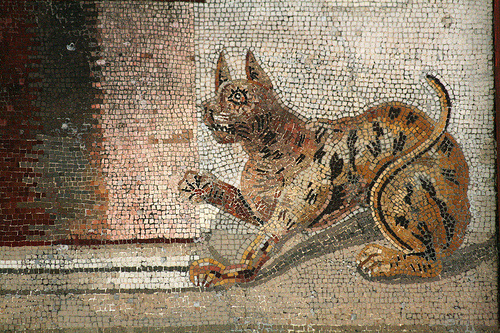
The Romans had cats, and so possibly did the Etruscans, the Romans' neighbors to the north, who conquered and ruled the Romans for a while before the Romans got their act together and took over 7/8ths of the Known World.  We know without a doubt that cats were in Ancient Rome around the time of Christ, because an archaeologist recently found cat paw-prints on a section of clay roofing-tile, dated about 2,000 years ago.  I wonder what that tile-maker's cat looked like, and what it was doing strolling across damp roof tile.  Speaking of tile, before Mt. Vesuvius blew its top and turned Pompei into the ancient world's biggest ashtray, there was a place called the House of the Fawn that had some pretty great mosaic artwork.  The most famous piece is Alexander the Great at the Battle of Issus, the one where the Great Al totally kicked the ass out of the Persian Empire's army and just about snagged the King of Kings, Darius, off of his retreating chariot.  A lesser known mosaic is this one here, presumably of the family's felis silvestrius catus:


Ego sum: Fera pessima bestia formidetur!
Although the claws are a little fanciful, the mosaic shows a really pretty kitty with orange fur and black tiger stripes.  Unfortunately, every human, dog and cat died when Vesuvius erupted.  But cats were in the empire to stay, and wherever the legions went, cats either followed or were already there once the legion pitched camp.  And when the empire fell apart and was forced into Chapter 11 bankruptcy courtesy of the Goths, cats stuck around to help chase the mice out of the barns and help themselves to any medieval handouts that came their way.  It was during the middle ages, however, that cats find their way into the written record.  Literally.  During the 14th century, an Italian manuscript called Lettere e commissioni di Levant, Vol. 13, has inky cat paw prints across a couple of pages.  Why the scribal monk who wrote this book didn't fix this feline desecration is because in order to do so, he would have had to trash hundreds of hours of meticulous, hand-written copy.  Better to just beat the cat instead.

There are strange appearances by cats in medieval literature, with people talking to cats and the cats talking back, cats being associated with angels and devils, cats being chased by dogs and cats chasing lions (and catching them, too!)  But there are sweet portrayals of cats as well.  My favorite one is this poem by an Irish scribe/scholar about his pet cat, Pangur Ban:

I and Pangur Ban my cat,
'Tis a like task we are at:
Hunting mice is his delight,
Hunting words I sit all night.
Better far than praise of men
'Tis to sit with book and pen;
Pangur bears me no ill-will,
He too plies his simple skill.

'Tis a merry task to see
At our tasks how glad are we,
When at home we sit and find
Entertainment to our mind.
Watch out, you moussesss!  Pangur Ban is in da houssssse!
Oftentimes a mouse will stray
In the hero Pangur's way;
Oftentimes my keen thought set
Takes a meaning in its net.

'Gainst the wall he sets his eye
Full and fierce and sharp and sly;
'Gainst the wall of knowledge I
All my little wisdom try.
When a mouse darts from its den,
O how glad is Pangur then!
O what gladness do I prove
When I solve the doubts I love!

So in peace our task we ply,
Pangur Ban, my cat, and I;
In our arts we find our bliss,
I have mine and he has his.
Practice every day has made
Pangur perfect in his trade;
I get wisdom day and night
Turning darkness into light.

During the Age of Exploration, cats hooked a ride on many a caravel and pinnace and found themselves in some pretty exotic locations.  Sailors really liked having cats on shipboard because they ate the mice and rats that ate the sailors' food, such that it was.  Once on shore in the South Seas or the Spanish Main, cats found themselves among fauna that had never met them before.  And that fauna, in some instances, suffered for it.  Biologists estimate that domestic cats are responsible for 32 species of New World birds going extinct.  Forever.  But the sailors didn't know what they were doing, and cats were just doing what they had always done, so although regrettable, we can't really blame cats for everything that went down.  And sailors being the superstitious crowd they are, no cat on a ship, no crew. Cats were literally that well respected.

Wherever Europeans set up colonies, cats came along to police the grain supply and to ingratiate themselves with people who owned warm fireplaces.  Although there is no mention of cats at Monticello, Mount Vernon or Paul Revere's house, it's not a huge leap of imagination to picture a grey-and-white tabby sitting on John Hancock's lap in the front parlor of his Boston home, having her ears scratched by the hand that wrote the biggest signature on the Declaration of Independence.  Hey, even this lady had a cat.

He's stuffed.  That's because he wouldn't
sit still for his portrait.
Which brings me to a very dark part of the feline/human relationship: the belief that cats are evil spirit-familiars who carry plague and kill children in their sleep.  While it is true that cats are disease carriers --hey, so are you! --they are certainly NOT carriers of bubonic plague.  They, like humans, were victims of plague, but only if they were bitten by an infected flea.  They were also collateral victims of medieval medical quackery that went something like this: plague was spread by the bad air breathed-out by cats and dogs, so kill all the cats and dogs and your town will be plague-free.  You can see where this is going.  Without cats and dogs around killing the host animals of the Bubonic Plague-infested flea, those fleas will jump onto humans, bite them, kill them, and > poof!< one-third of Europe's population is on their way to meet Jesus or Satan, depending on their level of medieval faith.


As for killing children in their sleep, the theory was that cats would crouch on a child's chest at night and steal their breath, thus killing the hapless child.  The reality of the situation is that cats like a warm place to sleep (who doesn't?), and it just so happens that humans radiate a lot of heat from their heads, which are usually outside of the sheets, blankets, duvets and duvet-covers at night, unless there are monsters under the bed, in which case the child's head is under the covers.  This is why I often wake up in the morning with a cat sleeping peacefully on my head.

Onto the part about cats being the familiar spirits of witches, warlocks, demons and that crowd.  As stated in the fourth paragraph of this article (scroll up- it's next to the picture of the African wildcat), cats are social creatures.  This means that they like to hang-out with people and other cats.  You could say that cats are familiar with people who feed them, clip their claws, play with them and stroke their fur.  When an old, ugly lady who had a couple of cats for mousing-purposes and for companionship was accused of being a witch, one of the exhibits for the prosecution would always include the poor little pudddycats, who would be put to death as well.  Such a raw deal!  Usually these cats were completely screwed if they happened to be black cats, the Devil's favorite color.  The sad part about this is that presently, people will cat-nap and torture black cats around Halloween, or sacrifice them in satanic rituals they make up by pulling some random occult shit right out of their asses.  This is why my two black cats are NOT allowed to trick-or-treat by themselves anymore, even though most of my neighbors are probably not closet satanists.
Actual autographed publicity-shot of Felicitte, the
French astro-cat

Finally, neither NASA, the Russian space program nor the European Space Agency have any current plans to send a cat into space, although dogs, monkeys, rabbits, mice, rats, frogs, frog eggs, fruit flies, a guinea pig (really?  using a guinea pig as a guinea pig? how droll), parasitic wasps, flour beetles, one tortoise, white flies, meal worms, spiders, a couple of fish, nematode worms, a stick insect and I am so totally not making this up, a couple of newts, have made it into space.  Only the French had the sense to send a cat into space.  The date was October 18, 1963; the place was some grotty French launchpad.  On board the Veronique sounding-rocket was Felicitte, a black-and-white stray cat from Paris.  Her flight lasted 15 minutes and she went 97 miles into space!  Her capsule was recovered with the chat blanc et noir safely inside, although the miserable French had stuck electrodes into her brain and recorded her brain activity, which probably went something like this:

"C'est dommage, there are no souris in this place to chase and ironically play with.  Et bien, I will nap for a... mon Dieu, what the hell was THAT noise?!?  I shall float over to the fenêtre for a look.  Ah, la beauté de la Terre is so, how you say, breathtaking this day.  Excuse me, I must see to my toilette."  There is no documentation from France's space program whether of not any litter box was included in the original mission specs, but I doubt one was due to the only 15 minute mission length.

Just because there has only been one cat in space so far, I firmly believe that as people venture off this lovely planet we call home and colonize miserable, airless, rocky, ultra-violet-light-bathed worlds completely hostile to life as we know it, sooner or later, a couple of mice will sneak along with us, making cats a necessary mission specialist for future space travel.  And since it takes a long time to get to the planets that are just in our own solar system, future astronauts would no doubt appreciate the company provided by a good cat.  Sure, something will have to be done about their shedding and feeding them in a weightless environment, but cats are adaptable creatures, so I bet they can hack it.  Besides, cats like cheese, and I hear that the moon is made of cheese... or was it Lunar Regolith?

"Mission Specialist Skeeter here.  I am stepping off the lander platform now.  The surface is loose and granular, perfect for liquid and solid waste disposal.  Will continue E.V.A. for 30 minutes, then return for some lap-time and a few treats."

Monday, August 3, 2015

Fun With Flags


I was on the beach yesterday in where can only be called "not close to the Mason-Dixon Line" AT ALL.  What I saw would have made Colonel Robert Gould Shaw (Mass. 54th Infantry- see Ferris Bueller's portrayal of him in the film, "Glory") turn over in his grave: the Confederate "Stars 'n Bars" in the form of a beach towel, being sat on by a nice little old lady from South Carolina.  I didn't ask her if her towel came from the flagpole at the statehouse in Colombia, but I did ask her how she liked Salisbury Beach: "Oh, such a lovely spot!  A bit more rocky than our beaches, but refreshingly cool."

Artist's conception of the sweet little old
Southern lady in her youth
What initially amazed me was that not one --not one of Massachusetts' nationally famous liberals, me included              --pointed out to the nice old Southern lady that her towel is the very image of slavery, racism and red-neck-ism, and she might want to exchange it for something a little less controversial, like, I don't know, Muhammad dancing the hokey-pokey.

That got me to thinking: why are people so apeshitedly invested in one flag or another?  And I'll give pride of place to the first crack at this question to that eminent historian, Dr. Eddie Izzard:  Eddie on Flags  We'll be coming back to Dr. Izzard and his sparkly dress later, but first, let's kick it back to what the first flags were, what their job was, and how that job changed over the years.

Yeah, like THIS bad-ass needed protecting!
Flags started out as identity markers for military units.  While there is no mention of Sparta's 300 or Thebes' Sacred Band or even the feared Bull Dykes of Lesbos using flags at or around Troy, Marathon or Thermopylae, we do see them being used by the Persian Sassanids' armies, and their implacable foes, the Roman Legions.  For a legionnaire, the legion's standard was kind of a cross between a battle banner and a religious idol. When a legion came to grief on the battlefield, its soldiers were expected to die defending their eagle to the last man; and indeed, battlefield anthropologists in places like Teutoburg Forest and Canea have found Roman corpses clumped together in such a way as to suggest that at the end, they all died fanatically defending something or someone. 

The "Something" was the golden eagle on top of that pole, carried by the huge guy wearing AN ENTIRE LION'S HEAD for a helmet, an officer called the Aquilifer.  As our modern re-enacter suggests, this job was given to the biggest, strongest soldier who was completely ok with marching into battle with a bird on a stick for a weapon.  So he might not have been the sharpest spear in the whole Legion, or maybe he was, because he knew an entire Roman Legion would be protecting him and his stupid bird.  And the officer who would wisely be standing next to him: a Consul in the days of the Republic. or a great general like Caesar Augustus.  

The Roman Eagle, or Aquilla, was a major deal to Roman Legionnaires.  The Aquilla was presented to the Legion during a huge religious ceremony, presided over by the Pontifax Maximus, or chief priest of Rome, who was usually the Emperor himself.  It was treated as a sacred idol, making it a powerful source of pride and identity to the Legion who possessed it.   But wait a minute: what's that red bit of fabric in the background, just to the right of our Roman Rob Gronkowski?
Modern recreations of actual Roman Legion battle standards.  Not shown are the Ducky, Moo-Cow
and Rainbow-Unicorn Legion standards.
These are among the first flags ever, and you can see they're not all that grand --merely a bit of red cloth stuck to a crossbar added to somebody's spear that told anyone who could read which Legion it was, its nickname and its mascot.  This was all very important to somebody the Legion had just run over; it was equally important to generals in the field, planning their battle strategy, as well as ordinary Roman citizens who loved to watch the Legions celebrate big victories with something called a Triumph --basically a huge parade. 

Meanwhile, over in China, the great armies of the Han Dynasty were using way more gaudy banners than our plain old Romans to identify their armies, and they were doing more: using them to communicate.  With the help of kites.  Really.  A Han General could get off a message to General Tso's army (of tasty chickens) by tying different colored banners to kites and then flying them high enough for said General Tso to see.  For example, green might mean, "Attack!" --red might mean "Retreat!" --yellow might mean "Gotta Take A Wizz- Be Right Back!" and so on.

And white with teal fringe might mean "Just ignore the guy with the boom mike"
The next time and place we see flags in is Medieval Europe.  By this time, the Roman Legions have had the stuffing knocked out of them by the Goths, Huns, Angles, Saxons, Franks, Teutons, Slavs and Vandals, just to name a few, and everybody who was left was too broke to field an army as big as a legion; but what they lacked in size, medieval armies made up for it in hardware.  By 1066, the average Anglo-Saxon knight, French-Norman chevalier or Spanish caballero andante was wearing so much steel that they needed these huge horses to carry them around the battlefield.  And, because they wore helmets that completely obscured their knightley faces, they needed some other way to identify themselves.  Seamstresses to the rescue!  They needed their own flag.

At first, knights would paint their shields with pictures and symbols that told a bit about their family history and their status, such as to whom they owed allegiance or held estates from.  Knights who fought from horseback sometimes put these designs on something called a pennon --basically a pennant-shaped bit of cloth tied around one's lance that made it easier to pull said lance out of the other knight one had just skewered.  In time, these bits of cloth got very fancy indeed and were carried about by a knight's Herald --basically a guy with a loud voice who would announce the knight's presence at the Lists, or Tournaments.
This one's a king's standard, because it hasn't
got shit all over it.

We're getting closer to Dr. Izzard's type of flag, but not quite yet.  For that kind of flag, humanity would have to suffer --and when I say suffer, I really, REALLY mean suffer.  Why?  Because it was after Europe's Medieval period that Europeans started to think of themselves as more than somebody's son or the resident of some village, the vassal of some lord or another.  They started to identify with other Europeans who spoke the same language, lived in the same general location, shared the same religion, history, dreams and aspirations.  They had begun to create something that the world had never seen before: the Nation State.
That's one old Danish
And this was its symbol.  At the top of Germany sits one completely bad-ass country: Denmark.  From the 780's onward, the Danes raided, plundered, killed, extorted and generally intimidated the hell out of the rest of Europe.  Ever hear of the Vikings?  Yeah, the ultra-violent ones came from Denmark.  Pretty soon, England, Ireland, France, even Sicily were terrorized by the mere sight of these Vikings swarming ashore from their longships.  Some local rulers went so far as to give in completely and pay them off with whatever the raiders wanted.  One even gave an entire province, complete with all the people and buildings in it, to this one especially nasty Viking named Rollo.  The land he was given is named Normandy, in honor of the Norse or Northmen who settled there.

Meanwhile, back in Denmark, the Vikings who stayed home began doing strange things.  They started brewing their own distinctive beer, making their own tasty cheese which they ate along with herring and rye bread, stewed berries, lots of different pork products, and speaking a language that wasn't quite Viking, German or Norse.  In short, they started behaving like Danes.  To celebrate this uniqueness breaking out all over the land, the Danes chose a king who would rule over them all, and adopted the white cross of Christ on the bloody red field of the Vikings as their symbol.

Hmm... coincidence?
Other peoples who fought for and established their very own nation states included the Swiss, whose flag looks remarkably like the Danish flag.  As a matter of fact, crosses were a kind of recurring motif in early European flags.  The best example of this is Great Britain's Union Jack, a flag that combines St. George's Cross (English) with St. Andrew's Cross (Scottish) and St. Patrick's Cross (Ireland) all into one flag.  By the way, missing from this flag is any direct reference to the kingdom of Wales.  This is because England had annexed Wales before the Union Jack was adopted.  That fact has made Welshmen cross for centuries (see what I just did there?  Cross? Welsh?  Hahahaha!)
Nope, no Wales here.  So just stop looking.

Which brings us to the late 18th, early 19th century.  Due to all of their keen inventions (steam engines, dynamite, cannons, muskets, railroads, kinky sex, canned food and --wait for it --textile sweatshops!), European countries set out with all the enthusiasm of a hipster-foodie turned loose in a Whole Foods market after-hours to explore, "discover," study and conquer the entire rest of the planet.  At gunpoint.  Why?  because: 1) they could; 2) the rest of the world was super-into European stuff like cotton underwear, woolen blankets and ironclad, steam-powered battleships; and 3) Europe's economic system of Capitalism demanded ever expanding overseas markets, ever increasing and infinitely inexpensive raw materials, tons of laborers smart enough to run the machines, yet stupid enough to work for shitty pay in dangerous conditions for 10-16 hours a day.  Or send their wives and children in to do the same thing.

The staff at Proletariat and Follicle's polishing their wieners after lunchtime floggings
Just a second Ex-Ppppprof, I hear you drunkenly stammer, Who'd be dumb enough to do that?  Well, given that the only other choice was to be stuck inside a workhouse, which was in turn stuck inside a Charles Dickens novel, which would later be stuffed inside an Andrew Lloyd Weber musical --a workhouse where you performed mind-numbingly boring work and got paid in floor space to sleep on and all the watery gruel you could shove  into your face at your 17-minute meal/pee-break/ flogging-free respite --even I would chose factory life.  That's not to say that everybody liked working in the factory: some didn't.

Help!  Save us from the evil factory --and that gigantic cop!
In fact, it was during this period that Karl Marx and Friedrich Engels invented communism as a way for the workers (who totally outnumbered the capitalists at this point) to steal their own lives, souls and destinies back from someone Marx (Karl, not Groucho) called the Industrial Bourgeoisie.  Well, the I-B thought to themselves, these poor misguided poopy-heads need some sort of distraction, so because there isn't any television just yet, we're going to give them all little flags, have them wave, teach their children to hate everybody who waves a different flag than their own one, and stick their older kids into gigantic conscript armies in order to: take over trade routes with their valuable markets and resources, as well as slaughter the older children from different countries who are trying to do the same thing.  And you know what?  It worked.  A whole bunch of times.  Hooray!

We'll be changing the line-up slightly for WWI, part II...
In places like the Soviet Union, where they gave Marx's ideas (Karl again, not Harpo) at least a half-hearted try, the state declared war on religion itself, substituting Russia's flag and portraits of her leaders Lenin (Vladimir Ilych, not John) and Stalin, for Russian saints and religious icons.  On the other side of the world, the United States, a country that has the separation of the state from religion in its founding documents, added the clause, "under God" to a little ditty it forced schoolchildren to recite every morning, something called The Pledge of Allegiance.  And what were these little darlings pledging their loyalty to?  Why, the United States of America.  And what was its symbol?  

Does nobody besides me find it ironic that a flag this BIG is on the field at RFK Stadium, where the Redskins play?
Bingo.  There you have it.  The reason people are so attached to their flags is because of all the historical, moral and racial baggage that those flags represent.  That's not to say the world would be a better place without them,  I think a flag flying around a flagpole can be a beautiful sight, no matter which country it represents.  For this reason, I kind of like the emerging tradition among American home owners where they fly a holiday or seasonally appropriate flag from their front porch (my favorite?  Halloween Black Cats!)  And maybe, just maybe, we would all benefit from going a little less apeshit whenever somebody flies a flag we don't like.

Friday, May 15, 2015

Medieval Diseases Gonna Kill You, Sukkah!


It's been a while since I've blogged, but I'm back with a really killer one --this post could actually kill you.  Dead.  Forever.  Unless you believe in the resurrection of the dead or the slightly greater likelihood of  becoming a zombie.  In that case, your death will be a mere temporary setback to your long-term goals of eternal life or dining on brains or whatever else strikes your fancy.  What I'm referring to that pale rider of the apocalypse: disease --medieval diseases in particular.

Hold still... I'm lancing and draining this last
punishment sent to you from God 
Now I know what you're thinking.  You're all like, "Geesh, Ex-Proff, doctors were really dumb back in medieval times.  Our doctors today are way smarter.  And we've got medicine and machines they didn't have back in the medieval day, so we're safe.  And besides, we've got immunity from all those nasty medieval diseases --they'd only give us the sniffles today."
To that, I say, "`Du bist aetrennesse of cw'ead" --for a translation of this, wake up the medieval linguist at the next History-Engineering Department faculty mixer.

Me?!?  But I soooo cute!!!
Let's start out with the really nasty one: Black Death.  Firstly, recent scholarship has cast doubt on the role of the black rat in spreading the disease back in the 1300's.  The way I learned it (and taught it for my entire career up until now) was that the basilicus virus which caused bubonic plague, was carried by the fleas which infested the black rat, which infested medieval Europe, which then jumped off (the fleas) of the rats, bit people, and killed one third of Europe's population during successive outbreaks. However according to Dr. Nils Christian Stenseth of the University of Oslo. Black Death was probably carried by the fleas on the Mongolian mouse, a.k.a. The Gerbil.

You see, according to Dr. Stenseth --who, by the way has made a career of studying tree rings from wicked-old trees in order to figure out what the weather was like in the distant past --the weather at about the time of the first major outbreaks of European bubonic plague featured especially crappy weather for rats.  What this means is that bunches of rats probably died, and the ones who survived stayed nice and warm in their little hidey-holes and weren't out sharing their fleas with people. However, the weather for those plague years were especially good for gerbils.  Who had their own fleas.  Which also carried the basilicus virus.  Play with the nice gerbil?  Boom -you done.

No, you did not see this during the Black Plague. Keep reading.
But hang on, Ex-Proff: isn't Black Plague gone these days?  Nope. 5-15 people catch it each year IN  THE  UNITED  STATES!!!  There was also a particularly bad outbreak in Madagascar in 2014.  And while it is true that there are antibiotics and a vaccine to deal with plague today, there is always the danger that the virus could evolve into a drug-resistant strain or mutate into one that is  even more deadly than the one that killed everybody in the 1300's.

Now, onto lesser medieval diseases.  Contrary to popular opinions, medieval doctors weren't the complete quacks history likes to think they were.  They were really good at setting broken limbs (all those knights to practice on) and were particularly good herbologists.  Their main problem was that they just didn't have the right medical theory --that disease came from tiny, microscopic bacterium and even tinier, electron microscopic viruses, because the microscope and electron microscope had yet to be invented.  But being educated (for their day) professionals carrying on the good work of Hippocrates, they did what medical professionals do today when faced with a real head-scratcher: they make shit up and then totally pulled answers right out of their butts.  Case in point: the unsightly King's Evil.
Woah dude, I am totally scrofulated!

This nasty little disease gave its sufferers black, painless masses growing all over their neck, looking for all the world like somebody (a king?) had beaten the unfortunate victim with the proverbial ugly stick and then gave 'em one more for bitching about it.  The cure was really weird: the touch of a real, properly anointed king.  It worked so well that King Henry IV of France reportedly cured 1,500 sufferers during his reign.  Just think of how many he could have cured if he had his own infomercial!

We know this disease today as scrofula (kinda sounds like a So-Cal surfer describing some tasty waves off of Huntington, dude!) and it is a kind of tuberculosis.  Regular tb affects the lungs, but this little beauty affects the lymph nodes, the existence of which medieval doctors knew, but had no idea of what they did.  This is because the medical establishment of the day had another misconception about disease that sounds a bit Chinese if you think about it.  They believed that health and sickness were dependant on the balance of the four bodily fluids, or "humors."

The four humors in question were blood, phlegm, bile and black bile.  This is why a common medieval treatment regimen often included the practice of leeching or bleeding the patient.  Too much blood?  Just slap on a few leeches and bleed him for a while.  That'll restore balance to the patient's humors (balance the Tao with the Chi?) and the patient will be upright soon enough, wielding his sword, fighting his enemies, oppressing the peasantry, good as new.  This practice continued up to and including (and once again, I am SO not making this up!) the physicians who treated George Washington on his deathbed.

Leeches are a remnant of the industrial bourgeoisie,
sucking the blood of the industrial proletariat
Of course, we know now that bleeding a person just makes them weaker and less able to fight infections (white cells as well as red cells get gobbled up by those leeches), so it's not a very good remedy.  Which is why I was so surprised to see a jar of leeches in a DENTIST'S OFFICE in the Soviet union in 1984!  I was on one of those Cold War student exchanges and our Intourist guide wanted us to see how great Soviet health care was, so we were ushered into this shiny, spotless, brand new dental surgery that had all the latest gadgets (and no dentists or patients, at least while we were
there!), and at least one medieval throwback in an EFFING JAR OF LEECHES!

But I digress.  the next medieval nasty on the list is the ever disgusting St. Anthony's Fire.

"I'm too sexy for my cloak, too sexy- who the fuck am I kidding?"
In 945, the good people of Paris were afflicted with these strange, painful (firey!) sores which covered their bodies.  They all came down with it pretty much at the same time, and for some reason St. Anthony was involved (one of the first victims must have misplaced his keys or something), so the sufferers did what came natural to them: they all hobbled down to St. Mary's Church (this was pre-Notre Dame Paris) and cried out for a cure.  Enter Duke Hugh the Great, Count of Paris.  Not only was he a noble, and in charge of Paris (which wasn't quite as big a deal back then as it would be today), but he also had at his disposal a huge (see what I did there?  Hugh, huge?) granary full of Holy Grain (what made it holy has never been fully explained, but I suspect more involvement by a certain Saint Anthony.)  Duke Hugh then set all the bakers to work, grinding the grain, firing up the ovens, and producing a seemingly endless supply of baguettes, boules, brioche, French toast, croutons, pain complete --you name it, they baked it.  And guess what?  After a while, the people were cured!  Hooray!  They were so happy that they gave Duke Hugh a rousing three cheers, then stuck him with the bill and returned home.  Where they promptly came down with St. Anthony's Fire.  Again.  And guess who just so happened to be fresh out of Holy Grain?

I'll take 1/2 dozen Holy Rolls, please.
You see, the problem wasn't St. Anthony at all.  The problem was that the Parisians' granaries were infested with this nasty fungus called Ergot, a little gem that flourishes in damp, cold environments and attaches itself to rye grain.  Duke Hugh's grain didn't have any problem with Ergot fungus because his granary was dry and not quite as cold (it must have been built with a nice southern exposure), so nobody got sick from eating it.  

And if you think that Ergot poisoning is a thing of the past, think again: in 1951, the last recorded outbreak of it occurred in Provence at the village of Pont St. Espirit, where an unethical farmer sold contaminated rye to an equally unethical miller, who mixed it in with a batch of wheat flour and thus condemned his fellow villagers to the fun symptoms of St. Anthony's Fire.  And one more thing: Ergot poisoning can manifest itself as gangrenous (the type the St. Anthony's Fire sufferers had), convulsive, or hallucinogenic.  That's right, this fungus was the medieval equivalent of Magic Mushrooms and may have had a hand in the witchcraft craze of the 15-1600's (-people convulsing with pain caused by unseen attackers?  -sightings of the devil dancing with your naked neighbors?  Sound familiar?)  And one more final thing: LSD is nothing more than synthetic hallucinogenic Ergot of Rye.

Tune-in, turn-on, and drop-out.  Oh, and try the rye toast!
The last and final medieval disease that could totally kill you and make you a total outcast from society at the same time is a doozy.  I was thinking of leprosy, but that one's been around ever since people had skin, so instead I choose the dreaded Dancing Disease of 1518.  Ok ok, 1518 is a little late for the Middle Ages, but hey, all this medieval/Renaissance/Age of Enlightenment crap are just arbitrary names assigned to clumps of time that vary according to the needs of the historian.  Or blogger, in this case.

Victims of the Dancing Disease, well, danced. A lot.  All the time.  Without stopping to pee or powder their noses.  Some of them danced until they died of heart attacks or exhaustion.  All the usual cures were tried: bleeding, herbs, dancing these poor bastards down to some shrine where they only kept dancing; all to no avail.  The weird thing about this disease is there had not been any prior outbreaks, nor have there been any since.  And it wasn't the "dancing mania" that killed its victims, it was the attendant exhaustion/heart attacks that did them in.  Which leads many in the historical/medical community to believe that the "disease" was kind of like a localized sociological mania, a "fad gone bad" that may have been responsible.

Or it could have been the first ever rave.  Ok, so it was kind of a lame rave...
So, there you have it.  With all the disease of medieval times, it seems amazing that there was anybody left at all to have a Renaissance, let alone a Reformation or an Age of Enlightenment, just to name a few.  Good thing they did, or we might not be here today.  So be careful: eat a balanced diet, wash your hands frequently, and just in case, keep a saint's relic nearby because you never know when medieval disease is gonna get you, sukkah!