
In this, my 41st posting to the blogosphere, I thought it would be fun to write about cats and how long they have been sponging-off of humans. I have two spongers now: Mimi and Ebby (short for Ebony). They are both black American shorthairs, but that's all they have in common. Mimi is very talkative, can be playful, likes to look at all the birds, squirrels, raccoons, badgers, dogs, elephants and orangutans cavorting around in the back garden; Ebby is invisible. Most of the time. And doesn't meow. And is literally afraid of his own shadow. Every now and then, especially whenever I am feeding them their expensive cat food --the kind that promotes a healthy feline urinary tract --I find myself complaining to them about the 21 1/2 hours a day they sleep, grouchily saying things like, "And I suppose you'd like it better if we worshipped you two freeloaders as goddesses, just like the Egyptians!" or the equally mean-spirited question, "And just HOW MANY mice did you catch and eat today?"
Truth be told, I suppose I'm a bit envious of my cats. I'm sure that if I went to, let's say, the Serengeti and tried to move in with a pride of lions, I doubt I'd get fed "human chow" every day and have my hair stroked, or be given bits of leftover bones to play with. We humans are --with the exception of the sign-language-communicating gorilla named Koko --the only species that keeps pets because we like them. But was this always the case? When did humans and cats connect? And given that there are few "working cats" left in the Western world these days, just why the heck haven't we turned these furry little freeloaders out to fend for themselves?
 |
| Not Mimi and Ebby- I have no pictures of them together because Ebby is too scared to come out from under the bed. Dipshit! |
 |
| No! I will NEVER be tamed! I will not be... wait, is that cream? I like cream. Hmm... but No! I must not... ooo, is that fish? Prrr... |
It's simple, really. Cats, both wild and domesticated, are carnivorous, solitary hunters, who nevertheless live social lives, usually with other cats, but who won't turn their noses up at the odd scrap tossed their way. By the Neolithic period, humans were giving up their nomadic ways in favor of a more or less fixed address, just as long as the fish, fowl, game animals, roots, wild berries, nuts and fruits held out. A few intrepid bands had supplemented their diets with these weird animals called pigs, cows, chickens and goats that they had managed to domesticate, with the help of Man's Best Friend, the dog. With all the food hanging around a Neolithic campsite being prepared, grown, caught or eaten, it was just a matter of time before the domestic cat's wild African cousin took notice, and decided to throw her lot in with humans.
 |
| "Can I haz a tiny nom of wheeeat?" "No. But I can haz juicy mousie, nom nom nom!" |
 This is a contemporary drawing of the Egyptian goddess, Bast, a.k.a Bastet, shown in her later, anthropomorphic form of a woman with a cat's head. She carries in her hands a sistrum, a kind of bronze rattle that sounds like a key ring being jangled about, and the ankh, the Egyptian symbol for life. To her devotees (which I am sure included lots of little old Ancient Egyptian ladies who had a few too many cats at home), she looked after cats (well, duuh!), protected people, and was a source of joy, dance, music and love. She had an entire temple devoted to her worship, staffed by a bunch of priests who took care of the sacred cats, who were sometimes awarded to lucky supplicants and taken home to protect it from vermin. This temple was even visited by Herodotus, the dude who actually invented history. Here's what he had to say about it:
 Save for the entrance, it stands on an island; two separate channels approach it from the Nile, and after coming up to the entry of the temple, they run round it on opposite sides; each of them a hundred feet wide, and overshadowed by trees. The temple is in the midst of the city, the whole circuit of which commands a view down into it; for the city's level has been raised, but that of the temple has been left as it was from the first, so that it can be seen into from without. A stone wall, carven with figures, runs round it; within is a grove of very tall trees growing round a great shrine, wherein is the image of the goddess; the temple is a square, each side measuring a furlong. A road, paved with stone, of about three furlongs' length leads to the entrance, running eastward through the market place, towards the temple of Hermes; this road is about 400 feet wide, and bordered by trees reaching to heaven."
Nice digs for our Egyptian goddess! I, however, was somewhat surprised that Herodotus neglected to mention anything about the temple litter box, which must have been extraordinary as well.
 |
| I told you to get the cat a meatball! What the Hades is she going to do with a yarn ball, you twit? |
If you close your eyes, it's easy to imagine cats all over Ancient Athens: prowling the Acropolis for mice trying to steal the food offerings to Athena, sideling their way through the Agora on watch for any dropped kibbee or discarded fish, sitting on Socrates' lap as he peppered Plato and his other students with his socratic questions. Now open those eyes, and if you're in Athens, you can see descendants of those Classical Cats ranging all over the city! I visited Athens in 1981 and was astonished to find myself trailed by no fewer than three cats wherever I went. They were kind of like my personal feline Greek homies. I ended up always having a spare bit of kebab on hand as a little treat for them. Abandoned and scruffy as they were, they always politely waited their turn for their treat, and never bit or scratched me.
The Romans had cats, and so possibly did the Etruscans, the Romans' neighbors to the north, who conquered and ruled the Romans for a while before the Romans got their act together and took over 7/8ths of the Known World. We know without a doubt that cats were in Ancient Rome around the time of Christ, because an archaeologist recently found cat paw-prints on a section of clay roofing-tile, dated about 2,000 years ago. I wonder what that tile-maker's cat looked like, and what it was doing strolling across damp roof tile. Speaking of tile, before Mt. Vesuvius blew its top and turned Pompei into the ancient world's biggest ashtray, there was a place called the House of the Fawn that had some pretty great mosaic artwork. The most famous piece is Alexander the Great at the Battle of Issus, the one where the Great Al totally kicked the ass out of the Persian Empire's army and just about snagged the King of Kings, Darius, off of his retreating chariot. A lesser known mosaic is this one here, presumably of the family's felis silvestrius catus:
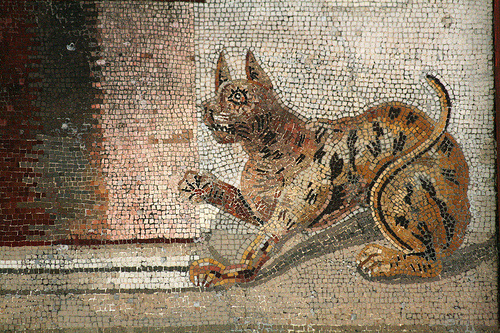 |
| Ego sum: Fera pessima bestia formidetur! |
There are strange appearances by cats in medieval literature, with people talking to cats and the cats talking back, cats being associated with angels and devils, cats being chased by dogs and cats chasing lions (and catching them, too!) But there are sweet portrayals of cats as well. My favorite one is this poem by an Irish scribe/scholar about his pet cat, Pangur Ban:
I and Pangur Ban my cat,
'Tis a like task we are at:
Hunting mice is his delight,
Hunting words I sit all night.
Better far than praise of men
'Tis to sit with book and pen;
Pangur bears me no ill-will,
He too plies his simple skill.
'Tis a merry task to see
At our tasks how glad are we,
When at home we sit and find
Entertainment to our mind.
Oftentimes a mouse will stray
In the hero Pangur's way;
Oftentimes my keen thought set
Takes a meaning in its net.
'Gainst the wall he sets his eye
Full and fierce and sharp and sly;
'Gainst the wall of knowledge I
All my little wisdom try.
When a mouse darts from its den,
O how glad is Pangur then!
O what gladness do I prove
When I solve the doubts I love!
So in peace our task we ply,
Pangur Ban, my cat, and I;
In our arts we find our bliss,
I have mine and he has his.
Practice every day has made
Pangur perfect in his trade;
I get wisdom day and night
Turning darkness into light.
During the Age of Exploration, cats hooked a ride on many a caravel and pinnace and found themselves in some pretty exotic locations. Sailors really liked having cats on shipboard because they ate the mice and rats that ate the sailors' food, such that it was. Once on shore in the South Seas or the Spanish Main, cats found themselves among fauna that had never met them before. And that fauna, in some instances, suffered for it. Biologists estimate that domestic cats are responsible for 32 species of New World birds going extinct. Forever. But the sailors didn't know what they were doing, and cats were just doing what they had always done, so although regrettable, we can't really blame cats for everything that went down. And sailors being the superstitious crowd they are, no cat on a ship, no crew. Cats were literally that well respected.
Wherever Europeans set up colonies, cats came along to police the grain supply and to ingratiate themselves with people who owned warm fireplaces. Although there is no mention of cats at Monticello, Mount Vernon or Paul Revere's house, it's not a huge leap of imagination to picture a grey-and-white tabby sitting on John Hancock's lap in the front parlor of his Boston home, having her ears scratched by the hand that wrote the biggest signature on the Declaration of Independence. Hey, even this lady had a cat.
Which brings me to a very dark part of the feline/human relationship: the belief that cats are evil spirit-familiars who carry plague and kill children in their sleep. While it is true that cats are disease carriers --hey, so are you! --they are certainly NOT carriers of bubonic plague. They, like humans, were victims of plague, but only if they were bitten by an infected flea. They were also collateral victims of medieval medical quackery that went something like this: plague was spread by the bad air breathed-out by cats and dogs, so kill all the cats and dogs and your town will be plague-free. You can see where this is going. Without cats and dogs around killing the host animals of the Bubonic Plague-infested flea, those fleas will jump onto humans, bite them, kill them, and > poof!< one-third of Europe's population is on their way to meet Jesus or Satan, depending on their level of medieval faith.

As for killing children in their sleep, the theory was that cats would crouch on a child's chest at night and steal their breath, thus killing the hapless child. The reality of the situation is that cats like a warm place to sleep (who doesn't?), and it just so happens that humans radiate a lot of heat from their heads, which are usually outside of the sheets, blankets, duvets and duvet-covers at night, unless there are monsters under the bed, in which case the child's head is under the covers. This is why I often wake up in the morning with a cat sleeping peacefully on my head.
Onto the part about cats being the familiar spirits of witches, warlocks, demons and that crowd. As stated in the fourth paragraph of this article (scroll up- it's next to the picture of the African wildcat), cats are social creatures. This means that they like to hang-out with people and other cats. You could say that cats are familiar with people who feed them, clip their claws, play with them and stroke their fur. When an old, ugly lady who had a couple of cats for mousing-purposes and for companionship was accused of being a witch, one of the exhibits for the prosecution would always include the poor little pudddycats, who would be put to death as well. Such a raw deal! Usually these cats were completely screwed if they happened to be black cats, the Devil's favorite color. The sad part about this is that presently, people will cat-nap and torture black cats around Halloween, or sacrifice them in satanic rituals they make up by pulling some random occult shit right out of their asses. This is why my two black cats are NOT allowed to trick-or-treat by themselves anymore, even though most of my neighbors are probably not closet satanists.
Finally, neither NASA, the Russian space program nor the European Space Agency have any current plans to send a cat into space, although dogs, monkeys, rabbits, mice, rats, frogs, frog eggs, fruit flies, a guinea pig (really? using a guinea pig as a guinea pig? how droll), parasitic wasps, flour beetles, one tortoise, white flies, meal worms, spiders, a couple of fish, nematode worms, a stick insect and I am so totally not making this up, a couple of newts, have made it into space. Only the French had the sense to send a cat into space. The date was October 18, 1963; the place was some grotty French launchpad. On board the Veronique sounding-rocket was Felicitte, a black-and-white stray cat from Paris. Her flight lasted 15 minutes and she went 97 miles into space! Her capsule was recovered with the chat blanc et noir safely inside, although the miserable French had stuck electrodes into her brain and recorded her brain activity, which probably went something like this:
"C'est dommage, there are no souris in this place to chase and ironically play with. Et bien, I will nap for a... mon Dieu, what the hell was THAT noise?!? I shall float over to the fenêtre for a look. Ah, la beauté de la Terre is so, how you say, breathtaking this day. Excuse me, I must see to my toilette." There is no documentation from France's space program whether of not any litter box was included in the original mission specs, but I doubt one was due to the only 15 minute mission length.
Just because there has only been one cat in space so far, I firmly believe that as people venture off this lovely planet we call home and colonize miserable, airless, rocky, ultra-violet-light-bathed worlds completely hostile to life as we know it, sooner or later, a couple of mice will sneak along with us, making cats a necessary mission specialist for future space travel. And since it takes a long time to get to the planets that are just in our own solar system, future astronauts would no doubt appreciate the company provided by a good cat. Sure, something will have to be done about their shedding and feeding them in a weightless environment, but cats are adaptable creatures, so I bet they can hack it. Besides, cats like cheese, and I hear that the moon is made of cheese... or was it Lunar Regolith?
'Tis a like task we are at:
Hunting mice is his delight,
Hunting words I sit all night.
Better far than praise of men
'Tis to sit with book and pen;
Pangur bears me no ill-will,
He too plies his simple skill.
'Tis a merry task to see
At our tasks how glad are we,
When at home we sit and find
Entertainment to our mind.
 |
| Watch out, you moussesss! Pangur Ban is in da houssssse! |
In the hero Pangur's way;
Oftentimes my keen thought set
Takes a meaning in its net.
'Gainst the wall he sets his eye
Full and fierce and sharp and sly;
'Gainst the wall of knowledge I
All my little wisdom try.
When a mouse darts from its den,
O how glad is Pangur then!
O what gladness do I prove
When I solve the doubts I love!
So in peace our task we ply,
Pangur Ban, my cat, and I;
In our arts we find our bliss,
I have mine and he has his.
Practice every day has made
Pangur perfect in his trade;
I get wisdom day and night
Turning darkness into light.
During the Age of Exploration, cats hooked a ride on many a caravel and pinnace and found themselves in some pretty exotic locations. Sailors really liked having cats on shipboard because they ate the mice and rats that ate the sailors' food, such that it was. Once on shore in the South Seas or the Spanish Main, cats found themselves among fauna that had never met them before. And that fauna, in some instances, suffered for it. Biologists estimate that domestic cats are responsible for 32 species of New World birds going extinct. Forever. But the sailors didn't know what they were doing, and cats were just doing what they had always done, so although regrettable, we can't really blame cats for everything that went down. And sailors being the superstitious crowd they are, no cat on a ship, no crew. Cats were literally that well respected.
Wherever Europeans set up colonies, cats came along to police the grain supply and to ingratiate themselves with people who owned warm fireplaces. Although there is no mention of cats at Monticello, Mount Vernon or Paul Revere's house, it's not a huge leap of imagination to picture a grey-and-white tabby sitting on John Hancock's lap in the front parlor of his Boston home, having her ears scratched by the hand that wrote the biggest signature on the Declaration of Independence. Hey, even this lady had a cat.
 |
| He's stuffed. That's because he wouldn't sit still for his portrait. |

As for killing children in their sleep, the theory was that cats would crouch on a child's chest at night and steal their breath, thus killing the hapless child. The reality of the situation is that cats like a warm place to sleep (who doesn't?), and it just so happens that humans radiate a lot of heat from their heads, which are usually outside of the sheets, blankets, duvets and duvet-covers at night, unless there are monsters under the bed, in which case the child's head is under the covers. This is why I often wake up in the morning with a cat sleeping peacefully on my head.
Onto the part about cats being the familiar spirits of witches, warlocks, demons and that crowd. As stated in the fourth paragraph of this article (scroll up- it's next to the picture of the African wildcat), cats are social creatures. This means that they like to hang-out with people and other cats. You could say that cats are familiar with people who feed them, clip their claws, play with them and stroke their fur. When an old, ugly lady who had a couple of cats for mousing-purposes and for companionship was accused of being a witch, one of the exhibits for the prosecution would always include the poor little pudddycats, who would be put to death as well. Such a raw deal! Usually these cats were completely screwed if they happened to be black cats, the Devil's favorite color. The sad part about this is that presently, people will cat-nap and torture black cats around Halloween, or sacrifice them in satanic rituals they make up by pulling some random occult shit right out of their asses. This is why my two black cats are NOT allowed to trick-or-treat by themselves anymore, even though most of my neighbors are probably not closet satanists.
 |
| Actual autographed publicity-shot of Felicitte, the French astro-cat |
Finally, neither NASA, the Russian space program nor the European Space Agency have any current plans to send a cat into space, although dogs, monkeys, rabbits, mice, rats, frogs, frog eggs, fruit flies, a guinea pig (really? using a guinea pig as a guinea pig? how droll), parasitic wasps, flour beetles, one tortoise, white flies, meal worms, spiders, a couple of fish, nematode worms, a stick insect and I am so totally not making this up, a couple of newts, have made it into space. Only the French had the sense to send a cat into space. The date was October 18, 1963; the place was some grotty French launchpad. On board the Veronique sounding-rocket was Felicitte, a black-and-white stray cat from Paris. Her flight lasted 15 minutes and she went 97 miles into space! Her capsule was recovered with the chat blanc et noir safely inside, although the miserable French had stuck electrodes into her brain and recorded her brain activity, which probably went something like this:
"C'est dommage, there are no souris in this place to chase and ironically play with. Et bien, I will nap for a... mon Dieu, what the hell was THAT noise?!? I shall float over to the fenêtre for a look. Ah, la beauté de la Terre is so, how you say, breathtaking this day. Excuse me, I must see to my toilette." There is no documentation from France's space program whether of not any litter box was included in the original mission specs, but I doubt one was due to the only 15 minute mission length.
Just because there has only been one cat in space so far, I firmly believe that as people venture off this lovely planet we call home and colonize miserable, airless, rocky, ultra-violet-light-bathed worlds completely hostile to life as we know it, sooner or later, a couple of mice will sneak along with us, making cats a necessary mission specialist for future space travel. And since it takes a long time to get to the planets that are just in our own solar system, future astronauts would no doubt appreciate the company provided by a good cat. Sure, something will have to be done about their shedding and feeding them in a weightless environment, but cats are adaptable creatures, so I bet they can hack it. Besides, cats like cheese, and I hear that the moon is made of cheese... or was it Lunar Regolith?
 |
| "Mission Specialist Skeeter here. I am stepping off the lander platform now. The surface is loose and granular, perfect for liquid and solid waste disposal. Will continue E.V.A. for 30 minutes, then return for some lap-time and a few treats." |


