Showing posts with label Roman. Show all posts

Monday, March 5, 2018

Relax. It's Not the End of the World


Evangelical Christians, who I have a lot of fun with only they don't know it, believe that Donald Trump's election is one of the heralds of something they like to call "The End Times."  Based on a totally sideways reading of the Book of Revelations,  it's a time when the world will be divided up into warring nations all following false prophets, the environment gets wrecked, some kind of beast shows up (Roseann Barr?) as does Jesus, everybody living and dead will be judged, and 1,000 years of peace and prosperity will follow -no word of what happens January 1 of year 1,001.  To answer this claim, I quote the late 20th century philosophers Frankie Goes to Hollywood and say, "Relax."  Sure, things aren't too spiffy now, but we -as in humanity -have been here before.  And we've pulled through.

It's me, Akhenaten, and really not an alien
Take the New Kingdom period in Egyptian history.  Things were finally looking up for the Two Lands: foreign invaders had been repulsed, monumental building projects resumed, the weather cooperated, and all looked peachy keen.  Until the reign of Amenhotep IV.  Five years into his rule, the Big A got this crazy idea that Egypt's polytheistic religion was a bunch of water buffalo poop and decided to do something about it.  He closed all the temples except the sun god Aten's,  moved the capital from Thebes to a city he was in the process of building, changed his name to Akhenaten (Everything's Great with Aten), and spent all his time bonking his wife, the fabulously beautiful Nefertiti.  Well, you can imagine what happened next! All the out of work priests were pissed, the people were terrified of offending the traditional gods, the new capital at Samarna royally sucked, and Nefertiti got bored with the Big A and took up papyrus origami.  If it wasn't the end of the world, it was pretty darn close.

Luckily, Akhenaten died and after a fumble or two the throne wound up in the hands of an eight year old boy called Tutankhamun -King Tut to you and me.  Now the Egyptians were really screwed, right?  It turns out no, because Tut's vizier was a capable career civil servant named Ay who really had a knack for ruling.  Under Tut/Ay, the capital was moved back to Thebes and the temples reopened, which earned the priestly class' undying gratitude.  And so things went on swimmingly on the banks of the Nile, right up until the 1180's BC, the next time the world turned into a festering pool of excrement.

For many reasons way too obscure to go into here, the entire greater Mediterranean world fell completely apart in the late Bronze Age.  How bad was it?  The Egyptians were totally whupped by a bunch of nasties collectively called the Sea Peoples, but that's not all.  Troy fell -for the fourth or fifth time, I lose track -Mycenaean Greece entered the Dark Ages, the Hittite Empire vanished, Assyria and Babylon were trashed, and even the mighty Phoenicians left town for Carthage, safely far away in present-day Tunisia.  Not one, but several end-of-the-world scenarios were being played out during this time.
Hey, we're the Sea Peoples.  So, Egypt... wassup?

However, eventually the Greeks got it together and invented philosophy, drama, democracy and baklava.  In Mesopotamia, the Persians put together the largest empire humans had managed to create up until that time.  It turned out that the move to Carthage was just what the Phoenicians needed, because they got staggeringly rich pedaling dye, grain, wine, olive oil and adult marital aids all over the known world.  And although Egypt wasn't the world-striding colossus it was during Ramses the Great's time, at least it turned into a peaceful backwater.

Let us next consider Rome, though let's skip the Grandeur part and go right into the Decline and Fall.  After Emperor Marcus Aurelius went on to join his family ghosts on the Elysian Fields, the Roman Empire lurched from one crisis to the next until the whole shebang wrenched apart and the Western half folded like a chump holding only a pair of sevens in a Texas hold 'em game.  Sure, the Eastern half would keep the lights on until the 1453, but for everybody in Spain, Italy, France, England and other smaller bits of Europe, life was shit that just kept on getting shittier.  Barbarians?  You bet: Huns, Vandals, Goths and Picts.  Disease? Yup.  Starvation and hopelessness? Ditto.  End of the world?  Not quite.

Know why it was called the Dark Ages? Because of all the KNIGHTS!!  Bwa-Ha-Ha!

For all the headaches of Western Europe's so-called Dark Ages, a vibrant culture emerged commonly called the Medieval world.  Knights, ladies, monasteries, great cathedrals and tales of chivalry were all hallmarks of this period.  Granted, life was difficult, but it went on all the same.  During this time, the seeds of all the wonderful qualities of Western Civilization were sewn: scientific inquiry, commercial capitalism, nation-states, engineering and exploration.  Democratic liberalism and rational medical treatment still had a long way to go, but at least they were on the right track.  The society produced was even strong enough to survive a series of events that, to their contemporaries in the 1300's, really did look like the end of the world.

In 1347, a merchant ship pulled into Genoa harbor from a trading post on the Black Sea.  The boat had left under fire from the Tatars who were besieging the port.  Among its cargo was the deadly virus Yersinia Pestis, a disease carried by the fleas that infest rodents like rats, mice, gerbils and hamsters, but can also attack humans.  The disease hit Southern Europe with the force of a bomb blast.  After several years of increasingly deadly outbreaks, 30-60% of Europe's population died.  For those that survived, their world view was warped by so much death, starvation, war and sickness that one wonders today how they found the strength to go on.  End of the world yet?  Close, but not yet.
Renaissance Man: six-pack abs and stone junk

Europe shook off the death shroud and donned a cloak of real radiance during the Renaissance
period.  Painters sculptors, poets, playwrights, businessmen, kings, princes, Popes, adventurers and even some ordinary people burst forth in an explosion of creativity whose echoes are still being felt today.  That's really what I admire the most about humanity: push us to the limit and we often show you human spirit at its best.  Granted, the Renaissance was mostly a cultural movement of Europe's political and social elites, but in cities like Florence, Italy, individual citizens were becoming important and valued for their contributions to society.  The years that followed were crowned by scientific achievements in industry and medicine, increasingly participatory governments and even greater artistic creativity, until it all almost destroyed itself in the 20th Century.


Starting with the Great War in 1914 and pausing at the Fall of the Berlin Wall in 1989, the blood-soaked 20th Century  actually had the ability to bring about the end of the world as we know it.  World Wars I and II brought industrial efficiency to the practice of killing soldiers and non-combatants alike, with  such crackerjack tech as the machine gun, attack aircraft, poison gas and submarines, finishing up with ballistic missiles and atomic bombs.  The ensuing so-called Cold War brought about a horrifying build-up and proliferation of ever more powerful atomic weapons and rocket delivery devices.  For the first time, humans had the ability to kill off entire populations within hours and to poison the whole planet with radioactive fallout.  Scientists even postulated a "nuclear winter" scenario affecting the climate, leading to mass species extinctions not seen since the KT-Boundary extinction event that wiped out the large land dinosaurs.  End of the world?  Believe it or not, no.

As of this writing, the world and humanity are open for business.  Since 1945, not one nuclear bomb has been used in war, although the USSR and USA came close during the Cuban Missile Crisis.  I am also pleased to report that we have passed the dates for the end of the world set by the Jehovah Witnesses, the Mayans and the Heaven's Gate cult.  That said, there are some ominous signs: drug resistant diseases, climate change, the proliferation of radical politics, and the growth of intolerant hate groups.  But there are some hopeful signs as well: recognition of the human role in climate change and the first attempts to slow down and mitigate the damage; the growth of multi-racial, multi-ethnic nations and families; advances in communications technology that literally puts in your pocket the ability to talk to the whole world, at least one person at a time. 

Sorry my evangelical friends. Donald Trump, although he has a highly inflated opinion of himself, isn't the end of the world.  When or if it ever comes, the real end of the world will be way more bigly, really yuge, believe me!
Now?  Is it the End yet?  Ready for me?  Sigh...

Wednesday, November 4, 2015

The Separation of Church and State


Today's post focuses on those times and places in human history when government and religion either got along or didn't, or maybe they didn't even notice each other for a while, or maybe, like, Religion got all weirded-out and did some stuff that got the government all p-o'd and junk, which made Religion behave even weirder until government was all like, "Yeah, no, you can't ever do that again, so we're just gonna kick you and all your followers out."  So Religion was all like, "FINE, what-EVER, just don't go bother us right before you DIE and want to be saved from the ultimate unpleasantness that awaits you on the OTHER SIDE, because we'll probably just ignore you, so HA!"

Not very mature for a venerable institution like Religion, which actually predated government in the chronological order of sociological institutions.  This is because the first of what we might call governments were probably extensions of the family's extended cousin, the clan.  Humans are similar to dogs, cats and naked mole-rats in that they are social animals who like to live together in groups.  There are genetic and psychological reasons I won't go into here that evolutionarily favor species that can live together without killing each other or eating up all the food in sight, so until early humans figured this out and set up actual rules for living together in groups larger than a clan, Religion had the whole place to itself.  This is because humans are the Earth's only animals that practice religious rituals.  Note, for example, the complete lack of synagogues inside a termite mound.

How do we know humans practiced religion?  A combination of two things: they way they treated their dead, and the pictures they drew on rock walls.  As far back as 50,000 years ago, people were burying their friends and families underground, arranging the corpse carefully, and including stuff the dead person owned along with the body.  This implies a belief in some sort of an afterlife, where the deceased person will need his stuff in order to get along.  What would you like to be buried with?  If
Ok, there's Fred, Jacquie, Wanda, Billy, your Mom and some random dude,
but WTF, who is that HUGE guy-thing on the right?!?
you believe the song, Willie the Wimp was buried in his Cadillac Seville.  Now, about those cave-rock wall- rock overhang drawings: they seem to show supernatural beings interacting with primitive people.  Could these be ancient aliens? --or could they be Supreme Beings conjured from the minds of primitive artists?  Also, among the animal paintings at Lascaux cave in France, there is a picture of a fearsome cave lion that had been struck thousands of times.  This implies a ritual --a ritual killing of a powerful predator in this case.


Government and religion ultimately collided in that totally man-made, artificial environment called the city-state.  These places were breaking out all over the Near East (as opposed to the Way-the-f*ck-over-There East) in places like Jericho and Sumeria.  Historians are fairly certain that the earliest governments of these places were priest/kings.  Why?  Because up to that point, only religious leaders could convince that many people to do things they might not ordinarily do, such as dig and maintain irrigation canals, not immediately kill people who offended them in some way, or construct these really weird statues and temples dedicated to gods and goddesses,  In Sumer, the priests even had a corner on the sex-trade market.  The temple of Ishtar was staffed by priestesses who were literally prostitutes.  For a price, men could lie with a priestess who was specially trained in the arts erotica.  Even amateurs got into the act.  If a Sumerian girl wanted a husband and wasn't rich enough or pretty enough to get a lot of suitors, all she had to do was to hang-out at Ishtar's temple and give it away for free --just as long as the guy took her home and raised a family with her.

My victory over these infidel unbelievers is made all the more complete
by using my wind-up horse chariot to smash the city's idols!  Mwa-ha-ha!
Religious leaders had to take a back seat to military leaders once cities started raiding each other for scarce supplies, but religion was still important.  What would make an army fight even better than usual?  Why, a special blessing from a priest!  However, there was trouble on the horizon.  See, whenever a victorious army broke into the walls of an enemy city, the second thing they did was to trash that city's gods by smashing the idols and killing the priests.  The first thing the army did was, of course, wipe their hobnailed boots on the corpses of dead enemies.  Thus began humanity's first religious war, a war that has been raging off-and-on for about four thousand years!

Sometimes, religious leaders and government leaders in the same city got into spats.  These usually worked themselves out with select banishments or a few well-chosen executions.  Sometimes religion won; sometimes government won.  This was the state of things when the Roman Empire was forced to deal with a new religious cult that had started in one of its eastern provinces.

Colosseum cat-food time!
On the whole, Romans thought of themselves as very open-minded when it came to the subject of religion.  There was, in fact, a temple in Rome called the Pantheon that had idols of every god/goddess/religious-type-thing worshipped in every corner of the Empire.  Romans had their own religion, of course, which was bits borrowed from the Etruscans, Greeks, Carthaginians and stuff they had pulled right out of their own toga-covered asses, but they generally left the different peoples within the empire alone when it came to practicing religion, except when that practice included human sacrifice which, strange as it may seen what with their love for gladiatorial contests and public executions, the Romans totally hated.  Because the Celtic Druids were big into the old kill-em-for-piety's sake rituals, the Romans got rid of Druids wherever they found them.  So what were they supposed to do with this weird messianic cult of ex-Jews who reportedly ate flesh, drank blood, and nevertheless professed to love their neighbors?

The first Christians were, of course, Jews who followed the teachings of Jesus of Nazareth, an itinerant rabbi who had his own problem with the Roman state --it crucified Him.  After Saul of Tarsus' conversion on the road to Damascus, Paul, as he was now called, enlarged the Christian communion to include Gentiles, ie., guys who still had their foreskins attached.  Pretty soon, there was even a bunch of these Christians living in Rome itself --they had followed the Apostle Peter there and helped him set up a church.  All went swimmingly until the sect began to grow and flex a little political muscle among the Roman plebeians, the working stiffs of Rome, with whom the new cult was very popular.  Slaves liked it too.  Emperor Nero came up with the idea of blaming the Christians for the great fire during his reign ("Woah, I've seen fire during my reign," he reportedly sang from his own private stage during the worst of the flames), and thus kicked-off a kind of free-for-all on Christians.  Things got so bad that Christians were driven literally underground into these burial vaults called catacombs, where even there they were sometimes ratted-out by a jealous neighbor or a total dipshit.

The Mass is ended.  Go in peace to love and serve the Lord.  And Tiberias? Tell your mom to keep her big, fat mouth shut!
However, Christians hung in there (some at the end of their ropes) and eventually were made the official religion of the Roman Empire.  There was only one small problem: the Roman Empire kind of sucked at this point.  It was invaded by a bunch of Germanic tribes and one Central Asian bunch called the Huns, until nothing was left but the Greek part which historians later called "The Greek Part of the Former Roman Empire," later shortened to "Byzantine," just because.  So now that the Church was still relatively ok and the State was on life-support --at least in the West --the Church busied itself with setting up a hierarchy because it knew that the state would come around sooner or later and have it out with the Church.

Note to self: don't piss-off Henry I-
he's a really mean drunk!
And a mere 604 years later, trouble broke out between Pope Gregory VII and Holy Roman Emperor Henry IV over something called investiture.  Basically, this bit of silliness was over the question of who got to hand out Church offices like Bishoprics and Archbishoprics: the Pope or the Emperor?  To be fair, the Church was well-meaning, attempting to curb the practice of Simony, where Church offices were sold to rich people.  When Gregory's reform-minded clergy told the Holy Roman Empire's nobility that Church offices were no longer for sale, the Emperor himself got into the fray, sending off some nasty-grams to the Pope, calling Holy Father, "Hildebrand, not-Pope but false monk," and other such neener-neenerisms that made Pope Greg hopping-mad.  This issue even darkened the relationship between Henry I of England and Pope Paschal II, resulting in Henry's pal, Thomas `a Beckett, getting sliced-up by a quartet of Henry's knights in the basement of Canterbury Cathedral.

It wasn't until 1122 that H.R. Emperor Henry V and Pope Calixtus II settled the whole unpleasantness with the unappetizing-sounding Concordat of Worms.  The meat of the Concordat is something like this:  kings and emperors and, I don't know, Grand High Poo-bahs, have this stuff called secular power, with which they can make Bishops in their territory help equip an army if the place gets invaded.  Popes have this stuff called sacred power, with which they give Bishops the power and authority and the duty to go out there and save some souls for Jesus.  So yeah, after all the pushing, shoving and at least one murdered Archbishop of Canterbury, it all came down to a compromise between Church and State that puts Bishops under both authorities.  Still want to be a Bishop?

Now you would think that with this kind of sensible solution, there would never again be a problem between the Church and State, right?  I sure thought that!  But alas and alack, this was not to be.  See, there was this little dust-up called the Protestant Reformation that brought out some... issues... that had been swept under the ol' altar rug for about 350 years.  In England, a different numbered Henry --number VIII --completely kicked the Catholic Church out of England and set up his very own church just so he could get a divorce.  And that new church, the Anglican Church?  Yeah, the English King was in charge of it.  In Germany, there were a couple of small wars (the Schmalkaldic Wars) that ended with the Peace of Augsburg, which basically gave German princes the right to pick Catholicism or Lutheranism as the official religion of their territory.  Protestantism continued to spread to places like Sweeden and Switzerland and even to the Netherlands, which made some devout Catholic kings totally furious.

Things got positively out of control with religion and the state with the 30 Years War, which lasted, um, 30 years.  It pitted the Protestant nations of Europe against the Catholic nations.  Nobody really won, lots of people got killed, but the French --who entered the war late and on the Protestant side, which is weird because the country was run by a Catholic Archbishop --kind of came out on top by not losing as badly as everyone else did.  They even got to thrash their next door neighbors, those miserable Spanish, in the process.  Hooray for religious wars!

Those are the Spanish on the horses, wisely choosing to not make horse-kebabs on the ends of French pikes.
Church vs. State conflicts became a bit more subtle after the 30 Years War, and it mostly had something to do with how much influence States allowed the Church to have in their countries.  There were countries like Spain and England where a person's religion was basically ordered by the State.  In 1492, Spain kicked all the Moors and Jews out, then created the feared Inquisition to find people who had fake-converted to Catholicism but were still secret Jews or Muslims.  The Catholic Church would hang onto this much influence in Spain until the death of Generalissimo Francisco Franco in the 1970's.  In Elizabeth I's England, she didn't really care of some English people were Catholic, just as long as they showed up once a month to an Anglican service.  Those who followed were less tolerant.  James I kicked the Pilgrim Separatists out, first to Holland, later to Plymouth, Massachusetts.  His son, Charles, got his head cut off because 1. he married a Catholic; 2. he probably was a Catholic; 3. he pissed-off the Puritan Parliament.  Oliver Cromwell then set up a Puritan military state in England and attacked Catholic Ireland because he was that much of a dick.  He even attacked the Protestant Dutch because he may or may not have gotten an STD from an Amsterdam hooker (ok ok, I just totally made that up- but the Anglo-Dutch war really happened).

In America before our revolution, Church and State had a mixed relationship.  New England started out pretty much as a theocracy lead by fiery Puritan Calvinist preachers, which went great until Salem and some other towns were convinced they were besieged by witches and hanged a bunch of mostly harmless old women who had a few too many pet cats.  In Virginia, they allowed so-called "dissenter meetings" such as Presbyterians and Baptists, but they had to pay a tax which was used to support the Anglican clergy in Virginia.  Maryland was basically set up as a place that English Catholics could go and, if they didn't starve or get killed by Indians, live in relative peace and quiet.  However, Maryland was soon overrun by Protestants, and Catholics had to put up with not being able to openly go to Mass without being molested by their neighbors.

I am Thomas Jefferson.  #*$! religion!
Enter Thomas Jefferson.  He was a young man who traveled in Europe, was a good student of Enlightenment authors, and although a nominal Anglican himself, was kind of bugged by Virginia having its own "official" religion.  I guess some of his best friends were Quakers, Lutherans, Anabaptists, Catholics, or Presbyterians.  He drafted Virginia's Religious Toleration Statute, which was basically copied and stuck into the First Amendment of the Bill of Rights which, along with Article IV, made the United States of America the very first country in the entire world that explicitly separated Church from State.

Over the years, lots of Supreme Court cases tested and further refined the "Establishment," "Free-Exercise" and "Religious Test" clauses of the Constitution, which has had the effect of really pissing-off the fundamentalist Christian right-wing wack-o's who basically want to unite Church and State and have THEM in charge of BOTH.  On the other side of the coin, atheists get all bent when they look at the money in their pocket and have to read, "In God We Trust," or send their kids to a school where the Pledge of Allegiance is recited, especially the "One Nation, under God" part.  There's basically just no pleasing some people!

Go in peace, and thank you very much.
There are a lot of religions in the United States today, some familiar, some exotic, some weird, and at least one completely preposterous religion.  I am referring, of course, to the Chapel of the Church of the Divine Elvis Presley, a "religion" that was invented by my friend, Voga Wallace, as a way to get out of paying his city property tax by claiming part of his apartment was a religious shrine devoted to --you guessed it --Elvis.  A small room that was probably supposed to be a pantry was outfitted with four Elvis posters lit by a dangling black light, an old guitar case was set up on a trunk, into which people were encouraged to leave free-will "Love Me Tender" offerings, and the perpetual "Elvis Light," a candle stuck inside an Elvis drinking glass, was always lit --whenever Voga remembered to do it.  And I am completely not making this up when I tell you that the city bought this charade, even listing it as one of the city's "places of worship"  on some grotty official publication.  That, despite the fact that the whole time I hung out with him, there was never one, not one person who visited Voga's stupid shrine!

Lastly, let me just say this: even though our state and religion are separate here in America, that doesn't mean that Americans aren't friendly towards religion in general.  Just look at the parking lots that surround mega-churches on a Sunday morning and you'll see what I mean.  So Iran can just suck it whenever they try to pass us off as the Great Satan or whatever.  I bet you there are more mosques in America than there are in Iran, tons more synagogues and tons-squared more churches to boot.  We just don't think our religious leaders should have a say in fixing potholes in the streets, or whether or not to go to war with some country whose religious leaders call us the Great Satan.  Get it?  So here's to religion and government: may they peacefully coexist as separate institutions because bad things tend to happen whenever they team-up.


Tuesday, October 20, 2015

Cats! They Walk Among us!


In this, my 41st posting to  the blogosphere, I thought it would be fun to write about cats and how long they have been sponging-off of humans.  I have two spongers now: Mimi and Ebby (short for Ebony).  They are both black American shorthairs, but that's all they have in common.  Mimi is very talkative, can be playful, likes to look at all the birds, squirrels, raccoons, badgers, dogs, elephants and orangutans cavorting around in the back garden; Ebby is invisible.  Most of the time.  And doesn't meow.  And is literally afraid of his own shadow.  Every now and then, especially whenever I am feeding them their expensive cat food --the kind that promotes a healthy feline urinary tract --I find myself complaining to them about the 21 1/2 hours a day they sleep, grouchily saying things like, "And I suppose you'd like it better if we worshipped you two freeloaders as goddesses, just like the Egyptians!" or the equally mean-spirited question, "And just HOW MANY mice did you catch and eat today?"

Truth be told, I suppose I'm a bit envious of my cats.  I'm sure that if I went to, let's say, the Serengeti and tried to move in with a pride of lions, I doubt I'd get fed "human chow" every day and have my hair stroked, or be given bits of leftover bones to play with.  We humans are --with the exception of the sign-language-communicating gorilla named Koko --the only species that keeps pets because we like them.  But was this always the case?  When did humans and cats connect?  And given that there are few "working cats" left in the Western world these days, just why the heck haven't we turned these furry little freeloaders out to fend for themselves?

Not Mimi and Ebby- I have no pictures of them together because
Ebby is too scared to come out from under the bed.  Dipshit!
Domestic cats are descended from the African wildcat, a little guy who lives in North Africa and the Arabian Peninsula.  In 2004, a neolithic grave was discovered in Crete that contained a human skeleton and a cat skeleton, side-by-side --although I have no doubt that the cat caused the human's death by twining around-and-between the human's legs until he tripped and cracked his skull on a Neolithic rock.  The gravesite was carbon-dated to about 9,500 years old, and it takes a few hundred years at the very least to domesticate an animal species, so cats have been hanging around humans for close to 10,000 years.  That's a lot of cat food cans!  But why in the world would cats choose humans to cozy-up to back in the Neolithic?

No!  I will NEVER be tamed!  I will not be... wait, is that cream?
I like cream.  Hmm... but No! I must not... ooo, is that fish?  Prrr...
It's simple, really.  Cats, both wild and domesticated, are carnivorous, solitary hunters, who nevertheless live social lives, usually with other cats, but who won't turn their noses up at the odd scrap tossed their way.  By the Neolithic period, humans were giving up their nomadic ways in favor of a more or less fixed address, just as long as the fish, fowl, game animals, roots, wild berries, nuts and fruits held out.  A few intrepid bands had supplemented their diets with these weird animals called pigs, cows, chickens and goats that they had managed to domesticate, with the help of Man's Best Friend, the dog.  With all the food hanging around a Neolithic campsite being prepared, grown, caught or eaten, it was just a matter of time before the domestic cat's wild African cousin took notice, and decided to throw her lot in with humans.

"Can I haz a tiny nom of wheeeat?"
"No.  But I can haz juicy mousie, nom nom nom!"
By the time the Neolithic Age had given over to civilizations in the Fertile Crescent, the Nile valley and China's Yellow River Valley, cats were firmly entrenched as human companions, and rightly so, because they had the all important job of helping to guard the grain surplus these civilizations had managed to accumulate, from marauding bands of mice, rats, birds and the like.  This was a totally huge problem, because ancient peoples of the Near East hadn't yet discovered the Midwest Grain Silo, the storage innovation that made it possible for so many Americans today to suffer from wheat gluten allergies.  Given the chance, wheat and grain-eating rodents would reproduce like mad and munch their way through the entire surplus of, say, ancient Jericho without even breaking a sweat.  They were, like, total opportunists.  Luckily, we humans had our own opportunistic animal allies fighting the good fight at our side: felis silvestris catus, a.k.a. the pussycat.  They aren't mentioned in the Sumerian written record, nor do they show up in Mesopotamian clay tablets, but cat skeletons are found at the same level of ancient Sumerian cities, indicating that cats lived and died inside the city walls.  If they lived inside Sumerian households, they probably chased and ate mice and rats that invaded the Sumerian home.  If they didn't it was probably because their services were required at the central granary and Sumerian priests may have had a monopoly on cat ownership.  Which totally makes sense, because across the Sinai desert, the Egyptians had a very close and well documented relationship with cats.

This is a contemporary drawing of the Egyptian goddess, Bast, a.k.a Bastet, shown in her later, anthropomorphic form of a woman with a cat's head.  She carries in her hands a sistrum, a kind of bronze rattle that sounds like a key ring being jangled about, and the ankh, the Egyptian symbol for life.  To her devotees (which I am sure included lots of little old Ancient Egyptian ladies who had a few too many cats at home), she looked after cats (well, duuh!), protected people, and was a source of joy, dance, music and love.  She had an entire temple devoted to her worship, staffed by a bunch of priests who took care of the sacred cats, who were sometimes awarded to lucky supplicants and taken home to protect it from vermin.  This temple was even visited by Herodotus, the dude who actually invented history.  Here's what he had to say about it: 

Save for the entrance, it stands on an island; two separate channels approach it from the Nile, and after coming up to the entry of the temple, they run round it on opposite sides; each of them a hundred feet wide, and overshadowed by trees. The temple is in the midst of the city, the whole circuit of which commands a view down into it; for the city's level has been raised, but that of the temple has been left as it was from the first, so that it can be seen into from without. A stone wall, carven with figures, runs round it; within is a grove of very tall trees growing round a great shrine, wherein is the image of the goddess; the temple is a square, each side measuring a furlong. A road, paved with stone, of about three furlongs' length leads to the entrance, running eastward through the market place, towards the temple of Hermes; this road is about 400 feet wide, and bordered by trees reaching to heaven."

Nice digs for our Egyptian goddess!  I, however, was somewhat surprised that Herodotus neglected to mention anything about the temple litter box, which must have been extraordinary as well.


I told you to get the cat a meatball!  What the Hades
is she going to do with a yarn ball, you twit?
There is no doubt that cats were purring, scampering, chasing balls of yarn and otherwise on the hunt for mice and moles in Ancient Greece.  One of the most important things that a Greek housewife did, especially if she was a noblewoman, was to prepare and weave wool into all kinds of useful things, like clothes, curtains, wall hangings and blankets.  With all of that yarn around to chase, I have no doubt that somewhere, on some lovely Greek island, there was a cat in the middle of it, making a hilarious muddle of things, much to the enjoyment of the lady of the house.  At least one Greek potter put this cute domestic scene on one of his pots.  

If you close your eyes, it's easy to imagine cats all over Ancient Athens: prowling the Acropolis for mice trying to steal the food offerings to Athena, sideling their way through the Agora on watch for any dropped kibbee or discarded fish, sitting on Socrates' lap as he peppered Plato and his other students with his socratic questions.  Now open those eyes, and if you're in Athens, you can see descendants of those Classical Cats ranging all over the city!  I visited Athens in 1981 and was astonished to find myself trailed by no fewer than three cats wherever I went.  They were kind of like my personal feline Greek homies.  I ended up always having a spare bit of kebab on hand as a little treat for them.  Abandoned and scruffy as they were, they always politely waited their turn for their treat, and never bit or scratched me.

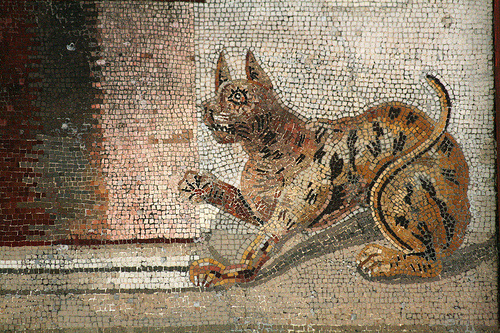
The Romans had cats, and so possibly did the Etruscans, the Romans' neighbors to the north, who conquered and ruled the Romans for a while before the Romans got their act together and took over 7/8ths of the Known World.  We know without a doubt that cats were in Ancient Rome around the time of Christ, because an archaeologist recently found cat paw-prints on a section of clay roofing-tile, dated about 2,000 years ago.  I wonder what that tile-maker's cat looked like, and what it was doing strolling across damp roof tile.  Speaking of tile, before Mt. Vesuvius blew its top and turned Pompei into the ancient world's biggest ashtray, there was a place called the House of the Fawn that had some pretty great mosaic artwork.  The most famous piece is Alexander the Great at the Battle of Issus, the one where the Great Al totally kicked the ass out of the Persian Empire's army and just about snagged the King of Kings, Darius, off of his retreating chariot.  A lesser known mosaic is this one here, presumably of the family's felis silvestrius catus:


Ego sum: Fera pessima bestia formidetur!
Although the claws are a little fanciful, the mosaic shows a really pretty kitty with orange fur and black tiger stripes.  Unfortunately, every human, dog and cat died when Vesuvius erupted.  But cats were in the empire to stay, and wherever the legions went, cats either followed or were already there once the legion pitched camp.  And when the empire fell apart and was forced into Chapter 11 bankruptcy courtesy of the Goths, cats stuck around to help chase the mice out of the barns and help themselves to any medieval handouts that came their way.  It was during the middle ages, however, that cats find their way into the written record.  Literally.  During the 14th century, an Italian manuscript called Lettere e commissioni di Levant, Vol. 13, has inky cat paw prints across a couple of pages.  Why the scribal monk who wrote this book didn't fix this feline desecration is because in order to do so, he would have had to trash hundreds of hours of meticulous, hand-written copy.  Better to just beat the cat instead.

There are strange appearances by cats in medieval literature, with people talking to cats and the cats talking back, cats being associated with angels and devils, cats being chased by dogs and cats chasing lions (and catching them, too!)  But there are sweet portrayals of cats as well.  My favorite one is this poem by an Irish scribe/scholar about his pet cat, Pangur Ban:

I and Pangur Ban my cat,
'Tis a like task we are at:
Hunting mice is his delight,
Hunting words I sit all night.
Better far than praise of men
'Tis to sit with book and pen;
Pangur bears me no ill-will,
He too plies his simple skill.

'Tis a merry task to see
At our tasks how glad are we,
When at home we sit and find
Entertainment to our mind.
Watch out, you moussesss!  Pangur Ban is in da houssssse!
Oftentimes a mouse will stray
In the hero Pangur's way;
Oftentimes my keen thought set
Takes a meaning in its net.

'Gainst the wall he sets his eye
Full and fierce and sharp and sly;
'Gainst the wall of knowledge I
All my little wisdom try.
When a mouse darts from its den,
O how glad is Pangur then!
O what gladness do I prove
When I solve the doubts I love!

So in peace our task we ply,
Pangur Ban, my cat, and I;
In our arts we find our bliss,
I have mine and he has his.
Practice every day has made
Pangur perfect in his trade;
I get wisdom day and night
Turning darkness into light.

During the Age of Exploration, cats hooked a ride on many a caravel and pinnace and found themselves in some pretty exotic locations.  Sailors really liked having cats on shipboard because they ate the mice and rats that ate the sailors' food, such that it was.  Once on shore in the South Seas or the Spanish Main, cats found themselves among fauna that had never met them before.  And that fauna, in some instances, suffered for it.  Biologists estimate that domestic cats are responsible for 32 species of New World birds going extinct.  Forever.  But the sailors didn't know what they were doing, and cats were just doing what they had always done, so although regrettable, we can't really blame cats for everything that went down.  And sailors being the superstitious crowd they are, no cat on a ship, no crew. Cats were literally that well respected.

Wherever Europeans set up colonies, cats came along to police the grain supply and to ingratiate themselves with people who owned warm fireplaces.  Although there is no mention of cats at Monticello, Mount Vernon or Paul Revere's house, it's not a huge leap of imagination to picture a grey-and-white tabby sitting on John Hancock's lap in the front parlor of his Boston home, having her ears scratched by the hand that wrote the biggest signature on the Declaration of Independence.  Hey, even this lady had a cat.

He's stuffed.  That's because he wouldn't
sit still for his portrait.
Which brings me to a very dark part of the feline/human relationship: the belief that cats are evil spirit-familiars who carry plague and kill children in their sleep.  While it is true that cats are disease carriers --hey, so are you! --they are certainly NOT carriers of bubonic plague.  They, like humans, were victims of plague, but only if they were bitten by an infected flea.  They were also collateral victims of medieval medical quackery that went something like this: plague was spread by the bad air breathed-out by cats and dogs, so kill all the cats and dogs and your town will be plague-free.  You can see where this is going.  Without cats and dogs around killing the host animals of the Bubonic Plague-infested flea, those fleas will jump onto humans, bite them, kill them, and > poof!< one-third of Europe's population is on their way to meet Jesus or Satan, depending on their level of medieval faith.


As for killing children in their sleep, the theory was that cats would crouch on a child's chest at night and steal their breath, thus killing the hapless child.  The reality of the situation is that cats like a warm place to sleep (who doesn't?), and it just so happens that humans radiate a lot of heat from their heads, which are usually outside of the sheets, blankets, duvets and duvet-covers at night, unless there are monsters under the bed, in which case the child's head is under the covers.  This is why I often wake up in the morning with a cat sleeping peacefully on my head.

Onto the part about cats being the familiar spirits of witches, warlocks, demons and that crowd.  As stated in the fourth paragraph of this article (scroll up- it's next to the picture of the African wildcat), cats are social creatures.  This means that they like to hang-out with people and other cats.  You could say that cats are familiar with people who feed them, clip their claws, play with them and stroke their fur.  When an old, ugly lady who had a couple of cats for mousing-purposes and for companionship was accused of being a witch, one of the exhibits for the prosecution would always include the poor little pudddycats, who would be put to death as well.  Such a raw deal!  Usually these cats were completely screwed if they happened to be black cats, the Devil's favorite color.  The sad part about this is that presently, people will cat-nap and torture black cats around Halloween, or sacrifice them in satanic rituals they make up by pulling some random occult shit right out of their asses.  This is why my two black cats are NOT allowed to trick-or-treat by themselves anymore, even though most of my neighbors are probably not closet satanists.
Actual autographed publicity-shot of Felicitte, the
French astro-cat

Finally, neither NASA, the Russian space program nor the European Space Agency have any current plans to send a cat into space, although dogs, monkeys, rabbits, mice, rats, frogs, frog eggs, fruit flies, a guinea pig (really?  using a guinea pig as a guinea pig? how droll), parasitic wasps, flour beetles, one tortoise, white flies, meal worms, spiders, a couple of fish, nematode worms, a stick insect and I am so totally not making this up, a couple of newts, have made it into space.  Only the French had the sense to send a cat into space.  The date was October 18, 1963; the place was some grotty French launchpad.  On board the Veronique sounding-rocket was Felicitte, a black-and-white stray cat from Paris.  Her flight lasted 15 minutes and she went 97 miles into space!  Her capsule was recovered with the chat blanc et noir safely inside, although the miserable French had stuck electrodes into her brain and recorded her brain activity, which probably went something like this:

"C'est dommage, there are no souris in this place to chase and ironically play with.  Et bien, I will nap for a... mon Dieu, what the hell was THAT noise?!?  I shall float over to the fenêtre for a look.  Ah, la beauté de la Terre is so, how you say, breathtaking this day.  Excuse me, I must see to my toilette."  There is no documentation from France's space program whether of not any litter box was included in the original mission specs, but I doubt one was due to the only 15 minute mission length.

Just because there has only been one cat in space so far, I firmly believe that as people venture off this lovely planet we call home and colonize miserable, airless, rocky, ultra-violet-light-bathed worlds completely hostile to life as we know it, sooner or later, a couple of mice will sneak along with us, making cats a necessary mission specialist for future space travel.  And since it takes a long time to get to the planets that are just in our own solar system, future astronauts would no doubt appreciate the company provided by a good cat.  Sure, something will have to be done about their shedding and feeding them in a weightless environment, but cats are adaptable creatures, so I bet they can hack it.  Besides, cats like cheese, and I hear that the moon is made of cheese... or was it Lunar Regolith?

"Mission Specialist Skeeter here.  I am stepping off the lander platform now.  The surface is loose and granular, perfect for liquid and solid waste disposal.  Will continue E.V.A. for 30 minutes, then return for some lap-time and a few treats."

Sunday, June 30, 2013

We're All Squeaky-Clean!

Friend and regular (as opposed to XXL) reader Susan suggests that in order to get lots of people to read these pearls of wisdom of mine, I should stick labels like "Justin Bieber" and "Kim Kardashian" in my blog.  Fine.  Here ya go.  And no, that noise you just heard wasn't Socrates spinning in his grave; that was Adjunct Proff smacking his noggin with a 2-by-4 over the death of intellectualism in America.  To be fair, my Mom's a big fan of "Keeping Up with the Kardashians," and I'm sure that the Bieb hasn't written only songs that suck.

Kim, on names: "Reading names is so.  Hard."
Justin, on the word German: "We don't say that in America."
Now that I have pandered to the puerile and prurient peccadilloes permeating the public's psyche (are you diggin' any of this, cute English Adjunct Proff???), on with the erudition!  During my moon-lit shower this morning at 4 a.m. (a.m.: after mooning), I took a moment to sadly reflect that not too many of us take the time for a good, long, hot... soak in the tub (shame on you dirty-minded eegits!)  Then I remembered the great Mike Stanton who once said, "Who wants to marinate in their own sweat, oil and dead skin?" --Mike was a bit on the fastidious side.  That got me to wondering about this whole bathing and personal hygiene thing in the first place, so grab your loofa and rubber-duckie, because we're going to dive head-first into the wonderful history of bathing.
"Hey, where's the babe in the other tub?  Hey, where's my friggin' Cialis?"
Nobody knows who the first human to bathe was, but it may probably have been a female homo sapiens-sapiens somewhere in Africa.  Why a female?  Well, every month she would have received her Mother Nature's Little Monthly Gift, and she probably would have washed the blood off of herself in order to present less of a target to cheetahs, lions, jackals, warthogs, meerkats and the rest of the cast of Disney's "The Lion King."  Mind you, it could also have been a male who wanted to wash away the smeared-on leftovers of the last gazelle feast for the same reason as above.  But whomever it was, they started a fad that continues to this very day.

You cray-cray if you think I can look this hot
with no bath, be-atch-ez!
Digging around in Mesopotamia, archaeologists have found clay pots that contained all the compounds needed to make soap.  Since the Mesopotamians wrote about bathing (what's the first thing Enkidu in The Epic of Gilgamesh does in order to civilize himself? --I mean after having sex with Shamash the Hooker, for an entire week?  That's right, take a bath!) and there is no record of Mesopotamians eating or drinking soap on purpose, and the men wore these elaborately coiffed hair styles and beards and so did hookers and noblewomen (only a pro can spot the difference ;-)), then there must have been some serious rub-a-dub-dub going on in and around the Tigris-Euphrates Rivers.

Egyptians were an especially hygienic bunch --then again, living so close to such a terrific river that's right at the edge of a bunch of deserts would make anybody thankful for a nice long soak.  Poetry, tomb art and weekly big box store circulars all attest to the Egyptian penchant for bathing.  Another bunch who felt that cleanliness was next to godliness (perhaps a bit too literally) were the Ancient Hebrews.  Heck, they even managed to keep clean while wandering around in the wilderness for 40 years by scrubbing with sand, ashes, pumice and clay (what else could they do with no water?) Yhwh, a.k.a. God, also reminded them to wash their hands before meals and ritual sacrifices to Him, although the source of all this water is a bit sketchy.  Supposedly, Moses whacked a rock with his staff and a freshwater spring just gushed forth.  What a lucky prick!

The Greeks reportedly used soap to get clean, and olive oil for an all-over marinade --err, moisturizer.  After a bout of wrestling, a footrace, a discus throw, javelin catch or other Olympic event, athletes would be dusted with very fine dirt in order to soak up the sweat.  A slave would then scrape all the sweaty dirt off with a curved, toothed scraper-thingy called a strigil, after which our athlete would get a massage and rub-down with olive oil.  Wish my gym did that.
Competitors ready themselves for the
Let's-stare-at-each other's-Junk event

But leave it to the Romans to elevate bathing and cleanliness to its zenith, imbuing it with religious as well as civic significance, and making the Roman Baths some of the ancient world's more impressive architectural structures.  At the social heart of every neighborhood in the Eternal City lay the baths, lavishly built and outfitted by politically ambitious men as a way of gaining favor with the publica.

Upon entering these impressive piles of marble-faced brick walls held together with that high-tech adhesive the Romans invented (cement), patrons proceeded along collonaded walkways towards the changing room, where they could ditch the old toga and sandals in favor of the even older birthday suit.  The first stop was the frigidarium, the pool that had room-temperature or colder water.  After a little swim and some shrinkage, the bather would make their way to the tepidarium, a room that had a warm water pool and tables for massages.  This was the biggest of the three main rooms, and it probably resembled the scene at a contemporary hotel's indoor pool.  The third room, or caldarium, had a big pool that was heated by a charcoal fire underneath the pool (some rather ingeniously vented to the outside by brick ductwork.  I wonder what kind of duct tape you'd use for brick), 3-4  small cold-water pools, and chairs and benches for the bather to rest in between hot and cold.  Only very fancy bath houses had something like a sauna, which was where a patron could relax to the point of wet noodledom and get a really good sweat on.
No, this is not the holodeck on the U.S.S. Enterprise (Star Trek TNG), it's a Roman Bath.  Kickass.
But were they finished after one last dip in the tepidarium and a rub-down with scented oils?  Not quite yet.  Afterwards, our Roman bathers could stroll through the bath's gardens, hear a lecture by some interesting person on some interesting topic, play a pickup game of handball (bocci would come much later), watch a performance by acrobats, or read a scroll from the bath's little library.  On-site beauty and esthetician services were also offered by skilled slaves or freemen.  One could literally stay all day at the baths!  Or, as that old grouch, Cicero writes, one could literally live over the baths:

"I live over a public bath-house. Just imagine every kind of annoying noise! The sturdy gentleman does his exercise with lead weights; when he is working hard (or pretending to) I can hear him grunt; when he breathes out, I can hear him panting in high pitched tones. Or I might notice some lazy fellow, content with a cheap rub-down, and hear the blows of the hand slapping his shoulders. The sound varies, depending on whether the massager hits with a flat or hollow hand.

To all of this, you can add the arrest of the occasional pickpocket; there's also the racket made by the man who loves to hear his own voice in the bath or the chap who dives in with a lot of noise and splashing."

Just like the hookers to ruin it for everybody
Other professional services were on offer at the baths, including that of the oldest profession (and no, it wasn't offered by my grandmother, you smartass!  I'm not THAT old!)  In fact, it was the proliferation of street-walkers around the baths that gave them a bad name in the eyes of the growing-in-size-and-political-muscle Christian Church.

After the fall of the Western Roman Empire in 476 CE (CE: Crap Exists now), public bathing fell out of fashion, partially because of the Catholic Church and their moral objections to it (men and women getting naked, massaged, washed by other people and being completely bare-ass naked and nude all together at the same time without any clothes on?  And naked?  I ask you: who could object to that?), and partly because LARGE HAIRY BARBARIANS had pretty much taken over all over Europe at this point, and that crowd thought that bathing was for pussies.  Just like a bully to be afraid of something like a bath!  And so, as late as 1492 we get people like Queen Isabella of Spain (yep, Columbus' queen) whose virtue was so great that she had only taken two baths in her entire life!  No word of what King Ferdinand, her husband, may have thought about this, but Columbus sailed all the way to America --four times! --to get away from her royal stench.
"In America, I found gold, and spices, and sandalwood --that makes a dandy
soap --and perfume, and douche, and body wash, and shampoo..."
But hey, Adjunct Proff-o-rama, what about the other Romans --the Byzantines?  Didn't they make it all the way to 1453?  Dude, you've been paying attention!  Gold star on the forehead for you!  Yes indeed, the Byzantines did make it to 1453, thus keeping the Roman bathing tradition alive all throughout the Middle Ages.  And when the Turks conquered Constantinople, they took a look around at the beautiful baths of that city and said, "Nice idea --but we can do it better," and voila, the Turkish bath was created.  Keeping the Roman basic design of three rooms of ever increasing temperature, the Turkish bath starts one out in the warm room, moves into the hot room which is heated by steam, and finishes out in the cold room.  Along the way, bathers get a full-body wash and a massage that is so rough that the masseur practically beats you up and shoves you in your own hip pocket.  Other treats include Turkish towels (a Turkish invention) and bathrobes that are ever so comfy, and a nice cup of Turkish tea to put the perfect finishing touch on one of the world's most pleasurable experiences.
Did I mention the pile of erotic soapsuds? 

But for the rest of the Western world not lucky enough to be conquered by the Ottoman Turks, bathing was still frowned upon.  Oh sure, there was the odd clean-freak like Queen Elizabeth I who took one bath every month "whether she needed it or not," but for the most part, Europe smelled like the Bruins locker room after one of those triple-overtime Stanley Cup games.  Europeans were SO stinky, that when the Portuguese and Dutch made it to Japan -a place that has an even more intense bathing experience than Turkey  -the Japanese were so horrified by their smell that they had to deal with those putrid people by wadding up a perfumed scrap of silk and breathing through it like a gas mask.  No wonder the Shogun kicked them all out in the 1700's!
"F*CK! The toilet paper is frozen again!"

But have no fear: all this would change in the 19th century with the discovery of germs and their role in disease.  Guess what? washing with soap kills germs by the gazillions and makes you smell good as a happy byproduct.  Soon Europeans were doing the unthinkable: scrubbing, scouring, rinsing, lathering and having a blast doing it.  And they were doing the even more unthinkable: building bathrooms inside their houses that combined the ultra clean (bath and shower) with the ultra dirty (toilet).  Prior to this, the toilet was confined to the outside in its own little house with crescent moons cut into the door.  This made it tough on folks who lived in northern climates to "do the necessary," especially in the middle of a snow storm.

Bathrooms were cropping up everywhere, even in hotels.  In the beginning (not as far back as the Big Bang Singularity), hotels would have one or two bathrooms per floor that every guest would share.  Doily Carte would have none of that.  Besides being Gilbert and Sullivan's producer, he was the major owner of London's Savoy Hotel, accommodations that boasted private bathrooms for some of the more expensive rooms.  A London newspaper of the day wondered out loud whether the guests were all amphibians.

Today, bathrooms have become a major selling point of a house --the more expensive the house, the fancier the bathrooms.  High-pressure, multi-spray shower stalls, jacuzzi tubs, bidets, urinals, heated floors and heated towel-bars are just some of the fixtures homebuyers can expect in the bathroom.  What people in the west can't expect is a public bath in the neighborhood.  While there are exceptions in New York and San Francisco, the public bath has gone the way of the dodo-bird. These days, there are day-spas, regular spas and municipal swimming pools filling in the gaps made by the lack of public baths.  So the next time you head off to Napa for a weekend of wine tasting, mud-wraps and cucumber slices on your eyes, take a moment to reflect on the long and squeaky-clean history of bathing.  But take care you don't slip on the soap!  Statistically, more household accidents occur in the bathroom than in any other room.
Who could take a dump in this beautiful bathroom?

Monday, March 18, 2013

It's Just Like Money in the Bank

the View from the Podium


It's Just Like Money in the Bank

Have you heard the most disgusting news yet from the already disgusting, on-going story of fiscal and financial mismanagement?  The country of Cypress (Motto: Cypress- we can't decide if we're Greek or Turkish.  Or maybe Albanian) is reeling under the news that banks will be taking money from the savings accounts of its depositors in order to bail themselves (the banks) out for making bad loans to that shady, flash-in-the-pan, broke-on-its-ass country of Greece (Motto: Greece- we're not as slippery as we sound).  That's right, banks are stealing from their depositors to cover their financially over-extended asses.
 Puh-leeeeze!

Where's my free calendar?
All of these bankers-behaving-badly have prompted Adjunct Proff to peer into the mists of history to reveal the slightly sleazy origins of what suckers around the world still call banks (instead of, I don't know, casinos with ATM's instead of slots?) so that you, my loyal, constant, got-way-too-much-free-time-on-your-hands reader, can steer clear of their shenanigans and keep your hard won coin safe.

Way back before there were CD's paying a paltry 1.3% interest for a 10-year term, there was the town of Jericho (the one with Joshua and the walls that came a-tumblin' down, not the fake Ohio town on that SyFy Channel post-apocalyptic series).  The people there were perfectly happy --or as happy as people just 5 hours removed from a hunter-gathering economy could be --because they had no money.  At all.  And no banks.  Anywhere.  If a Jerichoan (Jerichoite?) wanted to store a little of his excess grain in town, he just brought it to the granary and trusted that the fearsome cats of Jericho would do their job in eating any and all mice that tried to steal it.  Oh, and in case the next harvest was crap, our thrifty Jerichoian (???) could schlep to the granary and withdraw enough grain to keep him in pita-bread for the duration.

Mouse: I kan haz teeney nom of wheeete?
Cat: No; I kan haz moussie, nom-nom-nom!
The Sumerians altered the above transaction slightly by inventing a religion of gods and goddesses who had wings, bird-like feet, and owned all of the extra food in the whole town because they had, and this is where it gets really funny, allowed the poor farmer to sow and reap in peace.  This in no way took into account that the rest of our Sumerian farmer's time was taken up digging irrigation ditches to bring the water to his thirsty crops because the great-and-birdy Sumerian deities couldn't be bothered to make it rain.  Pleeeeeze, every decent civilization had at least one god in charge of rain!  So, the Sumerian farmers were the first to be robbed of their excess labor, although to be fair, it was the priests and not the bankers who were doing the dirty work.
Rain would ruin my pretty feathers

However, the Sumerians do have some blame in this whole scandalous history of banking because they came up with the first ever medium of exchange, the token (a fake coin that drivers used to throw in toll-collection bins before there were electric transponders that tracked their every move for the fascist imperialist usurper governments of the Running Dogs of Capitalism)

*** Adjunct Proff has just regained control of his blog from the Chinese Army's Cyber-Attack unit.  Disregard any weird stuff that you may have just read***

These tokens were little animal or grain-shaped clay figurines that represented a certain amount of the commodity.  This was so the temple "priests" could remember just how many sheep Sumerian-so-and-so gave back to the gods from their herd in thanksgiving for... whatever the "priests" said the "gods" did for the farmer-husband and his little family farm.  This wasn't quite yet money because you couldn't trade, say, sheep for grain (the sheep-tokens would eat the grain-tokens, duuh!), so it wasn't a true medium of exchange.  THAT invention would be left to the Lydians.
No, that's Lydia the Tattooed Lady,
not the Lydians!

The Lydians were a bunch of sea-going salesmen who predated the Phoenicians, although they were later driven out of business in the eastern Mediterranean by the aggressive (read "deadly") business practices of said Phoenicians.  It was the Lydians who invented the world's very first coins in order to have a way for their customers pay for the stuff they were selling.  They took a disc of silver or gold, stamped it with the image of a fearsome lion, and just like magic, folks all over the eastern Mediterranean were practically throwing their food, cloth, dye, timber and olive oil at the nearest Lydian they could find, in the hopes that he had some coins on him they could have in exchange.  In their over-eagerness, the peoples of the eastern Med forgot that they couldn't exactly eat the coins in times of famine, but hey, coins were shiny and everybody else was using them, so the only thing they wanted more of were those cool Lydian coins.

Which brings up a small problem.  Sure, coins as a medium of exchange were a great convenience --people didn't have to pay in sheep any more, though you still had the odd rube who wanted to.  The problem was this: if someone tried to steal your sheep, you or your dog, or certainly your sheep, would notice it and stop the thief in their tracks.  But coins were smaller --an enterprising thief could quite literally pocket an entire year's work of farm production and blow it on... well, an entire year's worth of farm production.  Or hookers --they had been doing a booming business ever since the discovery of sex.  What to do?
Sure, but will she work for coins?

The first bank was probably a strongbox inside somebody's house guarded by a dog and a guy named Joey-Two-Times or Benny-the-Knuckle-Crusher.  And it probably just contained the owner's pile of coins, unless they were a person one could rely on to give one's coins back on demand.  Rich people were already making loans during Greek and Roman times.  We know this for a fact, because debtors who defaulted on their loans were enslaved by the debt holder.  This was usually only done in cases of complete, utter inability to pay, because Greek and Roman moneylenders also employed the above-mentioned Joey and Benny to "lean-on" debtors who were slow in their repayments.

It was during Greek and Roman times that temples (note the continued connection between religion and money?  Shysters know their own kind.) added the big innovation of accepting deposits and "changing" money.  This was a big deal, because temples had by then gotten out of the grain-and-livestock trade and were on an all-cash basis by the time Jesus took a nutty and drove the money-changers out of the Temple in Jerusalem.

"Get out and STAY out!  Wall Street is over there.  Jesus Chr..."
But to really, really have a bank in the modern sense of the term, we have to turn to that crazy crowd that gave the world pizza, pasta and the Maffia --and I don't mean the Americans, the Chinese or the Sicilians.  I'm talking about those paisanos, the Renaissance Italians of Florence, Genoa and Venice.  And Jews.  This is because Jews were allowed to do something Christians were not: charge interest on loans.  The Church called this practice a sin (hear THAT, B of A?!?) and since Jews were already going to Hell for being Jewish, why not use them to do the dirty work of getting rich off of loans.  

This is also where the term "bankrupt" enters into financial nomenclature. A banco was the little bench our Jewish friend would set up to do his business in the piazza of the town.  Rupto  happened when our Jewish friend's banco was smashed up-side his head when he couldn't pay his investors the promised return on their investment.  Said banco could also be smashed just for shits-and-grins around Easter, Christmas, the Feast of Our Lady of Padua, or any other Christian holiday that  reminded good Christians to beat-up on the Jews for not believing in Jesus.
Everybody but cartoonists hated the
Jews during the Renaissance

Once the Houses of De Medici and Rothschild got started, nothing besides the odd panic, bank-run, "bubble," recession or Great Depression could stop those bankers.  They added a ton of services, including paper money, bills of lading, bills of exchange, double-entry bookkeeping, letters of credit, cheques, travelers  cheques, credit cards, stock margin-purchases, commodity trading, sub-prime mortgage bundling and hedge funds, just to name the top dozen money-makers --for the banks.  

Because that's exactly what banks do: make money --for their owners, which these days include a lot of non-human entities.  No, aliens haven't invaded Wall Street and the City of London (or have they?).  I'm talking about corporations, yet another creature of this viper's brood spawned by human greed.  A corporation is an artificial "person" who can own property, buy and sell property, sue and be sued in court, and rape young maidens with impunity (ok, rape is never funny, I get it, I'm sorry, won't do it again).  Actually corporations were invented in order to protect investors from those rapacious (not the same thing as rapists :-P) bankers!  How ironic is it that the banks that are "too big to fail" are all owned in whole or part by corporations?  Cosimo de Medicci is having a big laugh about that in his grave right now.

Yes, I have a huge honker,
but I'm not Jewish, you racist
Don't get me wrong: overall, I like banks.  Hell, I used to work for one in my younger days.  I especially like community credit unions, who loan money to local people and businesses with an eye more towards community betterment than towards shareholder dividends.  Remember George Bailey in It's a Wonderful Life and his building & loan society?  He's MY kind of banker.

Even the big commercial banks have their uses.  Without adequate financial resources, the U.S.A. couldn't maintain its totally kick-ass, nuclear missile-loaded armed forces, which makes it suicide for a respectable country to attack us --in fact, the only successful attackers as of late were suicide-minded asshole hijackers.  Without the dough-re-mi, there wouldn't have been a man on the moon or a robot leaving the solar system.  Money, and lots of it, is needed for everything from our road infrastructure to our gas, electric and sewer networks.  Money is being used to turn nuclear energy into electricity (and toxic waste.  Don't forget the toxic waste), wind into electricity, falling water into electricity, coal into electricity, natural gas and oil into electricity so that the whole world can watch commercials on their flat-screen T.V.'s.  For banks.  Starring has-been celebs.

They pay us tons to do their commercials,
which keeps us famous.  Win-Win.
So my friendly reader, give-it-up for banks.  Maybe Jefferson was wrong when he called large concentrations of capital inherently inconsistent with individual liberty.  Maybe, just maybe, Adam Smith's Invisible Hand is doing much more than just giving us an Invisible Hand-job.  Maybe money IS good for people.  But have you ever noticed that the people who lust after money the most are the poor? --rich people treat it like a burden that needs to be locked up.  In a bank.  Where only they can fondle it.  Wow, what would Freud say about the psychosis behind today's banking industry?

Sometimes it really IS a
dick up your ass.  What?