Showing posts with label Gilgamesh. Show all posts

Sunday, June 30, 2013

We're All Squeaky-Clean!

Friend and regular (as opposed to XXL) reader Susan suggests that in order to get lots of people to read these pearls of wisdom of mine, I should stick labels like "Justin Bieber" and "Kim Kardashian" in my blog.  Fine.  Here ya go.  And no, that noise you just heard wasn't Socrates spinning in his grave; that was Adjunct Proff smacking his noggin with a 2-by-4 over the death of intellectualism in America.  To be fair, my Mom's a big fan of "Keeping Up with the Kardashians," and I'm sure that the Bieb hasn't written only songs that suck.

Kim, on names: "Reading names is so.  Hard."
Justin, on the word German: "We don't say that in America."
Now that I have pandered to the puerile and prurient peccadilloes permeating the public's psyche (are you diggin' any of this, cute English Adjunct Proff???), on with the erudition!  During my moon-lit shower this morning at 4 a.m. (a.m.: after mooning), I took a moment to sadly reflect that not too many of us take the time for a good, long, hot... soak in the tub (shame on you dirty-minded eegits!)  Then I remembered the great Mike Stanton who once said, "Who wants to marinate in their own sweat, oil and dead skin?" --Mike was a bit on the fastidious side.  That got me to wondering about this whole bathing and personal hygiene thing in the first place, so grab your loofa and rubber-duckie, because we're going to dive head-first into the wonderful history of bathing.
"Hey, where's the babe in the other tub?  Hey, where's my friggin' Cialis?"
Nobody knows who the first human to bathe was, but it may probably have been a female homo sapiens-sapiens somewhere in Africa.  Why a female?  Well, every month she would have received her Mother Nature's Little Monthly Gift, and she probably would have washed the blood off of herself in order to present less of a target to cheetahs, lions, jackals, warthogs, meerkats and the rest of the cast of Disney's "The Lion King."  Mind you, it could also have been a male who wanted to wash away the smeared-on leftovers of the last gazelle feast for the same reason as above.  But whomever it was, they started a fad that continues to this very day.

You cray-cray if you think I can look this hot
with no bath, be-atch-ez!
Digging around in Mesopotamia, archaeologists have found clay pots that contained all the compounds needed to make soap.  Since the Mesopotamians wrote about bathing (what's the first thing Enkidu in The Epic of Gilgamesh does in order to civilize himself? --I mean after having sex with Shamash the Hooker, for an entire week?  That's right, take a bath!) and there is no record of Mesopotamians eating or drinking soap on purpose, and the men wore these elaborately coiffed hair styles and beards and so did hookers and noblewomen (only a pro can spot the difference ;-)), then there must have been some serious rub-a-dub-dub going on in and around the Tigris-Euphrates Rivers.

Egyptians were an especially hygienic bunch --then again, living so close to such a terrific river that's right at the edge of a bunch of deserts would make anybody thankful for a nice long soak.  Poetry, tomb art and weekly big box store circulars all attest to the Egyptian penchant for bathing.  Another bunch who felt that cleanliness was next to godliness (perhaps a bit too literally) were the Ancient Hebrews.  Heck, they even managed to keep clean while wandering around in the wilderness for 40 years by scrubbing with sand, ashes, pumice and clay (what else could they do with no water?) Yhwh, a.k.a. God, also reminded them to wash their hands before meals and ritual sacrifices to Him, although the source of all this water is a bit sketchy.  Supposedly, Moses whacked a rock with his staff and a freshwater spring just gushed forth.  What a lucky prick!

The Greeks reportedly used soap to get clean, and olive oil for an all-over marinade --err, moisturizer.  After a bout of wrestling, a footrace, a discus throw, javelin catch or other Olympic event, athletes would be dusted with very fine dirt in order to soak up the sweat.  A slave would then scrape all the sweaty dirt off with a curved, toothed scraper-thingy called a strigil, after which our athlete would get a massage and rub-down with olive oil.  Wish my gym did that.
Competitors ready themselves for the
Let's-stare-at-each other's-Junk event

But leave it to the Romans to elevate bathing and cleanliness to its zenith, imbuing it with religious as well as civic significance, and making the Roman Baths some of the ancient world's more impressive architectural structures.  At the social heart of every neighborhood in the Eternal City lay the baths, lavishly built and outfitted by politically ambitious men as a way of gaining favor with the publica.

Upon entering these impressive piles of marble-faced brick walls held together with that high-tech adhesive the Romans invented (cement), patrons proceeded along collonaded walkways towards the changing room, where they could ditch the old toga and sandals in favor of the even older birthday suit.  The first stop was the frigidarium, the pool that had room-temperature or colder water.  After a little swim and some shrinkage, the bather would make their way to the tepidarium, a room that had a warm water pool and tables for massages.  This was the biggest of the three main rooms, and it probably resembled the scene at a contemporary hotel's indoor pool.  The third room, or caldarium, had a big pool that was heated by a charcoal fire underneath the pool (some rather ingeniously vented to the outside by brick ductwork.  I wonder what kind of duct tape you'd use for brick), 3-4  small cold-water pools, and chairs and benches for the bather to rest in between hot and cold.  Only very fancy bath houses had something like a sauna, which was where a patron could relax to the point of wet noodledom and get a really good sweat on.
No, this is not the holodeck on the U.S.S. Enterprise (Star Trek TNG), it's a Roman Bath.  Kickass.
But were they finished after one last dip in the tepidarium and a rub-down with scented oils?  Not quite yet.  Afterwards, our Roman bathers could stroll through the bath's gardens, hear a lecture by some interesting person on some interesting topic, play a pickup game of handball (bocci would come much later), watch a performance by acrobats, or read a scroll from the bath's little library.  On-site beauty and esthetician services were also offered by skilled slaves or freemen.  One could literally stay all day at the baths!  Or, as that old grouch, Cicero writes, one could literally live over the baths:

"I live over a public bath-house. Just imagine every kind of annoying noise! The sturdy gentleman does his exercise with lead weights; when he is working hard (or pretending to) I can hear him grunt; when he breathes out, I can hear him panting in high pitched tones. Or I might notice some lazy fellow, content with a cheap rub-down, and hear the blows of the hand slapping his shoulders. The sound varies, depending on whether the massager hits with a flat or hollow hand.

To all of this, you can add the arrest of the occasional pickpocket; there's also the racket made by the man who loves to hear his own voice in the bath or the chap who dives in with a lot of noise and splashing."
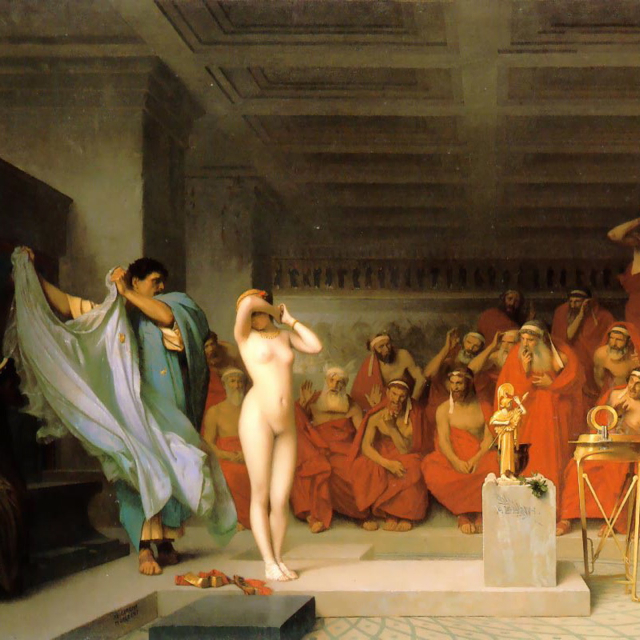
Just like the hookers to ruin it for everybody
Other professional services were on offer at the baths, including that of the oldest profession (and no, it wasn't offered by my grandmother, you smartass!  I'm not THAT old!)  In fact, it was the proliferation of street-walkers around the baths that gave them a bad name in the eyes of the growing-in-size-and-political-muscle Christian Church.

After the fall of the Western Roman Empire in 476 CE (CE: Crap Exists now), public bathing fell out of fashion, partially because of the Catholic Church and their moral objections to it (men and women getting naked, massaged, washed by other people and being completely bare-ass naked and nude all together at the same time without any clothes on?  And naked?  I ask you: who could object to that?), and partly because LARGE HAIRY BARBARIANS had pretty much taken over all over Europe at this point, and that crowd thought that bathing was for pussies.  Just like a bully to be afraid of something like a bath!  And so, as late as 1492 we get people like Queen Isabella of Spain (yep, Columbus' queen) whose virtue was so great that she had only taken two baths in her entire life!  No word of what King Ferdinand, her husband, may have thought about this, but Columbus sailed all the way to America --four times! --to get away from her royal stench.
"In America, I found gold, and spices, and sandalwood --that makes a dandy
soap --and perfume, and douche, and body wash, and shampoo..."
But hey, Adjunct Proff-o-rama, what about the other Romans --the Byzantines?  Didn't they make it all the way to 1453?  Dude, you've been paying attention!  Gold star on the forehead for you!  Yes indeed, the Byzantines did make it to 1453, thus keeping the Roman bathing tradition alive all throughout the Middle Ages.  And when the Turks conquered Constantinople, they took a look around at the beautiful baths of that city and said, "Nice idea --but we can do it better," and voila, the Turkish bath was created.  Keeping the Roman basic design of three rooms of ever increasing temperature, the Turkish bath starts one out in the warm room, moves into the hot room which is heated by steam, and finishes out in the cold room.  Along the way, bathers get a full-body wash and a massage that is so rough that the masseur practically beats you up and shoves you in your own hip pocket.  Other treats include Turkish towels (a Turkish invention) and bathrobes that are ever so comfy, and a nice cup of Turkish tea to put the perfect finishing touch on one of the world's most pleasurable experiences.
Did I mention the pile of erotic soapsuds? 

But for the rest of the Western world not lucky enough to be conquered by the Ottoman Turks, bathing was still frowned upon.  Oh sure, there was the odd clean-freak like Queen Elizabeth I who took one bath every month "whether she needed it or not," but for the most part, Europe smelled like the Bruins locker room after one of those triple-overtime Stanley Cup games.  Europeans were SO stinky, that when the Portuguese and Dutch made it to Japan -a place that has an even more intense bathing experience than Turkey  -the Japanese were so horrified by their smell that they had to deal with those putrid people by wadding up a perfumed scrap of silk and breathing through it like a gas mask.  No wonder the Shogun kicked them all out in the 1700's!
"F*CK! The toilet paper is frozen again!"

But have no fear: all this would change in the 19th century with the discovery of germs and their role in disease.  Guess what? washing with soap kills germs by the gazillions and makes you smell good as a happy byproduct.  Soon Europeans were doing the unthinkable: scrubbing, scouring, rinsing, lathering and having a blast doing it.  And they were doing the even more unthinkable: building bathrooms inside their houses that combined the ultra clean (bath and shower) with the ultra dirty (toilet).  Prior to this, the toilet was confined to the outside in its own little house with crescent moons cut into the door.  This made it tough on folks who lived in northern climates to "do the necessary," especially in the middle of a snow storm.

Bathrooms were cropping up everywhere, even in hotels.  In the beginning (not as far back as the Big Bang Singularity), hotels would have one or two bathrooms per floor that every guest would share.  Doily Carte would have none of that.  Besides being Gilbert and Sullivan's producer, he was the major owner of London's Savoy Hotel, accommodations that boasted private bathrooms for some of the more expensive rooms.  A London newspaper of the day wondered out loud whether the guests were all amphibians.

Today, bathrooms have become a major selling point of a house --the more expensive the house, the fancier the bathrooms.  High-pressure, multi-spray shower stalls, jacuzzi tubs, bidets, urinals, heated floors and heated towel-bars are just some of the fixtures homebuyers can expect in the bathroom.  What people in the west can't expect is a public bath in the neighborhood.  While there are exceptions in New York and San Francisco, the public bath has gone the way of the dodo-bird. These days, there are day-spas, regular spas and municipal swimming pools filling in the gaps made by the lack of public baths.  So the next time you head off to Napa for a weekend of wine tasting, mud-wraps and cucumber slices on your eyes, take a moment to reflect on the long and squeaky-clean history of bathing.  But take care you don't slip on the soap!  Statistically, more household accidents occur in the bathroom than in any other room.
Who could take a dump in this beautiful bathroom?

Wednesday, June 12, 2013

GO TO SLEEP!!!

Can anyone spot the sleeping undergraduate in this pic?
As yet another rosy-cheeked dawn kisses the eastern sky outside ol' Adjunct Proff's window (without the aforementioned Adjunct Proff being successful at wresting [pun intended] a single hour of sleep from the previous raven-hued night), my thoughts turn towards that bug-eyed monster called Insomnia.  What is it?  --why do I have it?  --have any famous people from history suffered from it also?  --what can I do to stop it? --but most importantly: is there a delivery service in all of Massachusetts' Merrimack Valley that can score me some hot pastrami on a kaiser roll with spicy brown mustard, mayo, jarlsberg cheese, grilled onions, a side of fries, and a nice, hot cup of chamomile tea with milk and honey? --at 4 a.m.?  Failing that, is there a loyal reader out there who will hit ol' Adjunct P in the head with a crowbar so that he can have a couple hours' unconsciousness before facing whatever fresh new Hell today has in store?  Somebody?  Anybody?  Bueller?
You could also hit me with a sandwich this big-
it'd probably have the same effect as a crowbar.

The earliest written record of anybody not having insomnia (and thereby confirming that there was insomnia) comes down to us from the Epic of Gilgamesh, that kooky moldy-oldie that also treated mankind to the first recorded threat of the Zombie Apocalypse (see my post OH NO! Zombies Ate My History Homework!  for more on those zany Akkadians), and is none other than the title character, Gilgamesh himself.  In Tablet XI (the Gilgamesh poet wasn't really big on chapters --or paper, for that matter!), the Sumerian equivalent of Noah, a dude called Utnapishtim (the same dude who survived the flood, built an ark, re-populated the entire world and who, with his old-lady, were just chillin' at the End of the World and groovin' on the fact that they were immortal), challenges Gilgamesh to stay awake for an entire week.  If he can stay awake, he's a god; if not, he's just a human being like you and me.  You can guess the result: big-G falls right to sleep and sleeps for an entire week (to be fair, he had had a rough couple of days before that).
I am a Sumerian God!
I never sleep! -or fart!

Why did the Sumerians, Akkadians, Babylonians and such all want their gods and goddesses to have insomnia?  It's because they wanted to feel like the bunch of hooligans that created them, the Earth, the sky, that miserable little yippy-dog that lives next door to me --that their gods were always on the clock, around the clock, looking out for their creation and protecting them.  And since nobody mortal --not even the semi-divine King Gilgamesh of Uruk --could stay awake all the time, insomnia was seen as a super-power of the gods.  Wow.  I wonder: were chronic insomniacs like me seen as semi-divine beings back then?  That would be almost worth it...

And it wasn't just the Mesopotamians who liked their deities wide awake.  Argos was a Greek giant who had a hundred eyes.  He needed them because Greek heroes were constantly trying to sneak up on him while 30-40 of his eyes were asleep so they (the heroes, not his eyes) could kill him.  Apparently he had pissed-off the Greek Heroes' Union Local #733 by killing so many Greek Heroes, and not all of them in self defense.

The Hebrews and Christians had these things called Angels, a.k.a. Watchers who, well, watched stuff in Heaven and, well, elsewhere.  They were supposedly wide awake all the time.  And the most powerful bunch of Angels, the Seraphim, supposedly surround God 24/7 and praise Him 24/7 for all eternity --I presume that they are awake during all this praising, unless there is a condition among the angelic called "sleep-praising."
That is one seriously bad-ass bunch of angels, Mr. Botticini!
I assume the Virgin is there because it's her assumption.
As for people you've probably heard of who suffered from this god-like affliction of insomnia, there was Sir Isaac Newton (of course he did!  Newton was such a hypochondriac that this was probably his only legitimate disease!)  Sir Isaac, or Figgy to his chums from prep school days, reportedly went all of 1693 without sleeping.  Needless to say, this depressed Figgy --that, and nobody was believing that he had invented differential calculus, and everybody was believing that kraut Leibnitz had.  Sir Winston Churchill suffered from it --he was having troubles with a different kraut.  And speaking of great looking celebrities, Marilyn Monroe and Michael Jackson both had such a terrible time getting to sleep that they were literally killed by their prescription sleep medication.
I don't think they ever slept together.
Ok you wide-awake, semi-divine Adjunct Proff, so what causes insomnia?  The biggest (and most mind-bogglingly unspecific) cause is stress --the psychological kind, not the force on the airframe of a Boeing 777 at take-off.  Here is a link to the world famous and completely expensive Mayo Clinic if you want to read up on other things the doctors at the Mayo think cause insomnia:


I suggest reading this late at night or early in the morning, especially if you can't sleep.  There's nothing better on nights like that than reading about why you can't go to sleep so that you can worry a lot about it.

So <YAWN!> there you have it: the complete and exhaustive <YAWN!> [pun not intended] history of insomnia, some <YAWN!> famous people who have had it, and some really... expensive... ideas as to what causes... Z-zzz-Z, ZZZ zzzzzzzzzzz... 

Tuesday, April 9, 2013

A Visit to the No-Tell Motel


After a particularly nice stay at a Marriott Comfort Inn and Suites (with soft-core porn on demand!  That, AND a make-your-own-waffle machine), I got to wondering about who and where the world's first ever hotel was, and whether or not they had as great a breakfast buffet as my Marriott (granola!  bacon AND sausage!  scrambled eggs that weren't slimy at all!)
Note the complete absence of unsupervised children running amok
The first hotel was probably in one of the first cities, Jericho and Chatal Huyuk in contention for that honor, and was probably nothing more than a spare room in a house where the kids had grown up and married, grandma and grandpa had died, and the dog had been roasted in honor of a local deity's feast day.  There are no records of this first hotel: no advertising, receipts, star-rating or snarky comments on the ancient equivalent of Yelp!.com.  Ancient peoples were more concerned with getting out of the rain and wondering if their hosts would rob them during the night to bother with filling out the obligatory guest survey.
That's your room on the roof under the stretched goat skin.  Check-out at 10 am.
Those wacky and wonderful Sumerians upped the hospitality-game by featuring inns run by widdows that served beer and that exotic import, wine.  In the Epic of Gilgamesh, one of these fine establishments shows up, in all places, and I am completely NOT making this up, at the END  OF  THE  WORLD (not to be confused with Douglas Adams' Restaurant at the End of the Universe).  Here is what happened when the title character, Gilgamesh, showed up at this tavern at the end of the world:

You like my kitty?
He's an actual lion
The tavern-keeper Siduri who lives by the seashore,she lives...the pot-stand was made for her, the golden fermenting vat was made for her.She is covered with a veil ...Gilgamesh was roving about...wearing a skin,...having the flesh of the gods in his body,but sadness deep within him,looking like one who has been traveling a long distance.The tavern-keeper was gazing off into the distance,puzzling to herself, she said,wondering to herself: "That fellow is surely a murderer(!)! Where is he heading! ..."As soon as the tavern-keeper saw him, she bolted her door,bolted her gate, bolted the lock.

Apparently, ancient bar-keeps had the same problems as modern ones, what with murderers and creepy-looking semi-mythical heroes strolling by and wanting a drink.

You probably remember from your kid's Christmas pageant the Inn at Bethlehem that didn't have any room for Joseph, Mary and the future Baby Jesus, thus missing out on the best free publicity any hotel could ever hope for, especially once the Magi finally showed up.  What you probably never heard about was the fact that the Romans --who basically invented the interstate highway --recognized this problem and actually did something about it.  Emperors from Augustus to Constantine made it a policy to encourage inns, hostels, horse-stables, rest areas and scenic views all along their superb network of roads in order to make the traveller's journey a little more pleasurable.
I had to give birth in a STABLE
 because YOU wouldn't call ahead for a RESERVATION!
Travel accommodations got the royal treatment during the Middle Ages when a king-on-the-road could expect lodgings at any one of several castles owned and operated by his vassals.  Amenities typically included hunting, feasting, fooling-around with the kitchen wenches, hawking, feasting, recreational horseback riding, feasting and feasting.  Even a nobody-knight could expect hospitality from brother knights and terrified peasants along the way.  Before you wax nostalgic about the days of yore, remember that staying at a castle was no picnic: they were cold, drafty, unhygienic, crowded --they basically had the same ambiance of a National Guard Armory.
Your room does include a bath, but unfortunately it's located in the dining hall.
And while we're on the subject of the Middle Ages, I would be remiss if I didn't mention the great accommodations offered by religious denominations along the pilgrimage routes.  These could be had at the hostelry or hospital of any monastery --word has it that the Benedictines were the best.  In fact, a whole order of chivalry was dedicated to the hospitality industry: the Knights Hospital, or the Hospitalers.  They are particularly noted for providing security for Jerusalem-bound pilgrims and for surviving the destruction of the Knights Templar order.
Would you prefer a smoking or a non-smoking room?  With or without armor?
As cities and commerce recovered during the High Middle Ages, inns and public-houses proliferated at about the same rate that stay-and-bugger-off-without-paying travelling salesmen, so much so that laws were adopted to punish these early spongers.  The English Common Law was especially helpful in this area, setting up the rights of guests and the duties of innkeepers towards their guests.  This was a problem, as there was one particularly notorious inn on the way into London whose guest room included a trap door which, when opened, deposited the guest under the inn where he would be robbed and his body tossed into the Thames.  If our guest escaped this trap, he could look forward to a shave-and-a-haircut from Sweeny Todd.
That was a CLOSE shave you wanted?

With a legal framework in place, the only thing that the hospitality industry needed next to make it even better was the automobile and --Presto! --the Motel was born.  A motel or motor-inn can be found in most American towns today.  My fondest motel memory was the motel in New Hampshire ski-country in the late 1960's.  My brother and I had our own room with a door in between my parent's room; there was a tiny refrigerator stocked with sodas and snacks; but best of all, there was a coin slot on the nightstand that, if you put a quarter in it, magic fingers would massage the stressful day of skiing right out of your body!  How cool was that!

The golden age of motels in the United States was, of course, the 1950's, and the road these great motels were on were the Mother Road, Route 66.  The space-age designs, modern exteriors and predictably good accomodations were famous the world over, almost as famous as America's wacky roadside attractions.  Dinosaur parks?  the birthplace of the guy who invented Saran Wrap?  the world's biggest ball of string?  See it all from your Chevrolet in the USA, and then pull in to the local motel for a rest, a dip in their pool, and some homemade pie from the diner across the street.
Or you could stay here and, um, see Norman's Mom?

Today's hotel experience can be anything from a student hostel with Dieter and Sven, the Techno-Twins, all the way up to the most exclusive hotel room in the entire world: inside Cinderella's Castle. At Walt Disney World, there is a room that one can't rent --one must be invited --and you would not believe all the luxury inside: a priceless glass slipper (hey, it is Cinderella's room after all!), a pool-sized tub that one can adjust the lighting-color-scheme to match your mood; priceless wood carving on the bed headboards; an amazing mosaic of Cinderella's pumpkin-coach on the floor --it just goes on and on!  Here is the link to this most exclusive of all hotel rooms:
http://www.firstcoastnews.com/news/local/story.aspx?storyid=82325
If you are lucky enough to ever stay in this room, a few words to the wise: don't set out any mousetraps; don't swat any small, flying creatures that might be buzzing around your head (it might be Tink!); and don't, DO  NOT  bug the concierge about seeing Cinderella and Prince Charming in person BECAUSE  THEY  ARE  FAIRY-TALES  AND  NOT  REAL.

So, have a nice stay and remember: checkout time is 10 am.

Wednesday, April 3, 2013

OH NO! Zombies Ate My History Homework!


If your whole life (death?) revolves around watching the Walking Dead, watching the Talking Dead podcast, visiting Walking Dead fan-sites, reading Walking Dead graphic novels and fanzines, then your world --like so many others' worlds, Adjunct Proff's included --is on hiatus until the next series installment.  But not to worry: Adjunct Proff is ready to fill the breach in our sadly temporarily depleted lives by filling you all in on the origins and continuing influence exercised by fears of the Zombie Apocalypse on our collective zeitgeist (German for whatever is friggin' buggin' you now).

Zombies ate my zeitgeist!  Either that, or
there's a zeitgeist peeking at me when I pee!
So, zombies have been around since... "Weekend at Bernies 2?" --the zombie movies of the 1950's drive-ins?  --the days of Vaudeville shows?  How about ever since the first friggin' story that human beings bothered to scratch onto a clay tablet sometime during the Akkadian period of Sumerian civilization?  Yup, those wacky Mesopotamians are at it again --this time giving voice to humanity's fear of the Zombie Apocalypse.  It's all right here in the first real story ever cuneiformed: The Epic of Gilgamesh:


Ishtar spoke to her father, Anu, saying:"Father, give me the Bull of Heaven,so he can kill Gilgamesh in his dwelling.If you do not give me the Bull of Heaven,I will knock down the Gates of the Netherworld,I will smash the door posts, and leave the doors flat down, and will let the dead go up to eat the living!
And the dead will outnumber the living!"

Now I don't claim to be able to translate ancient Akkadian cuneiform, but that sure sounds a lot like any given day on AMC's "The Walking Dead."  Why do zombies show up troubling the minds of ancient Akkadians?  Was this a recurring problem, dead rising from the grave and eating the living?  

We turn next to the ancient Greeks, who knew a thing or two about fighting monsters.  Ladies with snakes for hair?  --half-man-half-bulls who lived in an underground maze?  --whirlpools with teeth?  No problem: the Greeks would kill 'em all, then sit down with Homer and tell him all about it so that he could stick their adventures in his next epic poem.


"To which mighty Achilles said, "D'oh!"
Everybody knows the Iliad and the Odyssey. These two poems made ancient Homer's rep as da mos' def-jam mutha of the Greeks, yo. Nobody knows about the Nostoi, yet another epic poetry spin-off of the Trojan War. This story follows Achilles' kinsmen, the Myrmidons, and their long, adventure-filled journey home from the Trojan War. On one island, guess who they come across? These guys:

“It was there on that island when they noticed the men of ragged appearance. 
Their skin was a dull pale gray and the scent of putrid flesh was upon them. 
Their eyes were black as beings void of souls, they approached the Myrmidons with all the madness of a wild beast.”

And who might these dudes be? I dunno, maybe WALKERS?!? Guess what the baddest-of-the-badass Trojan War veterans, a.k.a. the Myrmidons, did then?  Did they stop those ancient Greek walkers with precise sword-head-shots?  Noooooo- they ran for it and "cursed Hades for sending these fiends amongst them."  Wow, where's Michonne when you need her?
About three thousand years in the future...

Fast-forward to Ireland in the 700's.  Archaeologists have recently uncovered a pile of skeletons buried sometime in the 700's with --get this -- bricks in their mouths.  When asked why the usually sensible medieval Irish did this wack-burial-job, anthropologists hypothesized that they were buried with a brick in their mouth in order to prevent them from --wait for it --rising from the dead like a zombie!  I am SO  COMPLETELY  NOT  making this up!  Ok ok, St. Patrick may not have driven the snakes from Ireland (see my St. Patrick's Day blog for more on this) --maybe his miracle was keeping the medieval Irish zombies DEAD  AND  BURIED  instead of running around the Emerald Isle noshing on the living.
...and they're magically delicious!

I could go on and tell you about Voodoo and Rastafarian religious practices, as well as relate Christian beliefs in an end of days that will occur before the return of Jesus Christ from, ah, Rancho Cucamonga, but you already know that  if you're hard-core zombie-apocalypse-preppers like me --that, or the demographic targeted by "The Walking Dead."

So, what's my favorite zombie scenario?  I really, really liked that movie, "Shawn of the Dead," where this British guy, his slacker buddy and his girlfriend survive the British zombie apocalypse by hiding out in the local pub that she gives him grief about spending so much time in before the British zombie apocalypse.  Funny, witty, edgy and ironic without being annoyingly British smuggish.

Let me leave you with this one brain-stretcher.  As already blogged-about in her award-winning blog, Jenny Lawson, a.k.a. The Bloggess, and her husband, Victor, a.k.a. the saint who's still married to The Bloggess, once had a conversation that went like this:


Me: Oh my God, did you see the name of that cemetery?  “Resurrection Cemetery”.  What a terrible name for a cemetery.
Victor:  It’s because they believe in the resurrection of believers, dumbass.
Me:  Still.  Some things just shouldn’t be resurrected.  Just what we need is a bunch of damn zombies wandering the earth. 
Victor:  Yeah, that’s not “resurrection”.  That’s “reanimation”.
Me:  Same difference.  Although I guess “Reanimation Cemetery” would be slightly more disturbing. 
Victor: It’s not the same difference.  Zombies are reanimated, but they don’t have their previous mental capacity so it’s not a resurrection.  Technically it’s “zombification”.
So, just what IS  this resurrection anyway, hmmm?  Isn't it the same quality that FREAKS  US  OUT  in zombies?  It's like, Jesus  JUST  WON'T  STAY  DEAD!!!  But worse of all, it means that for 2013 years, a lot of people have been worshipping, have constructed an entire religion around, and have committed unspeakable acts in the name of  A  ZOMBIE!!!  Ponder that one until Rick, Karl, Daryl, Michonne and the whole live-and-undead gang return for Season 4 which will be, no doubt, Totally Killer.
...and, unlike all those other zombies, Jesus can also walk on water
--which makes him slightly more creepy, come to think of it!