Showing posts with label Vikings. Show all posts

Tuesday, September 29, 2015

The Top Five Most Stupid Battles of All Time


War is hell.  And stupidity.  Just ask any vet sporting one of those futuristic blade-runner legs they're fixing our amputee service-people with from Iraq or Afghanistan and they'll give it to you straight.  Sure, they volunteered, but that doesn't make war such a good idea. And if you want to know just how exactly dumbass war is, it totally flies in the face of evolution, removing the young and strong from the gene pool and leaving the old dip-shit admirals and generals who are too busy writing their memoirs and getting their brass knobs polished to do any actual generaling/admiraling to give the first fuck about the lives they're about to toss into the meat grinder.  As a testament to the idiodacity of war, I present you, in no particular order, with the five most stupid battles ever fought.

1. The Battle of New Orleans - War of 1812.  What should have gone down as the best showing of the new American Repiblic's armed forces under the dynamic leadership of General Andrew Jackson, who had a real goddamn pirate fighting on his side during the course of this humiliating rout of the British Army, instead must necessarily be consigned to the "Whoops, we blew our chunks all over THAT one!" file, because the Battle of New Orleans happened after the fucking war was already over!  If there were NFL referees, the U.S. of A. would be hit with a "personal foul-late hit" penalty for this monumental communications breakdown.  Now granted, it's not like General Jackson could have called up the White House and told them "We march at dawn!" and President Madison would have said, "Umm, don't because we just beat them, ok?"  Still, it's not like guys that died at the battle would have been like, "Ok, guess we'll just go home now and not get killed, so have a nice day!"  So to recap: big win, totally bogus battle.

Um, you guys are late.  Does this battle really count?


2. The Battle of the Crater - U.S. Civil War.  The Confederate Army at Petersburgh was dug-in so superbly that finer trenches would have to wait for WWI to be built.  Robert E. Lee's troops nickname for their famous general was the King of Spades, not because he always seemed to have one up his sleeve during officer's poker-night, but because he properly understood the devastating effect of the rifled musket, the repeating rifle and the canister-shot shell, so he always had his troops well dug-in if time and conditions favored it.  This, of course, peeved Ulysses S. Grant to no end, who wished to march his Army of the Potomac right over Petersburgh on their way to Richmond.

The siege of Petersburgh had settled down to the dreary long-range artillery duel that so much of the Western Front would experience in 1914-1917, punctuated by sorties of brigade-sized units that made absolutely no headway, until one day, an officer from General Burnside's IX corps informed the mutton-chopped general he had an entire company of soldiers from Schuylkill County, Pennsylvania, the heart of coal mining country, who had an ingenious plan: they would tunnel under the Confederate lines. pack the tunnel with gunpowder, blow it up, charge through the gap and be heroes.  Burnside gave the go-ahead, but his superior, General George Meade, basically saw it as a way to keep the men busy during an otherwise boring siege.  An elite corps of black Union troops would lead the assault.  It would be totally kick-ass!

You will note at the center of the map, General, a very large crater.  Try and go around it if you can.

June 30 arrived, the mine was detonated, the Confederate lines were blown up, and then absolutely nothing went right after that.  The black troops were replaced by uninformed white troops whose commander was drunk the day of the battle.  And these troops, instead of intelligently charging around the massive crater in the earth where Confederate defenses used to be, charged straight down into the fucking crater, then got stuck and couldn't get out. The Confederates counterattacked, many of them giving turkey calls because a battle between two armies had just degenerated unto a turkey-shoot.  And so the siege of Petersburgh would go on for another seven months.

3. The Battle of Gettysburg - U.S. Civil War.  Robert E. Lee wasn't immune from making dumb strategic moves --he just made 85% fewer of them.  Case in point was the Battle of Gettysburg.  Lee's Army of Northern Virginia had invaded the North with two goals in mind: to win foreign intervention from Britain and/or France, and to bring about a negotiated settlement to the Civil War.  Although the war had been a nearly even affair up to that point, superior Union industry and numbers of soldiers were beginning to tip the balance.  Lee thought if his army could attack and take Pennsylvania's capital at Harrisburg, there would be a very good chance for an end to the war.

"Men! Up and to your posts!  Remember, you are from Old Virginia!
And you're working for Ted Turner!"
The one thing Lee didn't count on was Pennsylvania's macadam-covered turnpikes.  The Army of Northern Virginia was mostly shoeless, but they didn't really mind because most of the roads  they trod were dirt.  Macadam was a different story.  Think asphalt, but way more sharp and pointy.  His army was basically bleeding-out on the roads, and not a shot had been fired.  Lee's intelligence reported that there were shoes to be had up the road at the small town of Gettysburg, so he sent a detachment of troops to liberate said shoes.  Instead of returning triumphant with Pradas, Kate Spade's, vintage Chuck Taylors and classic Bostonians, Lee's scroungers ran into a detachment of dismounted Union cavalry, who stubbornly stood their ground.  So Lee sent more men in, forcing the Union elements to evacuate the town and take up positions on the best fucking terrain around.

During the night and into the next day, each side continued to pour more and more men into a totally nowheresville Pennsylvania town with absolutely no strategic value or military advantage.  And the shoes?  Someone had fucking lost them by day 1!  There was now nothing to do but fight: up Little Round Top, Culp's Hill, Seminary Ridge, the Peach Orchard, the Wheat Field, the Devil's Den, the Sunken Road, and finally, make George Picket destroy his entire division attacking the union center in the stupidest frontal assault of all time.  To his credit, Lee realized what a total mind-numbingly dip-shit he had been to fight here of all places, claiming the loss was "All [his] fault," but I personally think he should have been busted down to sergeant for such total pig-headed stupidity.  However, he didn't have his "eyes and ears" with him during the battle, as the Confederate cavalry under J.E.B. Stuart was absent for most of the fight, so we'll give him a pass on just this one.

3. Dunkirk - World War II.  The German War Machine had patched itself up from it's shabby old condition at the end of World Way I and had proven itself by conquering Poland, the Netherlands, Denmark, Norway and was just about to conquer France and destroy the British Expeditionary Force which was holed-up in the picturesque seaside town of Dunkirk, when the unthinkable happened.  The armored columns were told to halt and let the National Socialist Luftwaffa destroy the British on the beach.  Nazi General Gerd von Rundstedt was all like, "Umm, hey, we’ve got these Limeys in the bag, so why don’t we just go ahead and finish them?” But Hitler was all like, “Nope, Fat Herman’s gonna do it for you.”

"Quick men, commandeer that rowboat!"

What happened next was that Goering did send in his air force, which at that time consisted in large part of these slow dive-bombers called Stukas, which made a terrifying noise, but were fairly easy for anti-aircraft guns to hit.  While this duck-shoot was going on and the odd bomber was getting through, the British assembled the weirdest looking flotilla of anything that could float --ships, ferry boats, yachts, Huck Finn's raft, garbage scows, three guys in a tub --and sent it over to Dunkirk, where they saved the British Expeditionary Force, a few of their French and Belgium friends, and a dog named Digby, who went on to fight Rommel in North Africa and eventually fuck things up in Operation Market Garden, which is just barely edged-out by this bit of mind-fucking stupidity of the Dark Ages, starring the Saxons (basically half-British Germans) and the Vikings (not the NFL team from Minnesota).

4. The Battle of Maldon - Viking Invasion of England.  There were basically three types of Vikings: Swedes, Norwegians and Danes.  The Swedes were the ones who explored all of Russia's rivers, founded its first cities, traded in timber and amber, and got so stinking rich and famous that the Eastern Emperor in Constantinople kept a bunch of Swedish Viking warriors on retainer as his Varengi Guard.  The Norwegians explored the Orkneys, Shetlands, settled Iceland, Greenland and Vinland (Newfoundland to you and me), spreading their DNA from Oslo to Canada and back.  Then there were the Danes.  These were the "Let's kill everybody who won't make a good slave, rape the rest, steal their stuff, burn everything else, then get drunk and swap stories in Heorot Hall, pass out, and get eaten by the monster, Grendle during the night."  --oh, it was also this lot that attacked England.
"Unleash the ultimate Viking weapon: IKEA!!"

To a Danish Viking, England, Ireland and Scotland must have looked like easy pickings.  The place was chock-full of these places called monasteries, filled with unarmed men, who had lots of gold crosses and other nice stuff, and could be enslaved to do all the busy-work an important Danish Viking just doesn't have time for, because their days were heavily scheduled with berserk-fighting, dashing babies' heads out against stones, and drinking mead.  That is, until they ran into the Anglo-Saxons, those German-blokes who were slowly turning into Englishmen, who knew a thing or two about fighting.  Their king was one Ethelred the Unready, which doesn't have anything at all to do with how well prepared he was, because the Saxon form of his name is "Unroody," which means "unschooled," or "self-taught."  The Saxon force consisted of this citizen-militia called the fyrd, which was about as good as any citizen militia can be expected to be, plus the king's Housecarls and Earls, professional fighting men who could seriously mess you up if you had the poor sense to tangle with them.

The Vikings, for all the terror they caused, were essentially ship-borne raiders, whose main tactics were surprise attack and swift retreat with their jacked-stuff.  But once in a while, Ethelred's Earls and Housecarls caught up with the Vikings, and things would then be fairly evenly matched.  The Battle of Maldon was one of these occasions.  However, because of the inexplicable stupidity of the Head Saxon in Charge... well, just see for yourself.

Contrary to popular opinion, I am ready
...to pay-off the Vikings 
The Vikings had been looting and burning the English coast in Folkstone, Sandwich and Essex, before turning their attention to Maldon.  Landing on an island connected to shore by a land bridge at low tide, the Saxon commander, Ealdorman Brihtnoth, got into a shouting match with the Viking leaders when they demanded plunder and Eldorman told them to suck it.  The Vikings then made an incredibly ballsy request: put off the battle until low tide, so they could all cross and fight a proper battle at full strength.  And wonder of wonders, Ealdorman, whose fyrd and retainers were a smaller force than the Vikings had, actually agreed!

The battle was an especially brutal one, but luckily, Ealdorman was killed.  However, his boys fought so bravely that the Vikings said, "Aw, fuck it!" and limped back to their ships, leaving Maldon intact.  However, King Ethelred was convinced that with dip-shits like Ealdorman running his army, it might just be better to pay the Danes a heap of gold so they would just go the fuck back to Denmark.  Which they did.  Except for the bunch that didn't and settled on the East Coast, where they lived under their own Danish laws and customs.

Because of his incredibly stupid conduct at the Battle of Maldon, two new terms enter the English (or Anglo-Saxon) language: Danegeld, or gold paid to the Danes so they'll stop murdering and raping us, and Danelaw, the place the Danish Vikings settled and eventually became English.

5. The Battle of Los Angeles - World War II.  Folks were jittery in 1942, and quite understandably.  Following an invasion of Martians in Grover's Mill, New Jersey on Halloween in 1938, and the Japanese bombing of Pearl Harbor on December seventh in 1941, America was all like, "Just don't FUCK  WITH  ME  because if you do, I will SERIOUSLY fuck you up!"  Which partly explains what happened the night of February 24, morning of February 25, 1942.

The night before, a Japanese Submarine's deck gun opened up and pumped 14 shells into the Ellwood Oil Refinery, just north of Santa Barbara.  The next night, before midnight, air raid sirens sounded in Los Angeles.  A total blackout was ordered and air raid wardens were called out to enforce it.  Searchlights swept the sky, looking for all the world like the worst Hollywood movie premiere ever.  Then at about 3:16 a.m., the 37th Coastal Artillery Brigade went off the reservation, blasting away with their .50 caliber machine guns and 12.8 pounder anti-aircraft flak batteries.  Shrapnel rained down on Lala Land as the gunners fought like hell to bring down what was either some kind of  meteorological balloon or a barrage balloon that had slipped its moorings. Or it could have been a flying saucer.  I mean, there's this one pic of something caught in the searchlights that looks kinda E.T.  I'm just sayin'.
Weather balloon my ass.
Total casualties from the Battle of Los Angeles: 5.  Three car wrecks --L.A. drivers can't drive in the rain, fer chrissakes.  How do you expect them to drive during a blackout with shrapnel raining down? --and two heart attacks.  The balloon was never recovered.  Or so they say...

HONORABLE MENTION goes to something the British called "The War of Jenkins' Ear."  There were some good battles and it was by all accounts a decent war, but really?  Jenkins' Ear?  Come on.

Monday, August 3, 2015

Fun With Flags


I was on the beach yesterday in where can only be called "not close to the Mason-Dixon Line" AT ALL.  What I saw would have made Colonel Robert Gould Shaw (Mass. 54th Infantry- see Ferris Bueller's portrayal of him in the film, "Glory") turn over in his grave: the Confederate "Stars 'n Bars" in the form of a beach towel, being sat on by a nice little old lady from South Carolina.  I didn't ask her if her towel came from the flagpole at the statehouse in Colombia, but I did ask her how she liked Salisbury Beach: "Oh, such a lovely spot!  A bit more rocky than our beaches, but refreshingly cool."

Artist's conception of the sweet little old
Southern lady in her youth
What initially amazed me was that not one --not one of Massachusetts' nationally famous liberals, me included              --pointed out to the nice old Southern lady that her towel is the very image of slavery, racism and red-neck-ism, and she might want to exchange it for something a little less controversial, like, I don't know, Muhammad dancing the hokey-pokey.

That got me to thinking: why are people so apeshitedly invested in one flag or another?  And I'll give pride of place to the first crack at this question to that eminent historian, Dr. Eddie Izzard:  Eddie on Flags  We'll be coming back to Dr. Izzard and his sparkly dress later, but first, let's kick it back to what the first flags were, what their job was, and how that job changed over the years.

Yeah, like THIS bad-ass needed protecting!
Flags started out as identity markers for military units.  While there is no mention of Sparta's 300 or Thebes' Sacred Band or even the feared Bull Dykes of Lesbos using flags at or around Troy, Marathon or Thermopylae, we do see them being used by the Persian Sassanids' armies, and their implacable foes, the Roman Legions.  For a legionnaire, the legion's standard was kind of a cross between a battle banner and a religious idol. When a legion came to grief on the battlefield, its soldiers were expected to die defending their eagle to the last man; and indeed, battlefield anthropologists in places like Teutoburg Forest and Canea have found Roman corpses clumped together in such a way as to suggest that at the end, they all died fanatically defending something or someone. 

The "Something" was the golden eagle on top of that pole, carried by the huge guy wearing AN ENTIRE LION'S HEAD for a helmet, an officer called the Aquilifer.  As our modern re-enacter suggests, this job was given to the biggest, strongest soldier who was completely ok with marching into battle with a bird on a stick for a weapon.  So he might not have been the sharpest spear in the whole Legion, or maybe he was, because he knew an entire Roman Legion would be protecting him and his stupid bird.  And the officer who would wisely be standing next to him: a Consul in the days of the Republic. or a great general like Caesar Augustus.  

The Roman Eagle, or Aquilla, was a major deal to Roman Legionnaires.  The Aquilla was presented to the Legion during a huge religious ceremony, presided over by the Pontifax Maximus, or chief priest of Rome, who was usually the Emperor himself.  It was treated as a sacred idol, making it a powerful source of pride and identity to the Legion who possessed it.   But wait a minute: what's that red bit of fabric in the background, just to the right of our Roman Rob Gronkowski?
Modern recreations of actual Roman Legion battle standards.  Not shown are the Ducky, Moo-Cow
and Rainbow-Unicorn Legion standards.
These are among the first flags ever, and you can see they're not all that grand --merely a bit of red cloth stuck to a crossbar added to somebody's spear that told anyone who could read which Legion it was, its nickname and its mascot.  This was all very important to somebody the Legion had just run over; it was equally important to generals in the field, planning their battle strategy, as well as ordinary Roman citizens who loved to watch the Legions celebrate big victories with something called a Triumph --basically a huge parade. 

Meanwhile, over in China, the great armies of the Han Dynasty were using way more gaudy banners than our plain old Romans to identify their armies, and they were doing more: using them to communicate.  With the help of kites.  Really.  A Han General could get off a message to General Tso's army (of tasty chickens) by tying different colored banners to kites and then flying them high enough for said General Tso to see.  For example, green might mean, "Attack!" --red might mean "Retreat!" --yellow might mean "Gotta Take A Wizz- Be Right Back!" and so on.

And white with teal fringe might mean "Just ignore the guy with the boom mike"
The next time and place we see flags in is Medieval Europe.  By this time, the Roman Legions have had the stuffing knocked out of them by the Goths, Huns, Angles, Saxons, Franks, Teutons, Slavs and Vandals, just to name a few, and everybody who was left was too broke to field an army as big as a legion; but what they lacked in size, medieval armies made up for it in hardware.  By 1066, the average Anglo-Saxon knight, French-Norman chevalier or Spanish caballero andante was wearing so much steel that they needed these huge horses to carry them around the battlefield.  And, because they wore helmets that completely obscured their knightley faces, they needed some other way to identify themselves.  Seamstresses to the rescue!  They needed their own flag.

At first, knights would paint their shields with pictures and symbols that told a bit about their family history and their status, such as to whom they owed allegiance or held estates from.  Knights who fought from horseback sometimes put these designs on something called a pennon --basically a pennant-shaped bit of cloth tied around one's lance that made it easier to pull said lance out of the other knight one had just skewered.  In time, these bits of cloth got very fancy indeed and were carried about by a knight's Herald --basically a guy with a loud voice who would announce the knight's presence at the Lists, or Tournaments.
This one's a king's standard, because it hasn't
got shit all over it.

We're getting closer to Dr. Izzard's type of flag, but not quite yet.  For that kind of flag, humanity would have to suffer --and when I say suffer, I really, REALLY mean suffer.  Why?  Because it was after Europe's Medieval period that Europeans started to think of themselves as more than somebody's son or the resident of some village, the vassal of some lord or another.  They started to identify with other Europeans who spoke the same language, lived in the same general location, shared the same religion, history, dreams and aspirations.  They had begun to create something that the world had never seen before: the Nation State.
That's one old Danish
And this was its symbol.  At the top of Germany sits one completely bad-ass country: Denmark.  From the 780's onward, the Danes raided, plundered, killed, extorted and generally intimidated the hell out of the rest of Europe.  Ever hear of the Vikings?  Yeah, the ultra-violent ones came from Denmark.  Pretty soon, England, Ireland, France, even Sicily were terrorized by the mere sight of these Vikings swarming ashore from their longships.  Some local rulers went so far as to give in completely and pay them off with whatever the raiders wanted.  One even gave an entire province, complete with all the people and buildings in it, to this one especially nasty Viking named Rollo.  The land he was given is named Normandy, in honor of the Norse or Northmen who settled there.

Meanwhile, back in Denmark, the Vikings who stayed home began doing strange things.  They started brewing their own distinctive beer, making their own tasty cheese which they ate along with herring and rye bread, stewed berries, lots of different pork products, and speaking a language that wasn't quite Viking, German or Norse.  In short, they started behaving like Danes.  To celebrate this uniqueness breaking out all over the land, the Danes chose a king who would rule over them all, and adopted the white cross of Christ on the bloody red field of the Vikings as their symbol.

Hmm... coincidence?
Other peoples who fought for and established their very own nation states included the Swiss, whose flag looks remarkably like the Danish flag.  As a matter of fact, crosses were a kind of recurring motif in early European flags.  The best example of this is Great Britain's Union Jack, a flag that combines St. George's Cross (English) with St. Andrew's Cross (Scottish) and St. Patrick's Cross (Ireland) all into one flag.  By the way, missing from this flag is any direct reference to the kingdom of Wales.  This is because England had annexed Wales before the Union Jack was adopted.  That fact has made Welshmen cross for centuries (see what I just did there?  Cross? Welsh?  Hahahaha!)
Nope, no Wales here.  So just stop looking.

Which brings us to the late 18th, early 19th century.  Due to all of their keen inventions (steam engines, dynamite, cannons, muskets, railroads, kinky sex, canned food and --wait for it --textile sweatshops!), European countries set out with all the enthusiasm of a hipster-foodie turned loose in a Whole Foods market after-hours to explore, "discover," study and conquer the entire rest of the planet.  At gunpoint.  Why?  because: 1) they could; 2) the rest of the world was super-into European stuff like cotton underwear, woolen blankets and ironclad, steam-powered battleships; and 3) Europe's economic system of Capitalism demanded ever expanding overseas markets, ever increasing and infinitely inexpensive raw materials, tons of laborers smart enough to run the machines, yet stupid enough to work for shitty pay in dangerous conditions for 10-16 hours a day.  Or send their wives and children in to do the same thing.

The staff at Proletariat and Follicle's polishing their wieners after lunchtime floggings
Just a second Ex-Ppppprof, I hear you drunkenly stammer, Who'd be dumb enough to do that?  Well, given that the only other choice was to be stuck inside a workhouse, which was in turn stuck inside a Charles Dickens novel, which would later be stuffed inside an Andrew Lloyd Weber musical --a workhouse where you performed mind-numbingly boring work and got paid in floor space to sleep on and all the watery gruel you could shove  into your face at your 17-minute meal/pee-break/ flogging-free respite --even I would chose factory life.  That's not to say that everybody liked working in the factory: some didn't.

Help!  Save us from the evil factory --and that gigantic cop!
In fact, it was during this period that Karl Marx and Friedrich Engels invented communism as a way for the workers (who totally outnumbered the capitalists at this point) to steal their own lives, souls and destinies back from someone Marx (Karl, not Groucho) called the Industrial Bourgeoisie.  Well, the I-B thought to themselves, these poor misguided poopy-heads need some sort of distraction, so because there isn't any television just yet, we're going to give them all little flags, have them wave, teach their children to hate everybody who waves a different flag than their own one, and stick their older kids into gigantic conscript armies in order to: take over trade routes with their valuable markets and resources, as well as slaughter the older children from different countries who are trying to do the same thing.  And you know what?  It worked.  A whole bunch of times.  Hooray!

We'll be changing the line-up slightly for WWI, part II...
In places like the Soviet Union, where they gave Marx's ideas (Karl again, not Harpo) at least a half-hearted try, the state declared war on religion itself, substituting Russia's flag and portraits of her leaders Lenin (Vladimir Ilych, not John) and Stalin, for Russian saints and religious icons.  On the other side of the world, the United States, a country that has the separation of the state from religion in its founding documents, added the clause, "under God" to a little ditty it forced schoolchildren to recite every morning, something called The Pledge of Allegiance.  And what were these little darlings pledging their loyalty to?  Why, the United States of America.  And what was its symbol?  

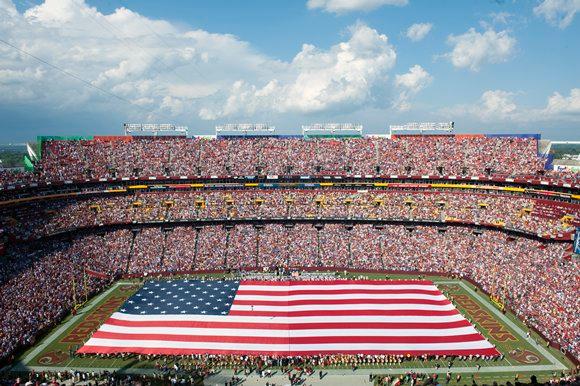
Does nobody besides me find it ironic that a flag this BIG is on the field at RFK Stadium, where the Redskins play?
Bingo.  There you have it.  The reason people are so attached to their flags is because of all the historical, moral and racial baggage that those flags represent.  That's not to say the world would be a better place without them,  I think a flag flying around a flagpole can be a beautiful sight, no matter which country it represents.  For this reason, I kind of like the emerging tradition among American home owners where they fly a holiday or seasonally appropriate flag from their front porch (my favorite?  Halloween Black Cats!)  And maybe, just maybe, we would all benefit from going a little less apeshit whenever somebody flies a flag we don't like.