Showing posts with label British. Show all posts

Thursday, August 23, 2018

A Tale of Two Tea Parties


Haven't heard a whole lot from the Tea Party lately, ever since they changed their name to the Freedom Caucus, and one of their higher profile members has taken a new job, delivering letters between Donald Trump and Vladimir Putin.  I haven't seen too many of their expropriated "Don't Tread On Me!" flags, either.  But then again, with all the air being sucked out of the atmosphere and spewed back as bloviated hate mongering or silent dog-whistles to the violent, racist fringe groups that our *President (asterisk intended) counts as his political base, it's no wonder that a quasi-respectable insurgent group like the Tea Party might want to lie low for a while.

And to my friends in the Tea Party, let me say that you have
Un-Be-Lievable Spec-Tac-U-Lar taste in friends, like ME!

This current low profile of the Tea Party got me to wondering: what about THAT OTHER Tea Party?

No no, the other, OTHER Tea Party -the one held in Boston, back when it was a fairly important trading port in the British Empire.  What was the perturbed state of mind of the good people of Boston that produced this touchstone of American resistance to imperial rule?  Why did the British overreact the way they did afterwards?  But the biggest question we all have: why did Sam Adams & Co. take out all their frustrations on tea?  Crumpets just wouldn't do?

Ah, what a pity that zis war is so..., so,... meaningless!


Faithful readers of this blog will be disappointed that the roots of the Boston Tea Party don't go all the way back to the Sumerians (the rest of you will be relieved).  We've only to go back a mere ten years to the end of the French and Indian War.  Besides being blamed on a colonel in the Virginia Colonial Militia named George Washington who was sent to support General Braddock in the Virginia back-country, the French and Indian War was not, in fact, a war between the French and Indians.  It was a war that pitted the French, their colonials and their Indian Allies, against the British, their colonials and their Indian allies against each other. My town of Methuen, Massachusetts produced one of the heroes of that conflict, a character named Richard Rodgers, who helped to teach colonial militia and British soldiers how to fight "Indian style" so they could whack the French, who insisted on fighting the French way by drinking wine, eating exquisitely prepared meals served in redolent sauces, and making ironic, existential comments on the futile condition of the world in general and their own armies in particular.  There isn't any monument to him because he picked the British side during the Revolution.  Oh well...

The war ended with the French kicked out of Canada and the Ohio Valley, the American colonies right where they were, and the British in possession of about 1/2 of North America.  Oh, and they were also broke.  You see, the world of the 18th Century hadn't yet figured out that the way to finance wars was to invent a Federal Reserve Banking System and have a floating currency, whose value would constantly fluctuate relative to other currencies based on investor confidence in the underlying macroeconomic soundness of a national economy.  Silly British! THEY thought the best way to pay off their war debt was to ratchet-up taxes on their subjects.  And WHO should pay these new taxes? Why, the colonial Americans, whose collective butts were just saved by the expense of British Blood and Treasure, that's who.

Jolly-good! Now: who fancies a spot of tea?

There was one small problem with this scheme, besides the economic mumbo-jumbo cited supra: colonial people just hated to pay taxes!  -and nowhere was this more the case than in the Province of New England (New England: more wild and barren and with nastier weather than Old England).  Those cheapskates insisted that the only valid taxes were those that their legislatures voted to impose on themselves.  They had this strange notion that tax money should be spent on stuff they could see and stuff that benefited people in the community, like fixing roads, caring for widows and insane people by -and I am SO not making this up! -auctioning them off to the LOWEST bidder, and building schools.  Colonial legislatures specifically DID NOT think spending money on maintaining a standing army to protect themselves against the beaten French and the vanished Indians was a good idea AT ALL.

But no matter, the British went ahead and instituted the Stamp Act, a revenue raising scheme where a bunch of goods like anything printed (calendars, almanacs, tide charts, newspapers, playing cards, porno-mags), glass, lead, and legal documents, all had to have a tax-stamp on them, showing that the manufacturer had paid the penny or so tax on it.  This cost was then passed onto the seller, who in inimitable capitalist fashion passed it onto the consumer.  

The Stamp Act touched a raw nerve in the New England colonies, who were already struggling under a post-war economic recession.  Tax collectors were harassed, tar-and-feathered, had their housed broken into and in some cases burned down.  Tax offices were similarly attacked by mobs who styled themselves "Sons of Liberty" instead of "That Great Big Scary Bunch of Drunks with Crowbars and Torches."  Broadsheets and newspapers attacked the tax, boycotts were organized, and committees were formed to coordinate resistance in other colonies.  It was at this point that the King and his Ministers had the extremely good sense to repeal the hated Stamp Tax, and All Sang Hallelujah!

Suck it, Jim Koch, I'm a
Maltster, not a Brewer!
However, one Boston son-of-a-b... errr, Son of Liberty was not all that happy.  Samuel Adams was a leading figure in the Boston Town Meeting and a leader behind Boston's resistance to the Stamp Tax.  By the time the tax was repealed, Adams had run his father's malt business into the ground and had become a full-time political agitator.  Now that the King had repealed the hated tax, what was he going to do -work for a living? Not our Sam!  Here's what he did: he and his group of radical Whigs (High-top Fades? Beehives?) seized on the one puny, little tax that remained- a tax on the import of tea- and blew it up into a giant conspiracy theory aimed at the heart of colonial America.  Without the rhetorical invective, here's how his tinfoil-hat-wearing argument went: 

1) everybody liked tea 
2) tea only came from India and China 
3) the crown had granted the East India Company a monopoly on the tea trade
4) NO COLONIAL MERCHANTS like Adams' friend John Hancock could legally ship tea, so they were forced to smuggle it 
5) this made everyone connected to the tea trade a de-facto criminal who might be arrested and thrown in prison at a moment's notice 
6) the tax on tea was part of an evil plan by George III's ministers to SET A PRECEDENT for taxing colonials WITHOUT CONSENT of their legislative assemblies, leading to 
7) eventual slavery of EVERYONE in colonial America, or 
8) their eventual sale to France or Spain, which would put them in the clutches of the dreaded Catholics and their Pope.


Again, I am not making this shit up.

In reality, the tax was a minuscule tax on middlemen merchants to help defray the cost of inspecting cargoes and policing thieves and smugglers (which was pretty much everybody in colonial Boston).  The average consumer would have to drink an entire gallon of tea every day to pay a $1 tax at the end of the year.

The rest of the story is familiar to grade school kids and even a few of my undergrads: a bunch of rowdies dressed themselves up as Mohawk Indians, broke into three tea laden ships in Boston Harbor, threw the tea into the sea, and took care to try and NOT do any harm to people or other property that night.  On a personal note, my wife's family counts as one of its ancestors a character named Boardman who was somehow identified through his Indian disguise and arrested afterwards.  He later jumped out of a second story window and ran for it, not stopping until he had reached Isleboro Island, Maine, where his direct descendants live to this very day.

For the LAST TIME, there is NO SUCH THING as ICED TEA! Just dump what's THERE!

What happened next was exactly what Sam Adams and his radical Whigs (French Braids? Beatles Bowl-cut?) knew would happen: the British took a complete nutty, closed the port of Boston, shut down the provincial legislature, moved Massachusetts' capital to Salem (yep, THAT Salem!), shut down courts of law, and sent a couple boatloads of red-coated Regular Army regiments to keep the peace.  This was all spun by Adams and his crew as a preposterous and tyrannical assaults on their English liberties, blah-blah-blah etc. and b.s.  You see, Adams knew that the English would go off their collective crumpets if the colonials made a deliberate attack on the PROPERTY INTERESTS of the British Empire, i.e. tea and the tea trade monopoly.  Remember that this was an era where most crimes against property carried the death penalty.  By provoking this arguably unreasonable reaction, Adams could then advance his Deep State Plan of replacing the British governing elite with a home-grown American governing elite.  

The Boston Tea Party was, therefore, Samuel Adams' last ditch effort to remain politically relevant in the Anglo-Colonial back-and-forth of the 1760-1770's, an effort that succeeded beyond his wildest dreams.  Once troops were quartered amidst a rebellious population, it would not be long before shots were fired, Continental Congresses were formed, armies raised, allies sought, and the Anglo-American Civil War (we call it the Revolutionary War -I wonder what it would have been called if we had lost it?) was raging up and down eastern North America.

But how do YOU know so much about what Samuel Adams was thinking and planning, Ex-Prof, I hear you all cry.  Simple: I read a lot.  That, plus I am a direct descendant on my mother's side to Sam and his cousin, John Adams.  Call it family insight.

No family insight is needed to explain the current day Tea Party.  What started out as a protest on April 15 highlighting government waste and fiscal irresponsibility, quickly took on a more socially conservative and libertarian cast as its organizers parlayed their popularity into elected seats in Congress.  Once there, the Tea Party members caucused with the Republicans, becoming an ultra-
conservative wing of that party.  Now calling itself the Freedom Caucus, they have used their influence to frustrate Democratic legislation like the Affordable (Health) Care Act, and, ironically, blocking Republican attempts to repeal and replace the ACA with a more watered-down version.  Like those behind the original Tea Party, the contemporary organization uses the press and that new terror, social media, in order to further its agenda.  Also like their predecessors, today's Tea Party manipulates patriotic symbols in order to lend political legitimacy to their cause.

I think that their fiscal frugality smacks more of Jeffersonian Democratic-Republicanism, but Monticello just isn't as cool a symbol as the Don't Tread On Me snake.  That, and there's also the problem of Jefferson's affair with Sally Hemmings on the d.l. that might not play to the more racially discriminative members of their caucus.  

But the real reason for the decline of the Tea Party's influence in today's political blood-splattered arena is this: it's being quietly absorbed by the Republican Party and will probably become a footnote to some boring historian's thesis on the influence of third parties on the American legislative agenda.  Which sounds like an awesome title for a thesis paper.  If I ever wanted to get a PhD. And go back to teaching bored undergrads for slave-wages.  Just sayin'.

So, one night in 1773, American colonials threw tea into Boston Harbor as a symbolic protest against taxation without representation.  And in the late 20th Century, American taxpayers threw copies of their 1040's W-2's, 1099's and 403-B's into bonfires to protest taxation with representation.  Patriots both? -or mere political opportunists struggling to retain their relevance?  I leave it to you, my wise and discerning reader, to decide.

Is he still, like, talking and junk?

Tuesday, September 15, 2015

5 Ways We Could Have (and probably should have!) lost the Revolutionary War


John Adams once wrote that there were three camps of American opinions about what he called "independency:" one-third who wanted to remain part of the British Empire, one-third who didn't, and one-third who were either too slave, female, illiterate, Indian, insane, or too far away from the colonial centers of population to give a shit about it one way or another.  Of course, John Adams had the luxury of writing this before the war for independence had gotten started, and his polling methods may not have been statistically sound, but he did not write this from prison at the close of an unsuccessful revolution awaiting the hangman, so he and his co-conspirators must have done something right.  Or did they?  What if American independence wasn't won by the Founding Fathers, but lost by an inept British king and his mad-cap, bumbling, 3-stooges-like ministers.  Here are, in no particular order of importance, 5 times we could have lost our revolution.  And the first is:

1. Lexington and Concord- On one very early April morning in 1775, His Majesty's troops stationed in that loutish city of Boston were on a super-secret mission: about 700 redcoats under Lt. Col. Francis Smith were to row across the Charles River, march to Concord (about 25 miles away), destroy arms and ammunition that radical colonial Whig politicians were storing there, and bring back two disreputable characters, John Adams and John Hancock, for questioning.

This wasn't a very tough assignment.  And this army had done the same type of thing before.  When they marched north to Salem, Massachusetts (yes, that Salem!), the town militias  along their way turned out and escorted the British Regulars down the road.  Once they arrived in Salem, they were greeted by Salem selectmen and were told that the army wasn't allowed into town until Salem's militia that did not contain any witches had finished hiding their secret stash of arms and ammunition, even though the British army was very keen on confiscating it all.  So there things stood, quite literally: the Salem militia, town fathers, other town militia units, umm, milling around, and the King's Own Regiment of Foot or some other bunch looking very silly because they weren't allowed to kill anybody.
Oh, please? Can't we kill just one person? Somebody you don't like?
To stop that sort of embarrassing thing from happening this time, strict secrecy was to be observed.  It was so secret that Paul Revere and all his friends and drinking buddies at the Green Dragon, a couple of prostitutes that specialized in British officers, one washerwoman, five apprentices and a guy named Phil were the only ones on the Colonial side to know.

To make a long story short and way more interesting, Revere, William Dawes and Dr. Samuel Prescott woke up the captain of the Lexington Militia. as well as everybody else along their route.  The militia did the sensible thing: voted to go home.  Then a bunch of them went to Buckman's Tavern for some 'flip, the colonial equivalent of the mudslide.  Then they got a bit bottle-brave and lined-up on Lexington Green.

And nobody would have sculpted me!
And here is where we could have lost the war before it even started.  The Lexington Minutemen stood their ground in a very manly fashion, while a British officer screamed at them to lay down their arms and disperse.  Nobody moved.  Farmer, husband, teenager, battle-scarred veteran of the French and Indian Wars, all stood facing a detachment of the army that won the 7-Years War, and nobody blinked. Then some idiot's pistol went off and the British column threw a fiery sheet of lead musket balls into the Minutemen, dropping a lot of them in the process.

But what if nobody shot anybody?  The troops would have gone to Concord, the same stand-off would have happened as at Salem, cooler political heads would have prevailed, America would have stayed in the British Empire, and we all would be like Canada today, except maybe not quite as polite.

You see, it was the out-of-control soldiers who fired against their orders that touched-off the swarming militia response that battered the retreating British column until it was rescued by Brig. Gen. Hugh Percy.  Without the battles, the Second Continental Congress would have adjourned after sending a severe message to Parliament to leave our taxpayers the fuck alone, commercial trade with America and India would have paid off Britain's war debt, and British North America would have run from the North Pole down to the Bahamas, but only as far west as the Mississippi because Napoleon probably wouldn't have sold Louisiana to the British in order to raise money to attack them.  Sure, imperial foreign policy might have had us invade Mexico and add all that Southwestern territory, and we might have bought the Louisiana Purchase from France a little later on, or maybe not. However, there would have been no Civil War in 1865, because slavery would have been ended in 1833 when it was ended in the British Empire.  So, tell me again why we fought this stupid war in the first place?  Oh yeah, Taxation without Lap Dancing is Tyranny.  Or Give me Rogain, or give me one of those cool powdered wigs.  Or some shit like that.

And George Washington?  Gentleman planter of Virginia's Tidewater, never to grace the one dollar bill, or quarter, or ever to have a new car sale dedicated to his birthday.

2. Bunker Hill- Just about everybody I talk to except historians, who are really hard to wake-up at faculty mixers, think that we won Bunker Hill.  We did not.  The town of Charlestown had the shit burned out of it by flaming cannon balls fired from British warships, and the earthenware redoubt constructed on Breed's Hill, not Bunker Hill, fell after four determined British charges.  But it WAS a Pyrrhic victory, because we wasted so many British regulars that day, with an especially high proportion of officers killed.  This is the reason that General Gage was so cautious about breaking out of the ring of colonial militia that kept him a prisoner in Boston.  But what if things had gone slightly awry at Bunker Hill?

Tell me again why we're attacking this stupid fort?
The two big heroes on the American side at Bunker Hill were William Prescott and John Stark.  Prescott lead the bunch who fortified the hill in the first place, and Stark played pivotal roles both during the battle and during the retreat.  If Prescott had built the fort on Bunker Hill like he was supposed to, the British in Boston couldn't have shelled it from their warships.  They might not have even attacked it, because it was too far away from Boston to do the colonists any good offensively either.  So no battle.  No battle, no casualties.  No casualties, no cautious British commander, who probably would have blasted out of Boston some other way.

I am John Stark and you must believe me
when I say, "Winter is Coming."
John Stark is the other variable.  His 1st and 3rd New Hampshire Volunteers were among the last to arrive on the scene, having to bully their way through a bunch of guys who had deserted before the fight actually started! so he was able to immediately see that the fort could be easily flanked on either side.  It looked like the British were going to try the side where a rail fence was first, so Stark sent his troops over there to shore up the fence as well as they could with straw and big rocks.  Sure enough, the British came his way first.  Stark had his guys hold their fire until the British had already passed them, making for an even more unpleasant surprise.  After getting sliced to ribbons by the future Granite Staters, the Brits came back and charged again.  Even though they were ready for Stark's men, they still got their asses handed to them and kicked down the hill.

By now, British command took the wise step of going full-frontal on the fort (slaughter continues), so they figured, why not do it again?  As luck would have it, the Americans were out of powder, shot, and witty "yo-Mama" insults to hurl down the hill, so on the fourth charge, everybody broke and ran for it.  John Stark to the rescue!  He held the only piece of land that connected Charlestown Peninsula to the rest of the dry land, and he calmed down the fleeing idiots that came running down the hill, making the American retreat off Breed's Hill much more orderly and profitable for the nascent American Army, for he who turns and runs away, lives to fight another day.

Hanging.  Because the British
don't do pinatas
So, what if Stark hadn't shown up?  What if he never got through that bunch of deserters, or had deserted along with them?  What if he had instead marched his volunteers to the coast to protect Portsmouth, New Hampshire, from an attack from the sea?  New Hampshire had to temporarily relocate its capital during the war for that very reason.  What if Stark had been killed during his service in Rogers' Rangers during the French and Indian War?  The other New Hampshire military light, General Cilley (pronounced "silly."  I swear I am SO not making this shit up!) was more of a politician than a soldier.  It's fairly certain that if he was in command of the 1st and 3rd New Hampshire, they may not have even sought out the most vulnerable point on the battlefield to defend, and in the unlikely event they did, they might not have withstood the first British assault.  And the retreat would have been a mess, so tons more Americans would have died than British.

So instead of no battle, we're faced with a big loss for America, fewer British casualties, an emboldened British commanding general, and one revolution crushed when Gage breaks out of Boston and begins stringing-up rebel officers at Town Neck in Roxbury.

3. New York City- The British had three, count 'em, three chances to obliterate the American Army and end the revolution --four if you count the diplomatic mission the Howe Brothers were charged with, so let's start with that.  The British landings at Staten Island was the largest amphibious landing ever seen until that time, only to be eclipsed by the Crimea, Gallipoli and Normandy D-Day in the future.  New Yorkers who saw this display of imperial might quite wisely ran-up the Union Jack and tried to get their daughters married to a handsome British or German soldier.  Congress and Washington, perversely, prepared for a fight.

Whole books are devoted to Washington's mistakes during the defense of New York.  Suffice it to say that he divided his outnumbered force in the face of overwhelming numerical superiority (a big no-no), and stuck his soldiers into trench works and breastworks of questionable design.  But before all the shooting, the Brothers Howe were entertaining certain gentlemen Congressmen on board Sir Richard Howe's flagship.  The topic of conversation was pardons.  The Howes were authorized to give anybody a royal pardon and once the army outside that was making all the tactical and engineering mistakes had disbanded and people started singing "God Save the King" again instead of "Yankee Doodle."  They would then take all their scary soldiers and go home.  --but leave behind a few JUST IN CASE Indians attacked.  Or the French.  Or Dutch.  Or Chinese.

Nice boat.  But beg your pardon, no pardons needed here, thank you.  Oh yes, I will have another crumpet!

If the Crown was really serious about ending things without bloodshed, they would have sent a few cabinet ministers as well who would have worked out a way to redress American complaints and keep her in the British Empire, not just a pair of military brothers armed with blank pardons.  To get a pardon, you have to admit you've done something wrong, and the Congressional delegation told the Howes that America had done nothing wrong, so no pardons needed, so fuck off and take your hired Kraut mercenaries with you.  Was this a real peace offering, or just a stalling tactic for both sides so they could get ready for the slaughter to come?  There are few hints in the extant letters, but the Congressmen were impressed by the cordiality and sincerity of the Howes, so at least they believed it, but everybody knows how easy soldiers are to fool into doing stuff, so who really knows.  The fact remains that the British had an opportunity to stop the war after only a few battles, make nice with the Americans, and they blew it.  Onto the shootin' war!

The British kicked-ass in Brooklyn, Long Island, Haarlem Heights, White Plains and some death trap named Fort Washington, and were about to finish annihilating the American Army when it got all cold and rainy, so General William Howe called off the attack so that he could take what he believed would be the American surrender in the morning, after everybody had had a good night's sleep.  Dumb move.  Washington's whole entire army slipped out of town like a sleazy salesman slipping out of a motel without paying.  The whole hot mess ended up in New Jersey, where they would go on to cause havoc at Trenton and Princeton, but most importantly, they were all alive and very much in the game.
Yeah, you bitches need me.

Had William Howe pressed his attack that night, the Americans had a huge army in their face and a river at their backs.  They would have all been shot down or surrendered.  The fight for American independence would have either died that night, or would have morphed into a hit-and-run guerrilla war that would have torn the country, its people and the imperial occupiers apart.  America could have become like Northern Ireland during the Troubles.

Finally, during one particularly badly fought battle around the Big Apple, the redcoats sounded the fox-hunting call as they chased fleeing Americans through some tall swamp grass.  This pissed-off Washington to no end.  He wheeled his horse around and then rallied anybody around him (about 16 guys who were looking for the ferry to Hoboken) and charged the offending British.  For his trouble, most of the guys died and Washington himself was hit multiple times in the coat, the hat, his saddle and his horse.  BUT  NOT  HIM!  Washington may have had some kind of Matrix-Ninja-ass stuff going for him, because this wasn't the only time he got shot but not anywhere in his body.  Since Generals Stirling and Sullivan were captured during the New York defense, that would leave Congress with Nathaniel Green, "The Fighting Quaker," Horatio "Granny" Gates, and Benedict "You guys wanna trade, 'cause I'm a great traitor" Arnold as possible replacements.  Not quite the Big GW.

4. West Point- Today, it's the home of the U.S. Military Academy, but back in the day, it was the most strategic spot on the whole Hudson River, which is strategic in itself because it is navigable all the way to Albany, deep in the interior of New York.  To get there, you have to sail past West Point, the part of the river that sailing ships of the day had to make a series of tacks, only if the wind is cooperating, which makes them vulnerable from getting blown out of the water by cannons from the West Point fort.  Benedict Arnold was given command of this fort, after he had married the most beautiful Loyalist girl of Philadelphia society, Peggy Shippen.  And after he was pissed-off at the way other generals and Congress treated him, passing him up for promotion again and again, and not giving him the credit he thought was due to him. 
It's not polite to Point.

Strangely enough, Arnold decided to sell the plans of the fort and the fort itself to the British, after doing everything he could do to weaken the fort's defenses.  All was set for him to defect.  Once in British hands, they had a chance to control the Hudson, despite Burgoyne's failed invasion from Canada.  Then two things happened: a robbery and a surprise visit.  The robbery was committed on the person of British Maj. John Andre, spy extraordinaire, and former boyfriend of Peggy Arnold.  The highwaymen who robbed him found West Point plans stuffed in his boots, and turned him over to a local militia unit.  The surprise visit was George Washington and company, come to see the Arnolds socially, and to inspect the fort, militarily.

Needless to say, it all fell through.  Andre was hanged, the Arnolds were shown the door (Peggy was.  Benedict had already defected).  But what if the "keys to the continent" wound up in British hands?  The force from New York City could have secured British access all the way to Albany.  The British then, having enjoyed naval superiority throughout the war, could have stockpiled provisions in Albany, concentrated troops there, and linked up with the garrison in Canada.  This would cut New England off from the rest of America and allow the British to blockade it and then destroy it.  Under this scenario, America would have probably become a place like Ireland or Scotland, occupied and beaten, but still in the British Empire.

5. The French Stay Home- Pretty much every historian says that it was French involvement that tipped the balance scale in favor of the Americans.  Not that there was any real love between the French and the American colonists.  The French were regarded as half-Indian frontier rats who fought dirty and were <gasp!> Catholics.  This was a clear case of the enemy of my enemy is my friend.  It was the French fleet that chased the British away from the Chesapeake; it was French engineers and artillerymen who designed the siege at Yorktown.  Finally, it was the French who the British tried to surrender to --Rochambeau refused, indicated Washington, who refused, indicated General Lincoln who had just been chased out of Charleston, South Carolina, who finally accepted it.

But what if there were no French?  They were almost broke at the time; the American Revolution put them firmly in the red, causing a fiscal crisis that started their own revolution.  What if Louis XVI's ministers convinced him that America was a lost cause?  After all, the only Frenchman Washington liked was the Marquis de Lafayette, the rest of the French volunteers being stuck on KP or latrine duty.  Let's say that Franklin, Adams and Jay completely botch their diplomatic mission.  Who was left?  Who could replace French power and might?

Now zis is what a real army looks like.  Go and fetch my poodle.

The Dutch sent some money and allowed St. Eustatius in the Caribbean to be used as a smuggling port.  Spain sent food and cloth through their possessions in Florida.  Russia was sympathetic, but it was doubtful the Czar would send any troops.  Prussia was too expensive to hire as mercenaries, as were the other German principalities.  Poland sent a couple of generals, one of whom created the U.S. Cavalry even!  Unfortunately, all this well meaning help would still not have been enough to replace the French if they didn't show.  So merci beaucoup Frenchies!  Without you. we'd be just like Canada, but not the hip, cool, chic French part.

Our revolution was by no means a sure thing,  In fact, it should have failed.  What is surprising is that it did succeed.  And a good thing, too!  Where would this world be without World Wars I and II?  There is no way in hell Germany, a new nation in 1874, would have started anything untoward, certainly not against a humongous British Empire that included all of America.  World War I might have just been the 3rd Balkan War, with minor participation by Russia and Austria, with a peace treaty mediated by France or even Romania.  And without World War I, no World War II.  Hitler would have lived and died in obscurity.

No Civil War, maybe no Vietnam either, but there's a downside too.  We would have been involved in every British colonial fight in Africa, the Middle East and Asia.  And who knows: we, not India, might be the brightest jewel in the crown, and therefore the last one to go, if at all.  I'm sure that Britain would have had the sense to get rid of the endemic corruption American Patriots complained of.  I am also sure that the democratic movements of the 19th and 20th centuries would have been well received in Britain and her North American possessions, and also that Constitutional Law and English Common Law would take deep root in American soil.  And it wouldn't be too bad to be like Canada --hey, they seem to like being in the British Empire, unlike those Israeli kooks who hated the British because they wanted their own little synagogue-sized country, but hey every family has some nuts.

Sunday, March 17, 2013

St. Patrick was a Britt

The View from the Podium


St. Patrick was a Britt
On this high-holy day for Irishmen and honorary Irishmen and pretend Irishmen, I fear that I, Ex- Prof, must be the bearer of bad news: St. Patrick was an effin'-Britt.  From Britain.  And not at all Irish.  And he never drove the snakes out of Ireland.  And he probably preferred wine to beer, as he was educated in France. And he only went to Ireland in the first place because he was kidnapped.  And he might have been two separate people. Really.

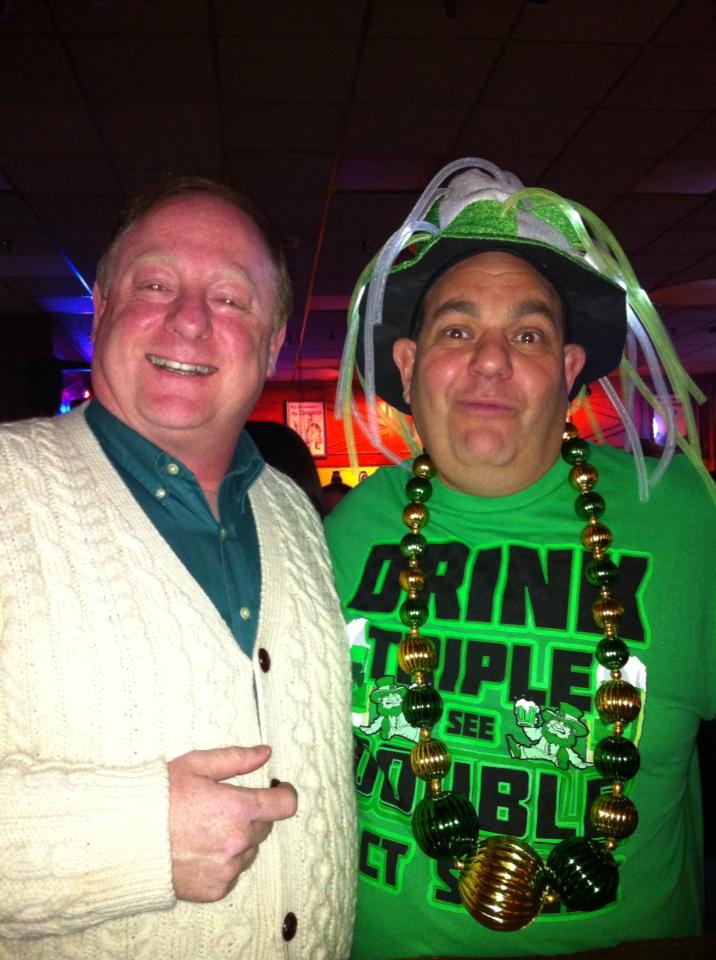
Me and another pretend Irishman
on St. Patrick's Day.  Ah, but who is whom?
The real St. Patrick was born in Roman Britain in a place called Banna Venta Berniae, a place that nobody knows where exactly it was, but probably was in Cumbria.  His dad was a deacon, and his grandfather was a Christian priest, so you could say that he went into the family business.

About the time he turned 16, Patrick was kidnapped by Irish Pirates --they're the ones with chickens instead of parrots on their shoulders --and dragged back to Ireland, where he was forced to tend his kidnapper's sheep.  Patrick had found his first Irish followers: the sheep!  Somehow, he managed to escape, get a boat back to Britain and to his family, and leave the otherwise promising trade of slave-shepherd behind him.  

Here's where things get interesting.  According to Patrick, he had a dream one night where he heard the voice of the miserable Irish he had recently left in the rear-view mirror of his life, and this is what they said:


"We appeal to you, holy servant boy, to come and walk among us."

Actually, in his dream, Patrick was reading a bunch of letters brought to him by a man named Victorious, and he imagined that he heard these voices, but hey, it was enough to convince Patrick to leave his comfy digs in Britain and hit the road for Jesus.
St. Paddy was an effin' WHAT??
Patrick then went to France, got religious instruction from a couple of famous French clerics, and went back to Ireland.  Once  there, he had a tough row to hoe, as the current religious establishment, a.k.a. Druids, had a bad attitude towards Christians.  Here's one of their prophecies concerning proselytizing Christians:

Across the sea will come Adze-head, crazed in the head, his cloak with hole for the head, his stick bent in the head.  He will chant impieties from a table in the front of his house; all his people will answer: "so be it, so be it."


...and after the human sacrifice, let's set a
bunch of random people on fire! It'll be fun!
And Patrick didn't do much in the way of winning friends and influencing people.  You see, Pagan-Ireland of the mid-400's was really big on gift-giving and gift-receiving as a way to get in tight with all the petty kings who ruled Ireland back then.  Since Patrick didn't accept any gifts from these Pagan VIP's, this essentially put him on the outside of the society he was hoping to bring to Christ.  And boy, did the Irish really, REALLY need Christianity in the 400's!

You see, the Druids practiced human sacrifice --individually and in groups.  One lucky (?) kid who was recently discovered preserved in a bog got to be sacrificed to THREE gods at once; he was therefore garroted, knifed and had his skull bashed-in, although not necessarily in that order.  The Romans, who just plain hated the Druids, wrote accounts of a bit of fun the Druids called "Wicker-Men."  This was the climax of the Celts' fire-festival: a bunch of random people would be caged inside of these giant-sized man-shaped wicker monsters, that were then set on fire.  Hey, it was a fire-festival, wasn't it? Fun.

Things get tricky at this point.  Supposedly, Patrick then sets about converting tons of people and building churches and performing miracles, like driving the snakes out of Ireland.  Unfortunately, Ireland never had any snakes to begin with, so that's kind of a non-miracle miracle.


I am  s-s-SO Irish!  Hey, I'm green and everything!  Hello?!?
In fact, Patrick is credited with doing so much cool stuff that historians believe that he was actually two apostles-to-the-Irish.  The other guy who may have "helped" Patrick convert the entire Irish nation was named St. Palladius, who was actually Bishop of Ireland before  St. Patrick's return-trip.  Prosper of Aquitaine knew Palladius well enough to stick his name in a book he, Prosper, was writing --which was a big deal back then, because every book was written by hand, not easily printed, xeroxed or scanned.

Gutenberg can just suck it.
Palladius was ordained by Pope Celestine and sent to Ireland in 431, tramping around the kingdom of Leinster, and Clonard in County Meath.  Word has it, he really sucked at his job and quit.  According to Muirchu who wrote about Palladius 200 years later in the Book of Armagh,

 God hindered him...and neither did those fierce and cruel men [the Irish] receive his doctrine readily, nor did he himself wish to spend time in a strange land, but returned to him who sent him.

After his Irish ordeal, Palladius left for Scotland --BIG improvement there! --leaving his pals Solinus, Sylvester and Tweety (ok, not Tweety) behind to fight the good fight-for-Jesus, right about the time that Patrick was just getting his feet stuck into Irish bog-water.  When Palladius died, apparently a lot of people thought he was Patrick.  I mean hey, how many Roman Catholic missionaries whose names began with P were running around during the 400's?  Two.  So some of the stuff Palladius was able to accomplish just might have been credited to Patrick.  But so what?  Who really cares who did what for whom and when, just as long as those crummy Irish Pagans stopped sacrificing humans and started being nice to each other, a tradition that continues to this very day, unless you count the hideous acts committed on both sides of the "Troubles" in Northern Ireland.
It came.  People died.  Happy?
I, for one, am a big fan of Saint Patrick, because if he didn't convert the Irish, they would have done nothing to stop Christianity from disappearing from Europe entirely after the collapse of the Roman empire.  And even though the Roman Catholic Church has some control-freak issues, it was sure better than whatever gods the Franks, Vikings and Burgundians worshiped, who probably thought it was ok to butcher women, kids and little guys just for giggles and grins.  And Patrick really worked hard and really suffered while he was there, spending some of his time in chains, awaiting execution. His biggest coup was in converting the High King at the Rock of Cashel, explaining the mystery of the Trinity by using the humble Irish shamrock as a symbol: three (leaves) out of one (stem).  At least that part of his legend isn't in all that much dispute.

So, Happy Saint Patrick's Day, you ex-shepherd, effing-Romanized-Britt, shadowy, voice-hallucinating, old dead dude. Thanks to you, the world has a great excuse to get drunk, act stupid and listen to the Drop Kick Murphys, at least one day in the year.

Yerra, Drop-shite Murphys!  Luv ya, boy-os!  Fuck, where's me feckin' beer?